Most households waste energy on rooms nobody’s using. A well-planned thermostat schedule fixes that without anyone touching the wall dial. The ten wall units and specialty controls below cover common HVAC setups, line-voltage heating, and even attic ventilation, so you can match a model to the system you already have.
The Main Contenders

PRO1 T725 Heat Pump/Conventional Programmable Digital Wall Thermostat (2H/1C)
PRO1 T771 Single Stage Non-Programmable Wall Thermostat for Conventional Systems
Honeywell TH1100DV1000 PRO 1000 Vertical Non-Programmable Thermostat

PRO1 T701 Single Stage Non-Programmable Wall Thermostat for Conventional Systems
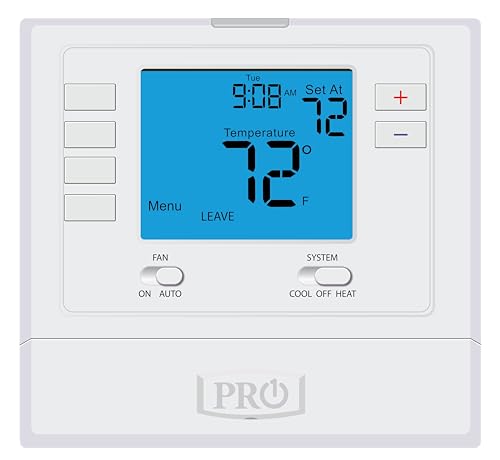
PRO1 T715 Multi-Stage Programmable Gas Thermostat for 2H/2C Systems

Heagstat NonProgrammable Thermostat 1 Heat/1 Cool for Home Conventional Systems

Honeywell TL7235A1003 Line Volt Pro Non-Programmable Digital Thermostat (240-Volt)

PRO1 T721 Non-Programmable Wall Thermostat (2H/1C Heat Pump or 1H/1C Conventional)

Ventamatic XXFIRESTAT 10-Amp Adjustable Thermostat with Firestat
PRO1 T805 Single Stage Programmable Wall Thermostat for Conventional Systems
More On The Choices That Made The List
The PRO1 T725 sits in the middle of PRO1’s programmable wall lineup, and it earns that spot by covering two system styles from a single faceplate. A household running a heat pump with auxiliary heat can run the four daily blocks (a “7-day” programmable thermostat lets you set a different wake, leave, return, and sleep target for every weekday), while a conventional furnace home can switch wiring at install and use the same schedule logic. The blue backlit 4-square-inch display stays readable from across a hallway at night.
Where this model helps most is during shoulder seasons when the heat pump alone cannot keep up. The schedule lets you pre-warm the house before the morning alarm and let temperatures drift down during the workday, then come back to comfort by the time you walk through the door. It is a sensible upgrade over the simpler PRO1 T701 you’ll see later in the list, and it gives schedule-building households a real reason to leave the manual dial behind.
The Value In It
- Handles both 2H/1C heat pump and 1H/1C conventional systems from one unit
- 7-day or 5/1/1 programming covers work-from-home weeks and traditional Monday-to-Friday routines
- Blue backlit display shows the current schedule mode (wake, leave, return, sleep) at a glance
- Shared T700 platform parts make service and replacement switches familiar across the lineup
Things To Consider
- The 4 sq. in. screen feels compact compared to the T805’s oversized display
- Wiring must be confirmed before install since heat pump systems use a different terminal layout than conventional setups
Key Specs
Whose Wall It Belongs On
Heat pump households ready to schedule around real wake-and-leave routines rather than nudging a manual dial each morning.
Skip It When
You only need single-stage conventional control and prefer the simpler PRO1 T701 instead.
The PRO1 T771 is not built for a busy family room, and that is exactly the point. Its setpoint range stretches from 25°F up to 90°F, which makes it the right pick for spaces that most indoor thermostats ignore. A detached garage that needs freeze protection all winter, a workshop that runs cool most mornings, or a shed housing a small fan coil all benefit from a thermostat that can actually reach those lower numbers.
Because it is non-programmable, the dial-style logic keeps operation simple. You set the temperature and walk away. The blue backlit screen helps in low-light corners, and swing adjustment plus calibration let a careful installer match the reading to a separate thermometer. Compared to the T701 you’ll meet later, the T771 trades the home-focused glow button for that wider range and specialty focus.
Useful Touches
- Wide 25°F to 90°F setpoint range covers unconditioned spaces that regular thermostats cannot reach
- Backlit display helps when adjusting in a dim garage or workshop
- Swing adjustment and calibration allow finetuning for tricky installs
- Single-stage simplicity means fewer wiring surprises during replacement
Worth Noting
- Non-programmable design means no automatic setback for an empty workshop
- Some specialty installs may need a common wire (C-wire) for steady power, which older garages often lack
Made For
Garages, sheds, and workshops that need freeze protection or specialty low-temperature operation rather than full-home scheduling.
Not Your Match When
You want the same wide range but with scheduling; the programmable PRO1 T725 is the better fit.
The Honeywell TH1100DV1000 keeps a tight focus. It is a heat-only, vertical, non-programmable unit in a premier white finish, and that simplicity is the appeal. In a basement bedroom that runs on a single baseboard heater, or a small addition wired to its own furnace, the last thing anyone needs is a screen full of menus.
The vertical body fits narrow gang boxes and tight wall sections where a wider square thermostat would feel crowded. You turn the dial, watch the temperature line up with the mark, and the room responds. Maintenance stays light, though owners commonly note that vertical thermostats collect dust faster than flush-mount units and benefit from a quick wipe during seasonal HVAC checkups. It pairs well as a companion to the PRO1 T771 for households running mixed system types.
What Earns Its Place
- Vertical footprint fits tight wall cavities and narrow gang boxes
- Heat-only design keeps wiring and operation simple for single-room baseboard circuits
- Premier white finish blends into most trim packages without standing out
- Mechanical-style logic means no firmware updates or app pairing to manage
Trade Offs
- Heat-only build means it cannot run a central cooling system
- The vertical body tends to show wall texture and dust more than flush-mount thermostats
Best Suited To
Homeowners running a single baseboard or furnace loop in a basement or addition who want set-and-forget simplicity.
A Better Fit Elsewhere
Pick the Honeywell TL7235A1003 if your baseboard heater runs on 240V line-voltage wiring.
Not every household wants a programmable thermostat, and the PRO1 T701 is built for that crowd. It runs a 1H/1C conventional system (one heating stage plus one cooling stage, the most common residential setup in North America) and skips any weekly schedule logic in favor of a straightforward up-and-down temperature adjustment. The glow-in-the-dark light button is a quiet but useful touch, letting a resident find the wall control during a midnight trip down the hall without flipping the room light.
On the larger T700 platform body, the 4-square-inch blue backlit display sits clearly across the wall. The trade-off shows up for anyone whose weekday routine shifts hour to hour: this model cannot drop the temperature automatically when the house empties. Compare that to the T725 above, which trades the glow button for genuine scheduling, and you can see where each one earns its place.
Good Reasons To Consider
- Glow-in-the-dark light button keeps the unit findable without flipping room lights
- Spacious 4 sq. in. blue backlit display stays legible from a few feet away
- AA battery or hardwire power options suit older homes without a C-wire
- Single-stage simplicity keeps installation quick for standard 1H/1C setups
Honest Caveats
- Non-programmable design cannot lower the temperature automatically during work hours
- Lacks multi-stage support, so two-stage HVAC systems will not get full efficiency from it
Who It Suits Best
Residents who live a steady routine and just want a clear, dependable thermostat to bump up or down without menus.
Look Elsewhere When
Daily schedules swing between early mornings and late nights; the PRO1 T715 handles that kind of multi-stage schedule work.
The PRO1 T715 is the multi-stage answer for homes that have outgrown single-stage control. A two-stage gas furnace cycles between a low and high burn rate, and a two-stage air conditioner does the same on the cooling side. Wiring this thermostat into that equipment means the schedule can lean on the lower stage most of the day for quieter operation and only ramp up when the temperature gap is large.
The 7-day, 5/1/1, and non-programmable modes give this model unusual flexibility for a wall thermostat. Households whose weeks shift between busy office days and slower weekends can build distinct profiles without buying a smart thermostat. The glow-in-the-dark button and 4-square-inch backlit screen keep adjustments easy after dark, and you may find the battery or hardwire option helpful when the wall lacks a common wire.
A Few Highlights
- Two-stage heating and cooling scheduling cuts down on loud furnace kicks during mild weather
- Three program modes (7-day, 5/1/1, or non-programmable) fit mixed routines in one unit
- Blue backlit display paired with a glow-in-the-dark light button helps in dim hallways
- Battery or hardwire power eases install in older homes without a C-wire
Points To Keep In Mind
- Programming takes more upfront time than single-stage thermostats because each stage needs its own target
- Two-stage systems cost more to install overall, so pairing this thermostat only pays off if the equipment supports it
Feature Snapshot
Right Fit For
Larger households with two-stage gas furnaces who want the efficiency of low-stage cycling matched to a real weekly schedule.
Reach For A Different Pick When
Your system is single-stage only, in which case the PRO1 T701 covers the job without extra programming effort.
The Heagstat HCGSTAT lands on this list because it solves a specific problem that catches a lot of homeowners off guard. Many older thermostats run on five or fewer wires, and plenty of newer conventional replacements will not even mount on a five-wire base. This model is built to accept a 2-to-5 wire setup, which makes it a forgiving choice when swapping out an aging wall unit without rewiring the wall cavity.
It is strictly conventional, meaning gas, oil, or electric forced-air furnaces paired with a standard AC condenser, and explicitly not for heat pump or line-voltage baseboard circuits. The white backlight on the display makes nighttime adjustments easy, and the non-programmable interface keeps operation simple. For shoppers replacing a worn wall unit with something clean and predictable, it earns consideration right alongside the T701 above.
The Case For It
- 2-to-5 wire compatibility makes it a forgiving replacement on older conventional walls
- White backlit display keeps nighttime adjustments simple
- Works with 24VAC single-stage gas, oil, or electric forced-air systems
- Non-programmable interface means no schedule to build during install
Possible Compromises
- Not compatible with heat pump setups, so dual-fuel homes should look at the PRO1 T721 instead
- Wiring configurations above 5 wires are not supported, which limits its use in some larger homes
Who Should Grab It
Homeowners with a standard 24V conventional system and an older wall plate who want a clean, no-fuss swap.
Swap It Out When
You actually want a weekly schedule on the same conventional system; the PRO1 T805 is the better fit.
The Honeywell TL7235A1003 is one of those units you only learn about when a regular 24V thermostat refuses to power a baseboard heater. Line-voltage thermostats (these carry the full 120V or 240V the heater itself uses, rather than the low-voltage control signal a furnace expects) sit directly in the heating circuit, and the TL7235A1003 handles the 240V side cleanly. It is rated for electric baseboards and convectors, the kind of heating that is common in older apartments and additions.
The on-demand backlight helps when adjusting in a dim hallway, and the silent electronic operation is a quiet upgrade over mechanical thermostats that click loudly each time the heater kicks on. A small heating indicator light confirms at a glance that the system is actually pulling power, which matters on a circuit that runs quietly. For most homes, this is a specialty tool rather than a daily-use wall unit.
The Practical Payoff
- 240V line-voltage compatibility covers electric baseboard and convector heaters directly
- Silent electronic operation reduces the clicking noise common with mechanical thermostats
- On-demand backlight and a heating indicator make status checks quick
- Honeywell build quality suits long-term installs in utility rooms and additions
Where It May Fall Short
- Not a substitute for a low-voltage thermostat on a central furnace
- Non-programmable design means no automatic setback during travel, though owners commonly pair it with a separate timer for occupied-room schedules
Built With In Mind
Apartment dwellers and addition owners running 240V electric baseboard heat who want a digital upgrade over a noisy mechanical dial.
Another Choice May Suit
Pick the Honeywell TH1100DV1000 if your heating system is a low-voltage heat-only furnace instead.
The PRO1 T721 covers a corner of the market that gets confusing fast. Some homeowners switch between a heat pump and a conventional fossil-fuel system depending on outdoor temperature, or they live in a home where the heat pump handles winter and a backup furnace kicks in for the coldest nights. The T721 accepts both 2H/1C heat pump and 1H/1C conventional wiring from the same faceplate, which avoids buying two different thermostats as the system evolves.
The shared T700 platform keeps the blue backlit display and glow-in-the-dark light button consistent with the T701, T715, and T725, so households mixing these models across rooms get the same user experience. Power options cover AA batteries or hardwired 24V, helpful for older homes without a common wire. The honest read is that non-programmable households get strong flexibility here, but anyone wanting weekly scheduling should look up to the T725.
Bright Spots
- Accepts both heat pump (2H/1C) and conventional (1H/1C) wiring in one unit
- Glow-in-the-dark light button and blue backlit display match the rest of the T700 family
- AA battery or hardwire power eases install on older walls without a C-wire
Smaller Limits To Know
- Non-programmable design lacks any weekly setback routine for empty households
- The 4 sq. in. screen reads smaller than the T805’s oversized 7 sq. in. display
Perfect Match For
Homeowners running a heat pump with conventional backup or transitioning between system types who want one flexible wall thermostat.
Where A Sibling Pick Shines
Pick the PRO1 T725 if you want the same system flexibility plus a weekly schedule.
The Ventamatic XXFIRESTAT is the most specialized item on this list, and it earns its spot by solving a problem most wall thermostats ignore. Power attic ventilators move superheated air out of attic spaces during summer, but they need a thermostat that knows when to stop. This model includes a Firestat cutoff that disables the fan once the attic reaches 183°F, protecting the motor and surrounding materials from overheating.
Setup is old-school and direct. The bi-metallic switch adjusts with a simple screwdriver turn, and the operating range runs from 50°F to 120°F, which lines up with the temperatures most attics reach on a hot afternoon. It controls up to three attic fans with a combined draw of 10 amps. For most homes this lives in a utility-only category, but for households with the right setup it quietly handles attic safety in the background.
What It Does Well
- Firestat cutoff stops the fan automatically at 183°F to protect wiring and motor life
- Adjustable bi-metallic switch lets a screwdriver tune the trigger temperature to the attic
- Controls up to three power attic ventilators within a 10-amp combined load
- Operating range of 50°F to 120°F covers most summer attic conditions
What To Weigh
- Strictly a specialty product for attic ventilation rather than living-space comfort
- Installation is screwdriver-based with no digital menu, so fine adjustments take a little patience
Whose Shelf It Belongs On
Homeowners with a power attic ventilator who want a safe, automatic way to control it through summer afternoons.
Not Your Match When
You need a thermostat for an actual living area; the PRO1 T701 or Heagstat unit will fit a standard wall much better.
The PRO1 T805 closes the list with a feature wall thermostats do not always deliver: a 7-square-inch screen. That is roughly 75% more display area than the 4-square-inch units elsewhere in the lineup, and for anyone whose eyesight is not what it used to be, that extra real estate turns the schedule from a chore into a quick glance. It runs on the newer T800 platform rather than the T700 platform that the earlier PRO1 models share.
Programming supports 7-day, 5/1/1, or non-programmable modes, which makes it easy to step down to a manual thermostat if the schedule ends up feeling like too much management. The glow-in-the-dark light button keeps adjustments easy after dark, and the blue backlit display remains readable across a wide living room. Compared to the T725 at the top of this list, you trade heat pump support for a much larger screen.
Strong Points
- Extra-large 7 sq. in. blue backlit display is easy to read from across the room
- 7-day, 5/1/1, and non-programmable modes fit any schedule commitment level
- Glow-in-the-dark light button helps with nighttime adjustments
- Built on the T800 platform, so it pairs well in homes running newer conventional HVAC
Practical Considerations
- Single-stage conventional only, so two-stage homes should look at the PRO1 T715
- Programming the 7-day mode takes longer at install than a simple non-programmable swap
Quick Facts
Who Will Love This
Conventional-system households who want a real weekly schedule plus a screen large enough to read from a few feet away.
Consider Something Else When
You run a heat pump rather than a conventional furnace; the PRO1 T725 covers that system family instead.
Picking The Right Schedule Style For Your System
The most useful thermostat schedule is one that matches the equipment already on the wall. A schedule that swings eight degrees overnight only pays off if the heating or cooling system can actually reach those setpoints without short-cycling (turning on and off in rapid bursts, which wears the compressor and never quite holds temperature). Start by reading the system label on the indoor unit or the breaker legend; the number of heat and cool stages listed there dictates which models on this list are even candidates.
Conventional single-stage systems are the most common residential setup, and they cover the broadest range here. The PRO1 T805, PRO1 T701, and Heagstat model all serve that system type, with the T805 adding real weekly scheduling and a larger display. Heat pump homes need the PRO1 T725 or PRO1 T721, since heat pumps call for different terminal wiring than a standard furnace.
For larger homes with two-stage equipment, multi-stage scheduling lets the system ride the lower stage most of the day and only ramp up when the temperature gap is large. The PRO1 T715 is built for that setup. Specialty cases round out the list: the Honeywell TL7235A1003 handles 240V electric baseboard circuits, the PRO1 T771 reaches low-temperature setpoints for unconditioned spaces, and the Ventamatic XXFIRESTAT manages attic ventilation with a built-in high-temperature cutoff.
Key Considerations Across These Picks
Wrong Turns To Avoid
A common slip-up is matching the thermostat to the wrong system type. Heat pumps and conventional furnaces use different terminal letters on the wall plate, and a thermostat designed for one will not run the other correctly even when the wires physically fit. Count the wires at the wall and confirm the system type before choosing a model.
Another trap is assuming every programmable thermostat requires a common wire (the “C-wire” that delivers continuous 24V power to the wall unit). Many models on this list, including the PRO1 T725 and T721, run on AA batteries or hardwired 24V without a C-wire, which matters in older homes where pulling a new wire through the wall would mean drywall repair.
When Paying More Pays Off
Higher-tier models like the PRO1 T805 and T715 earn their keep by giving the system more ways to run efficiently. A larger display makes the schedule easier to manage, and multi-stage support lets a two-stage furnace cycle quietly on the lower stage during mild weather. For most homes with steady routines, the upgrade shows up on the monthly bill rather than the wall. In apartments with electric baseboard heat, the Honeywell TL7235A1003 is the upgrade that actually changes how the system runs, since it lets digital temperature control replace a noisy mechanical dial.
Frequently Asked Questions
Do all thermostat schedules work with heat pumps? Only thermostats specifically designed for heat pump wiring handle the auxiliary heat stage. The PRO1 T725 and T721 on this list are the heat pump options, while the rest are built around conventional furnace wiring.
Can a programmable thermostat run without a C-wire? Several models on this list run on AA batteries or 24V hardwire without a C-wire, including the PRO1 T725, T715, T721, and T701. Wi-Fi thermostats usually need a C-wire, but these wall units are designed for older homes.
How wide a setpoint range do I need for a garage? Most indoor thermostats stop around 40°F, which is not low enough for garage freeze protection. The PRO1 T771 reaches 25°F, which makes it the right choice for unconditioned spaces.
What is the Firestat cutoff on the Ventamatic XXFIRESTAT? It is a safety feature that stops the attic fan at 183°F, preventing the motor and surrounding wiring from overheating during extreme summer attic temperatures.
Are weekly schedules worth it for an empty house? A weekly schedule pays off most in homes with predictable daily routines. The 5/1/1 mode on models like the PRO1 T805 lets weekdays run one pattern while Saturday and Sunday run a separate one, which covers most work-from-home and office-going households.
The Takeaway
A solid thermostat schedule turns a wall unit from a manual chore into a quiet, automatic part of the home. Match the model to the system on the wall first, then pick the schedule style that fits your routine. The rest of the savings show up on the heating and cooling bill without you having to lift a finger.