A wall thermostat does more than show the temperature. It decides how comfortable your living room feels at 6 a.m., how often the furnace kicks on during a cold snap, and how much you spend on utilities month after month. Non-programmable thermostats keep things simple, with no schedules to set and no apps to learn, which makes them a smart fit for renters, guest houses, workshops, and anyone who just wants a reliable dial-style control. This roundup focuses on affordable wall and specialty thermostats that handle a range of HVAC setups, from single-stage conventional systems to heat pumps and line-voltage baseboards.
A Snapshot Of The Selections

PRO1 T725 Heat Pump/Conventional Programmable Digital Wall Thermostat
PRO1 T771 Single Stage Non-Programmable Wall Thermostat
Honeywell TH1100DV1000 PRO 1000 Vertical Non-Programmable Thermostat

PRO1 T701 Single Stage Non-Programmable Wall Thermostat
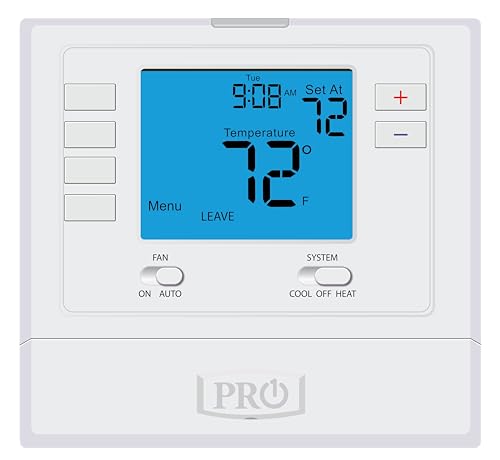
PRO1 T715 Multi-Stage Programmable Gas Thermostat for 2 Heat/2 Cool Systems

Heagstat NonProgrammable Thermostat 1 Heat/1 Cool for Conventional Systems

Honeywell TL7235A1003 Line Volt Pro 240-Volt Thermostat

PRO1 T721 Non-Programmable Heat Pump/Conventional Thermostat
PRO1 T805 Single Stage Programmable Wall Thermostat
A Closer Look At Each Pick
The PRO1 T725 sits at the top of this list because it bridges two common system types in a single unit. A heat pump system uses an outdoor compressor paired with an indoor air handler, while a conventional system relies on a furnace or air conditioner that runs independently. Homeowners whose property combines both, like a heat pump upstairs paired with a conventional unit in a basement addition, often struggle to find one control that handles each without rewiring.
This model covers 2 heat/1 cool heat pump setups and 1 heat/1 cool conventional setups, with 7-day or 5/1/1 scheduling options for those who want some automation. A 4 sq. in. blue backlit screen shows the current schedule mode at a glance. For renters or homeowners who don’t want scheduling complexity, the unit can run in non-programmable mode once installed.
Practical Pluses
- Handles both heat pump and conventional wiring from a single control board
- Flexible scheduling options suit owners who want weekday/weekend control
- Backlit display improves readability in dim hallways and basements
- Large platform makes wiring easier during installation
Worth Noting
- More wiring terminals than a true basic thermostat, so installation may take longer
- Programming features add complexity that some shoppers won’t use
Key Attributes
Made For
Owners running mixed heat pump and conventional equipment who want one control for both systems.
Look Elsewhere When
You need a pure single-stage conventional control, where the PRO1 T701 is a simpler match.
Most wall thermostats assume a 60°F to 80°F comfort range, but garages, workshops, and sheds often need to maintain temperatures well below that. The PRO1 T771 reaches down to 25°F on the low end and up to 90°F on the high end, making it useful for spaces where you’re protecting pipes, pets, or sensitive equipment from extreme cold.
This single-stage conventional unit keeps the controls straightforward, with a 4 sq. in. blue backlit display and swing adjustment (a setting that controls how far the room temperature can drift before the system kicks back on). Calibration tools help the displayed temperature match a separate thermometer. You won’t find scheduling here, and that’s the point.
What Stands Out
- Extended low-temperature setpoint suits unheated spaces
- Swing adjustment and calibration improve accuracy
- Simple interface requires no learning curve
Trade Offs
- Limited to single-stage conventional systems only
- Backlit glow button is absent, unlike sibling PRO1 units
Whose Shelf It Belongs On
Anyone heating a detached garage, workshop, or storage building where standard thermostats bottom out too early.
Where Another Pick Suits Better
Main living areas with standard comfort ranges are better served by the PRO1 T701 with its glow button.
The Honeywell TH1100DV1000 trades width for height, with a vertical footprint that fits narrow wall sections where a horizontal thermostat would look awkward. Measuring roughly 4 11/16 inches tall by 2 7/8 inches wide, it slips into tight spots near door frames or in slim baseboard cavities. This model is heat-only, meaning it triggers heating equipment but doesn’t run an air conditioner.
Designed for single-stage forced-air systems, the PRO 1000 keeps controls mechanical in feel: a temperature dial on the side, a switch for fan operation, and a small lever for system mode. The premier white finish blends with most interior trim. Owners commonly value its simplicity, especially in rental units or guest cottages where the fewer features, the better.
What Works In Its Favor
- Vertical layout fits narrow wall locations
- Mechanical-style controls are intuitive for any user
- Heat-only operation suits boiler and hot-water baseboard systems
Honest Caveats
- No cooling control, so it won’t run an air conditioner
- Smaller display area than horizontal PRO1 models
- Lacks a backlight for nighttime adjustments
Quick Facts
Best Suited To
Homeowners with hot water baseboard or boiler-only systems who want a simple dial thermostat in a vertical shape.
Skip It When
You need cooling control, in which case the Honeywell TL7235A1003 (for line voltage) or PRO1 T701 (for conventional) fit better.
The PRO1 T701 is the kind of thermostat you set once and forget. Built for 1 heat/1 cool conventional systems, it covers the most common residential setup in North America: a gas furnace paired with a central air conditioner. Unlike the PRO1 T725 covered above, this one drops the heat pump support and the scheduling options, which makes the interface cleaner.
A 4 sq. in. blue backlit display provides clear readability, and a glow-in-the-dark light button lets you find the controls in a dark hallway. You can power the unit with AA batteries or pull from the system’s common wire (the “C” wire that delivers continuous 24VAC power). For most homeowners with a standard furnace and AC, this model hits the sweet spot between capability and simplicity.
Key Advantages
- Glow-in-the-dark button aids nighttime operation
- Battery or hardwired power options ease installation
- Compatible with gas and electric conventional systems
- Larger T700 platform simplifies wiring access
Points To Keep In Mind
- No scheduling means manual setpoint changes
- Limited to single-stage equipment, so multi-stage furnaces need a different control
Right Fit For
Owners of standard 1 heat/1 cool homes who want reliable temperature control without learning curves.
Not Your Match When
You run a two-stage furnace, where the PRO1 T715 handles that complexity better.
Multi-stage equipment runs at different intensity levels depending on how far the room temperature drifts from the setpoint. A two-stage furnace uses a low-burn setting for mild days and a high-burn setting for bitter cold, which improves comfort and efficiency. A basic single-stage thermostat can’t talk to that equipment properly, which is where the PRO1 T715 comes in.
This unit handles 2 heat/2 cool configurations across gas furnace systems, and you can run it in 7-day, 5/1/1, or fully non-programmable modes. The T700 platform supports a 4 sq. in. blue backlit display and a glow-in-the-dark light button. Battery or hardwired power works equally well. For homeowners with mid-to-large houses running two-stage HVAC, this thermostat unlocks the equipment’s full potential.
The Value In It
- Supports multi-stage gas furnace and AC equipment
- Three operating modes cover scheduling preferences
- Glow button aids low-light adjustments
- Common-wire or battery flexibility simplifies retrofits
Possible Compromises
- Programming depth may overwhelm first-time installers
- More wiring terminals demand careful labeling during setup
Feature Snapshot
Who Should Grab It
Homeowners with two-stage heating and cooling equipment who want to actually use those stages.
A Better Fit Elsewhere
Single-stage households don’t need this complexity, and the PRO1 T701 handles them with less wiring.
The Heagstat non-programmable thermostat targets one specific scenario: a 24VAC (24-volt alternating current, the standard low-voltage power used by most HVAC control boards) conventional single-stage system with two to five wires at the base. That covers the majority of older homes where the existing wiring is minimal, and it rules out heat pumps, multi-stage equipment, and systems using six to eight wires.
A white backlight illuminates the display for nighttime adjustments, and the controls are stripped down to mode, fan, and temperature up/down arrows. For a basic replacement in a guesthouse, in-law suite, or rental property, this thermostat does the job without extras you don’t need.
What Makes Sense
- Compact footprint suits shallow electrical boxes
- White backlight aids low-light use
- Straightforward controls reduce tenant confusion
- Works with gas, oil, or electric furnaces matched to standard AC condensers
Small Caveats
- Not compatible with heat pump or multi-stage systems
- Limited to 2-5 wire installations, which excludes newer wired homes
Who It Suits Best
Landlords and homeowners with minimal 24VAC wiring who need a no-frills replacement.
Consider Something Else When
You have a heat pump system, where the PRO1 T721 handles heat pump and conventional setups in one unit.
Most thermostats in this list run on 24VAC low voltage from a control board. The Honeywell TL7235A1003 runs on 240 volts directly, which is the world of electric baseboard heaters, fan-forced wall units, and some radiant ceiling panels. A “line-voltage” thermostat like this one switches the full heating current rather than signaling a separate relay. Installation requires caution because you’re working with mains-level electricity, not the low-voltage signal of the other picks here.
Electronic temperature control replaces the older bi-metal mechanical elements found in many baseboard thermostats, giving more precise setpoint holding. An on-demand backlight helps in dark rooms, and a heating indicator confirms at a glance whether the element is actively drawing power. Soundproof operation reduces the clicking noise common with mechanical relays.
Positive Takeaways
- Built for line-voltage electric heat systems
- Electronic control delivers tighter temperature accuracy than mechanical dials
- On-demand backlight and heating indicator add convenience
- Reduced clicking noise compared to relay-based designs
Worth Bearing In Mind
- 240V wiring requires confident DIY skills or a licensed electrician
- Limited to electric heating, not central HVAC
Built With In Mind
Homeowners with 240V baseboard or wall heaters who want electronic accuracy instead of mechanical drift.
Reach For A Different Pick When
Your system runs on standard 24VAC, where any of the PRO1 models in this list will wire up more safely.
The PRO1 T721 occupies an interesting middle ground. Compared to the PRO1 T725 reviewed earlier, this one drops the scheduling options entirely but keeps the dual heat pump and conventional system support. So you get flexibility across equipment types without the menu layers that come with programmable units.
Designed for 2 heat/1 cool heat pump or 1 heat/1 cool conventional setups, the T721 fits homes where the system type might matter more than automation. A 4 sq. in. blue backlit display and glow-in-the-dark light button match the rest of the T700 platform. AA battery or hardwired common-wire power both work.
Strong Points
- Heat pump and conventional compatibility in a single unit
- Non-programmable simplicity appeals to set-and-forget owners
- Glow button improves nighttime usability
- Battery or hardwired power options
A Few Limitations
- No scheduling means manual setpoint changes throughout the day
- Limited to 2 heat/1 cool heat pump configurations
Perfect Match For
Heat pump households who want straightforward temperature control without programming menus.
Where A Sibling Pick Shines
Conventional-only homes with no heat pump should choose the PRO1 T701 for a simpler installation.
The PRO1 T805 closes this list with the largest display in the roundup. A 7 sq. in. blue backlit screen takes up most of the faceplate, which makes it easier to read from across a living room or for anyone with vision limitations. Compared to the PRO1 T701 reviewed earlier, the upgrade here is mostly screen real estate and platform size, sitting on the T800 base rather than the T700.
You can run this model in 7-day, 5/1/1, or non-programmable modes, so the scheduling depth is optional. Single-stage conventional equipment in 1 heat/1 cool configurations is supported. A glow-in-the-dark light button rounds out the low-light features. For owners who want the option to schedule later but prefer a simpler setup today, this thermostat offers room to grow.
The Upside
- Extra-large 7 sq. in. display for better readability
- Three operating modes give scheduling flexibility without forcing it
- Glow button supports nighttime visibility
- T800 platform provides roomy wiring access during installation
Things To Consider
- Larger faceplate may not fit shallow or decorative wall boxes
- Limited to single-stage conventional equipment
Key Product Details
Who Will Love This
Households that want a large, readable display and the option to schedule later when ready.
Swap It Out When
Your wall cavity is shallow or your system runs on 240V line voltage, where the Honeywell TL7235A1003 is a safer match.
What To Weigh Before Picking A Non-Programmable Thermostat
The right thermostat depends less on features and more on what your system actually needs. A mismatch can mean flickering displays, short-cycling equipment, or a thermostat that simply won’t power on.
Match The Thermostat To Your System Type
The first question is whether your home runs on a conventional system (a furnace or boiler paired with an air conditioner) or a heat pump (an outdoor compressor that handles both heating and cooling). Most homes fall into the conventional category, where models like the PRO1 T701 or Honeywell TH1100DV1000 fit cleanly. Heat pump households need a control with the right staging terminals, which is where the PRO1 T725 or T721 come in. Line-voltage electric heat, like 240V baseboards, requires a different class entirely, which the Honeywell TL7235A1003 covers.
Check Your Wiring Before You Buy
Thermostats rely on labeled wires carrying 24VAC signals between the wall control and the HVAC equipment. A typical 5-wire setup includes Rh (red power for heating), Rc (red power for cooling), W (heat call), Y (cool call), and G (fan call). Newer systems add a C wire, short for “common,” which provides continuous power so the thermostat doesn’t need batteries. The Heagstat model in this list only supports 2-5 wire installations, so homes with six to eight wires need a different pick. Always turn off the breaker before swapping thermostats, and photograph the existing wiring before disconnecting anything.
Think About Where The Thermostat Lives
A thermostat in a dim hallway benefits from a glow-in-the-dark button, which several PRO1 models include. A tight wall section near a door frame may need a vertical layout like the Honeywell TH1100DV1000. Garages and outbuildings need a wider temperature range, which the PRO1 T771 delivers with its 25°F to 90°F setpoint range. The physical location shapes the practical value of each option more than any spec sheet suggests.
Practical Pointers For Narrowing Down The Field
Where Shoppers Go Wrong
A common mistake is buying a thermostat based on display size or backlight color without checking system compatibility. A beautiful screen does nothing if the wiring terminals don’t match the equipment in your basement. Another slip is assuming all thermostats are 24VAC. Line-voltage models like the Honeywell TL7235A1003 carry 240V and require extra caution during installation. Finally, some shoppers overlook the staging requirements of multi-stage furnaces. A single-stage thermostat wired to a two-stage furnace forces the equipment to run on high fire constantly, which wastes fuel and shortens equipment life. Matching the thermostat to the system is the foundation of a smooth install.
When Paying More Pays Off
Spending slightly more usually buys three things: a larger display, a glow-in-the-dark light button, and the option to schedule later if you change your mind. The PRO1 T805’s 7 sq. in. screen is noticeably easier to read than the 4 sq. in. display on the T701, which matters for anyone who checks the temperature from across a room. Multi-stage support on the PRO1 T715 also unlocks the efficiency built into two-stage furnaces. If your equipment is multi-stage or your eyes prefer larger text, the upgrade is worth it. For a basic replacement in a guesthouse or workshop, the budget-friendly models handle the job without extras.
Frequently Asked Questions
Do non-programmable thermostats save money on utilities?
They can, especially when they replace an older mercury-switch model or a malfunctioning digital thermostat that ran the equipment longer than needed. A non-programmable unit keeps the temperature at whatever setpoint you choose, so the savings depend on how consistently you adjust it manually.
Can I install one of these thermostats myself?
Most 24VAC models are within reach of a careful homeowner comfortable with low-voltage wiring. Turn off the breaker, photograph the existing wire labels, and match them to the new terminals. Line-voltage models like the Honeywell TL7235A1003 carry 240V and are best left to a licensed electrician unless you have solid electrical experience.
Will a non-programmable thermostat work with my heat pump?
Only if it’s designed for heat pump systems. The PRO1 T725 and PRO1 T721 both support 2 heat/1 cool heat pump setups. Conventional-only units like the PRO1 T701 won’t trigger the heat pump’s reversing valve properly and should be avoided on those systems.
What does the C wire do?
The C wire, or common wire, delivers continuous 24VAC power from the HVAC control board to the thermostat. Without it, the thermostat usually runs on batteries. Many newer thermostats, including several in this list, can operate on battery power alone if no C wire is present.
How do I know if my system is single-stage or multi-stage?
Single-stage equipment runs at one capacity level, either fully on or fully off. Multi-stage equipment has two or more capacity levels, which improves comfort and efficiency. The model number on your furnace or air handler usually indicates staging. Two-stage units often carry an “XV” or “VS” in the serial plate, and the thermostat must support that staging to function correctly.
Closing Remarks
The right thermostat comes down to matching your system type, wiring configuration, and where the control actually lives on your wall. Single-stage conventional households will find the PRO1 T701 or Honeywell TH1100DV1003 familiar and easy to install. Heat pump owners get more flexibility with the PRO1 T725 or T721. Line-voltage electric heat calls for the Honeywell TL7235A1003, while the PRO1 T771 handles garages and outbuildings that need a wider temperature range. Pick the model that fits your equipment, double-check the wiring, and the rest tends to take care of itself.