Wall thermostats rarely get attention until they quit, and by then you are juggling a chilly house and a confusing spec sheet. Choosing a replacement comes down to your system type, the controls you actually want, and the wiring already in the wall. The ten models below cover common line-voltage and low-voltage heating setups, from baseboard heaters and radiant floors to heat pumps and conventional furnaces.
How The Shortlist Stacks Up

PRO1 T725 Heat Pump/Conventional Programmable Digital Wall Thermostat
PRO1 T771 Single Stage Non-Programmable Wall Thermostat

PRO1 T701 Single Stage Non-Programmable Wall Thermostat
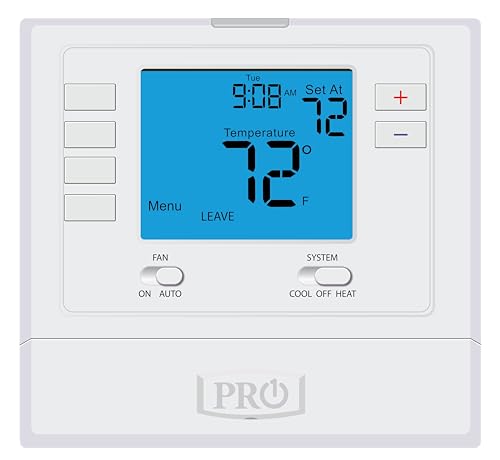
PRO1 T715 Multi-Stage Programmable Gas Thermostat

Heagstat NonProgrammable Thermostat 1 Heat/1 Cool

PRO1 T721 Non-Programmable Wall Thermostat

Stelpro SWT1CC Line Voltage Thermostat, Mechanical 240 Volts

ELECTECK Non-Programmable Digital Thermostat, 1 Heat/1 Cool

OJ Microline UTN4 Radiant Floor Heat Thermostat with Class A GFCI
PRO1 T805 Single Stage Programmable Wall Thermostat
The Picks, Examined More Closely
The PRO1 T725 is built for households whose heating system is not quite one thing or the other. It covers 2 heat/1 cool heat pumps and 1 heat/1 cool conventional setups, which makes it a safe pick if your equipment label has ever left you guessing. Programming runs across 7-day or 5/1/1 schedules (weekday/weekend blocks), and the 4 sq. in. blue backlit screen is easy to read from across a room.
Compared with the simpler PRO1 T701 and T771 later on this list, the T725 adds real scheduling without doubling the learning curve. Anyone moving into a house with a heat pump who wants a 7-day plan will appreciate the wake/leave/return/sleep blocks baked in.
Everyday Advantages
- Dual system support removes the need to match a thermostat to a single equipment type.
- 7-day and 5/1/1 scheduling fit most working-from-home and commuting routines.
- The blue backlit display stays readable in low light, useful in hallways and basements.
- Compact 4 sq. in. footprint replaces older PRO1 units without repainting the wall.
Things To Consider
- Setup menus can feel layered for homeowners who have never programmed a thermostat.
- Heat-pump-specific features go unused on conventional-only systems, which can feel like dead options.
- Owners commonly report that battery replacement is a twice-a-year task rather than an occasional chore.
Feature Snapshot
Who It Suits Best
Homeowners with a 2H/1C heat pump or a mixed conventional setup who want a real schedule without a learning curve steeper than their old analog dial.
Skip It When
The PRO1 T701 is a better match for renters or anyone running a plain 1H/1C conventional system who will never touch the scheduling menus.
The T771 is the most niche option on this list, and that is the point. Its setpoint range stretches from 25°F to 90°F, which matters in unheated spaces where a normal living-room thermostat bottoms out too high. Think detached garages, pole barns, and sheds that need freeze protection rather than comfort heating.
Unlike the programmable T725 above, this unit skips schedules entirely. You set a temperature and it holds it, which keeps the interface friendly for utility spaces that nobody is adjusting three times a day.
Key Advantages
- Low-end setpoint of 25°F supports freeze-protection use in garages and outbuildings.
- Non-programmable layout means no menu diving, which suits rarely visited spaces.
- Swing adjustment lets you tune how often the system cycles on and off.
- 4 sq. in. blue backlit display remains visible in dim corners.
Worth Noting
- Not the right tool for whole-home heating where scheduling would cut energy use.
- Calibration steps add a small setup chore that basic analog thermostats skip.
- Wiring still has to match a 1H/1C conventional system, which rules out heat pumps.
Made For
Shoppers outfitting a garage, workshop, or shed with a single-stage conventional heater who want reliable set-and-hold control.
Look Elsewhere When
The PRO1 T701 is a stronger fit for indoor living areas where scheduling is unnecessary but the wider room-temperature range is fine.
The T701 is the no-surprises choice. It runs a 1H/1C conventional system without menus, schedules, or app pairings, and that is genuinely the appeal. You turn the dial (or press the up/down arrows), the room responds, and that is the whole experience.
Sitting between the T771 above and the T725 with scheduling, the T701 gives up program features in exchange for a cleaner interface. The 4 sq. in. blue backlit display and glow-in-the-dark light button help in hallways at night, and the larger T700 platform keeps the wall footprint familiar for PRO1 upgraders.
The Upside
- Minimal interface works for family members who never learned to program a schedule.
- Gas or electric configurability fits most single-stage furnace setups.
- Glow-in-the-dark button is handy in kids’ rooms and dark hallways.
Honest Caveats
- No scheduling means you cannot automatically drop the temperature at night or while you are away.
- Heat pump owners should look at the T721 or T725 instead.
- Single-stage only, so it is not a match for two-stage equipment that benefits from finer control.
Best Suited To
Anyone replacing a worn analog dial with a digital unit and wanting the simplest possible wall interface.
Reach For A Different Pick When
The PRO1 T715 makes more sense for multi-stage gas systems that need both staging logic and programming.
The T715 is where this list leaves the basics behind. It handles 2 heat/2 cool gas systems, which means it can drive a two-stage furnace and a two-stage air conditioner without a separate controller. Programming options cover 7-day, 5/1/1, or full non-programmable, so you can scale the interface to whoever lives in the house.
Compared with the T701’s single-stage simplicity, the T715 adds the staging logic that bigger HVAC equipment actually needs to run efficiently. The T700 platform also keeps the layout consistent if you ever swap to a sibling model.
Why It Works Well
- True 2H/2C staging reduces temperature swings common with single-stage thermostats.
- Three programming modes let you choose between strict schedules and hands-off operation.
- Glow-in-the-dark light button aids nighttime adjustments.
- Compatible with both battery and common-wire (hardwired) setups.
Points To Keep In Mind
- Multi-stage systems require correct wiring, which can be a hurdle in older homes.
- Feature depth is overkill for a small ranch with a basic single-stage furnace.
- Configuration menus take longer to learn than the simpler T701.
Perfect Match For
Homeowners with a two-stage gas furnace and central air who want tighter temperature control plus full scheduling.
A Better Fit Elsewhere
The PRO1 T805 is a strong alternative for homes that need a bigger display and only run single-stage equipment.
Heagstat’s 1H/1C thermostat is aimed at 24VAC conventional systems (the standard low-voltage control used by most forced-air furnaces and central air conditioners) with two to five wires. That wire count matters: it tells you the unit is built for simple, common residential setups rather than complex multi-stage equipment.
Alongside the PRO1 models above, this one trades brand familiarity for a leaner spec sheet. There is no scheduling and no heat-pump support, so the audience is narrow but well served.
Real-World Strengths
- Two-to-five-wire compatibility covers many older homes with minimal rewiring.
- White backlight keeps the screen readable without being harsh at night.
- Compact body fits standard decorator-style wall plates.
- Gas, oil, or electric furnace configurability broadens its fit.
Where It Is Less Suited
- Six-to-eight-wire systems exceed its baseplate layout, ruling out some installs.
- No heat-pump support means it is not a fit for homes relying on a heat pump year-round.
- Owners commonly report that documentation is thinner than what major brands ship.
Quick Facts
Whose Shelf It Belongs On
Property managers and homeowners replacing a basic thermostat in a low-voltage conventional system without needing schedules.
Swap It Out When
The ELECTECK thermostat below is worth a look if you want a larger LCD and single-stage digital control at a similar price.
The T721 fills a gap on this list. It runs either a 2H/1C heat pump or a 1H/1C conventional system, which is helpful if you are not sure which one your home actually has, or if you plan to swap equipment later. The interface stays non-programmable, so the day-to-day experience is as simple as the T701.
Sitting between the scheduling T725 and the conventional T701, this unit trades a 7-day program for broader system compatibility. The glow-in-the-dark light button and AA-battery option also keep it friendly to older wiring.
Features That Help
- Heat pump and conventional compatibility in a single model.
- Non-programmable operation keeps the wall controls intuitive for guests and kids.
- 4 sq. in. blue backlit display with glow-in-the-dark light button.
- Battery or hardwired power options fit varied wiring situations.
Trade Offs
- No scheduling means you cannot set back the temperature automatically at night.
- Single-stage cooling only, which leaves multi-stage A/C systems underutilized.
- Heat-pump setup menus assume some familiarity with reversing-valve terminology.
Who Should Grab It
Buyers replacing a thermostat on a heat pump or a mixed system who want broad compatibility without a learning curve.
Consider Something Else When
The PRO1 T725 is a better pick if scheduling matters and your home runs a 2H/1C heat pump.
The Stelpro SWT1CC is the only true line-voltage thermostat on this list, and that distinction matters. Most entries above run low-voltage control wiring; this one switches the full 240V circuit that electric baseboards and wall fan heaters actually use. A line-voltage thermostat carries the heating current directly rather than signaling a furnace to turn on.
It is mechanical, which means a simple dial rather than a digital screen. For homeowners with electric baseboards, convectors, or commercial fan-forced heaters, that dial is exactly what the system expects.
Practical Pluses
- Genuine 240V switching handles electric baseboards and fan-forced heaters directly.
- Mechanical dial removes software quirks and battery dependence.
- Broad compatibility with most heating products reduces guessing about fit.
- White finish blends into most residential interiors.
Things To Weigh
- Mechanical accuracy is coarser than digital thermostats, often within a couple of degrees.
- No scheduling or smart features, so set-backs must happen by hand.
- 240V installation demands caution; DIYers with low-voltage experience should double-check their familiarity before wiring.
Feature Card
Right Fit For
Anyone with electric baseboard or wall fan heaters who needs a 240V thermostat that simply turns the system on and off.
Where A Sibling Pick Shines
The OJ Microline UTN4 is the better match for radiant in-floor heating, where a built-in GFCI is required by code for many installs.
The ELECTECK thermostat is a single-stage 1H/1C unit with a bigger LCD than most rivals in its tier. The screen real estate makes a noticeable difference for anyone who has squinted at a small wall display across a room.
It runs gas or oil systems and electric configurations, but it will not play with 110-240V electric heat, so it is firmly a low-voltage conventional thermostat. Think of it as a direct competitor to the PRO1 T701, with a bigger screen as its calling card.
Useful Highlights
- Larger LCD improves legibility from across a room.
- Single-stage 1H/1C control is easy to grasp on day one.
- Configurable for gas, oil, or electric furnace setups.
- Straightforward installation for a competent DIYer familiar with low-voltage wiring.
Room For Improvement
- Not compatible with line-voltage electric heat or heat pumps, which narrows its audience.
- Non-programmable design limits energy savings during away hours.
- Button layout can feel less intuitive than the PRO1 T701’s dial-style approach.
Who Should Grab It
Homeowners with a conventional low-voltage system who value a large, clear display over scheduling features.
Not Your Match When
The Stelpro SWT1CC is the right answer for line-voltage electric baseboard heat, which this unit will not handle.
The OJ Microline UTN4 is the only thermostat on this list designed for radiant in-floor heating. It carries a built-in Class A GFCI (Ground Fault Circuit Interrupter), the safety device that detects imbalances in the heating current and cuts power fast enough to prevent a shock in a wet-floor scenario.
It runs on either 120V or 240V and supports dual temperature sensing: air temperature plus a floor sensor that lives in the slab. That dual sensing is the trick that keeps tile and stone comfortable without overheating the room air.
Points In Its Favor
- Built-in Class A GFCI satisfies safety requirements for many underfloor heating installs.
- 120V/240V compatibility covers most North American floor heat circuits.
- Dual sensing with included floor probe prevents both cold floors and overheated rooms.
- Non-programmable interface keeps the controls simple once installed.
Possible Compromises
- Limited to radiant floor applications, so it is not useful as a general wall thermostat.
- Non-programmable design means no automatic set-back for empty rooms.
- Specialty install usually benefits from a licensed electrician, raising total project cost.
Spec Overview
Built With In Mind
Homeowners with electric radiant floor heating who want one thermostat that handles safety and sensing together.
Reach For A Different Pick When
The Stelpro SWT1CC handles wall-mounted electric heat, while the PRO1 T725 covers whole-home heat pump systems.
The PRO1 T805 is the upgraded sibling to the T701 and T725, sitting on the larger T800 platform. Its 7 sq. in. blue backlit display is roughly 75% bigger than the 4 sq. in. screens elsewhere on this list, which makes it the easiest read of the bunch for aging eyes or large living rooms.
It runs single-stage 1H/1C conventional systems with 7-day, 5/1/1, or full non-programmable modes. That flexibility lets households scale the interface to whoever is actually touching it.
Positive Points
- 7 sq. in. display is the largest in this roundup, ideal for long sight lines.
- Three programming modes cover strict schedules and hands-off use alike.
- Glow-in-the-dark light button helps nighttime adjustments.
- T800 platform provides a clean visual break from older PRO1 installs.
Some Limits To Know
- Single-stage only, so multi-stage gas systems will underuse its scheduling.
- Larger footprint requires more wall space than smaller PRO1 models.
- Higher feature count can feel like overkill for a small guest cottage.
At A Glance
The Right Fit
Households with conventional 1H/1C equipment who want both scheduling and a noticeably larger display than most thermostats offer.
Another Choice May Suit
The PRO1 T715 is worth considering for multi-stage gas systems that need finer heating and cooling control.
Picking the Right Wall Thermostat for Your System
Most household thermostats fall into two camps: low-voltage models that send a signal to a furnace or air handler, and line-voltage models that switch the heating circuit directly. Low-voltage wiring (typically 24VAC) is what you will find with forced-air furnaces, heat pumps, and central air conditioning. Line-voltage wiring (120V or 240V) is what electric baseboards, wall fan heaters, and radiant floors usually use, which is why those systems need a thermostat rated for the higher voltage.
Match the thermostat to your equipment first, then worry about features. A programmable thermostat on a heat pump is wasted if it lacks the right staging terminals. A non-programmable dial on a multi-stage furnace will leave comfort on the table because the system cannot stage properly. Wire count matters too: older homes with only two or three conductors at the wall limit which thermostats can drop in without new wiring.
Common features worth weighing include 7-day scheduling, glow-in-the-dark light buttons, backlit displays, and dual temperature sensing. Scheduling shines for predictable weekday routines, while a larger display helps anyone who checks the temperature from across the room. Dual sensing is the deciding factor for radiant floors, since air-only thermostats overheat the slab long before the room feels warm.
Common Shopping Slip Ups
Mistakes Worth Dodging
Choosing a low-voltage thermostat for a 240V baseboard heater is the most frequent mistake, and it is also the most dangerous: the thermostat will not handle the current and can fail or pose a fire risk. Verify the voltage on the heater label before you buy.
Another trap is ignoring wire count. A thermostat that needs a common wire (the “C” terminal providing continuous 24V power) will not power up cleanly on a two-wire system, even if the terminals physically fit. Count the conductors in the wall first, then match the spec sheet.
Where The Extra Money Goes
Higher-tier thermostats tend to add scheduling flexibility, larger displays, glow-in-the-dark buttons, and better staging logic for multi-stage equipment. None of those matter on a basic system, but they show their value the moment you have a two-stage furnace or a heat pump that needs precise control.
Spending more makes sense when you will use the scheduling every day, or when your equipment can take advantage of staging. For a one-bedroom apartment with a single-stage furnace, a basic non-programmable model delivers the same comfort for less.
Frequently Asked Questions
What is the difference between line-voltage and low-voltage thermostats?
Line-voltage thermostats switch the full 120V or 240V heating current directly and are used with electric baseboards, wall fan heaters, and some radiant floors. Low-voltage thermostats run on 24VAC and signal a furnace, heat pump, or air handler to turn on.
Can I use a low-voltage thermostat with electric baseboard heaters?
No. Electric baseboard heaters need a line-voltage thermostat rated for 120V or 240V. Using a low-voltage model risks overheating, failure, and potential safety hazards.
Do I need a programmable thermostat to save energy?
Programmable scheduling helps when your routine is predictable, because the system can set back the temperature automatically. For households that are home most of the day, a non-programmable unit can deliver similar comfort without the menus.
How do I know how many wires my system has?
Turn off the power at the breaker, pull the existing thermostat faceplate off, and count the thin conductors connected to the terminals. Two to five wires is common in older homes; six or more is more typical in newer installs with a common wire.
What is a C-wire and why does it matter?
The C-wire (common wire) delivers continuous 24V power to the thermostat so it does not need to “steal” power from the heating or cooling circuit. Smart and feature-rich thermostats usually need a C-wire to run reliably.
Wrap Up
The right thermostat depends almost entirely on the equipment already in your wall. Low-voltage conventional systems are best served by the PRO1 T701, T725, or T805; heat pumps point toward the T721 or T725; electric baseboards need the Stelpro SWT1CC; and radiant floors call for the OJ Microline UTN4. Once the system match is locked in, scheduling, display size, and lighting features decide the rest. Start with what is in the wall, then pick the controls that fit your routine.