A detached garage stays freezing for most of the year, and the dial on a portable heater rarely lands where you actually want it. Toss in a slightly oversized unit, and the temperature swings from cold to stuffy every time the compressor kicks on. The right thermostat fixes that, reading the air precisely and holding the room steady so the heater cycles properly instead of running wild.
Most garage heaters just need a low-voltage (24VAC) wall control with a sensible temperature range, decent swing adjustment (the band the thermostat allows above or below the setpoint before firing), and a backlit display you can read with gloves on. The ten picks below cover exactly that profile, with options for programmable schedules, multi-stage furnaces, and even an attic-vent specialty unit.
A Fast Comparison Of The Options

PRO1 T725 Programmable Heat Pump Thermostat
PRO1 T771 Non-Programmable Wall Thermostat

Honeywell TH1100DH1004 PRO 1000 Thermostat

PRO1 T701 Non-Programmable Wall Thermostat
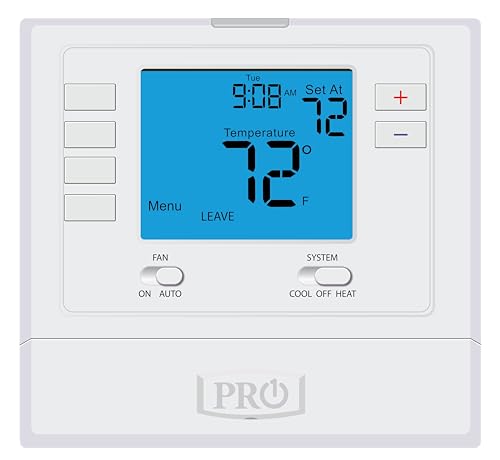
PRO1 T715 Multi-Stage Programmable Thermostat

Heagstat Non-Programmable 1H/1C Thermostat

PRO1 T721 Heat Pump Thermostat

ELECTECK Non-Programmable 1H/1C Thermostat

Ventamatic XXFIRESTAT Attic Thermostat
PRO1 T805 Programmable Wall Thermostat
A Breakdown Of The Leading Choices
The PRO1 T725 is the rare wall thermostat that genuinely straddles two worlds, accepting 2 heat/1 cool heat pump wiring and falling back to 1 heat/1 cool conventional control without extra jumpers. For a converted garage where the ductless heat pump handles shoulder seasons and a gas unit kicks in only during deep winter, that flexibility removes the “wrong thermostat” anxiety altogether.
Programmability comes in 7-day or 5/1/1 layouts, so a weekday-shed regular can shape a wake/leave/return/sleep routine without overthinking. The 4 sq. in. blue backlit display is readable from across the garage, which matters more here than it does in a living room.
Everyday Advantages
- Dual-system wiring support means one SKU covers most garage retrofits, simplifying stocking for installers.
- Schedule granularity lets you trim runtime when the workspace is empty and recover automatically before you arrive.
- Backlit screen reduces fumbling with gloves, a real benefit in cold-weather entry.
- The T700 platform offers consistent terminal layouts for anyone who has worked with other PRO1 units.
Things To Consider
- Programmable interfaces require a one-time setup session, which may be overkill for a single-purpose garage.
- Battery and hardwire options exist, so you’ll want to confirm the C-wire (the common wire that delivers continuous 24V power) is present before assuming full functionality.
Key Specs
Who It Suits Best
DIYers retrofitting a garage with a heat pump who also want a programmable schedule and a screen they can read from across the room.
Consider Something Else When
The PRO1 T771 makes more sense for uninsulated garages that need a lower setpoint range and a simpler non-programmable interface.
The PRO1 T771 is one of the few wall thermostats on the market that genuinely supports low-temperature setpoints down to 25°F. For an uninsulated shop where frost matters more than fine-grained comfort, that lower bound is a quiet superpower. You can let the room drift near freezing overnight without the heater fighting itself, then bump it up before you walk in.
It runs a single-stage conventional 1H/1C system, which covers most gas and electric garage heaters that wire through a 24VAC control loop. Calibration and swing adjustment give you the freedom to tune cycling behavior to your heater’s personality, useful in spaces where overshoot is annoying.
The Practical Payoff
- 25°F minimum setpoint protects pipes and equipment without wasting fuel overnight.
- Single-stage conventional design keeps wiring simple for most gas or electric garage heaters.
- Backlit display offers quick readability in low-light shop conditions.
- Adjustable swing and calibration help match the thermostat’s cycling to your heater’s output.
Worth Noting
- Non-programmable means you’ll nudge it manually when routines change, which can feel old-fashioned for daily users.
- Wide setpoint range adds flexibility but also increases the chance of an accidental extreme setting.
Right Fit For
Owners of detached workshops and garages that need frost protection and a wide low-end setpoint range more than a weekly schedule.
A Better Fit Elsewhere
The Honeywell TH1100DH1004 fits better when you specifically want a heat-only single-stage thermostat with a garage-specific temperature scale.
The Honeywell PRO 1000 is a heat-only horizontal thermostat that has been in garages and utility spaces for years, and the TH1100DH1004 continues that lineage. The dual-power design (battery or hardwire) means the installer can match what the wall already has without rewiring, and the backlit display is easy to read in dim corners.
What separates this from most wall thermostats is its switchable temperature scale: standard 40°F to 90°F for living spaces, or a garage-friendly 35°F to 90°F scale that lets you dial into the lower band without special ordering. For a heat-only garage heater on a single 24VAC wire pair, it’s almost purpose-built.
Positive Takeaways
- Garage-specific scale drops the floor to 35°F, perfect for frost-watch duty.
- Dual power (battery or hardwire) adapts to legacy wiring without extra parts.
- Backlit display stays legible in dimmer shop corners.
- Horizontal PRO form factor fits tight wall spaces above workbenches.
Points To Note
- Heat-only design won’t help if you later add a cooling circuit or a heat pump.
- Non-programmable operation means manual nudging on routine changes.
Feature Snapshot
Best Suited To
Owners running a heat-only single-stage garage heater who value simplicity and a garage-specific temperature scale over scheduling.
Skip It When
The PRO1 T725 makes more sense when you need a programmable thermostat that supports both heat pump and conventional systems.
The PRO1 T701 is the everyday backbone of the T700 lineup, a non-programmable single-stage unit that handles 1H/1C conventional gas or electric furnace wiring with minimal fuss. For a garage that already has a forced-air furnace, this slot-in replacement is the path of least resistance.
The 4 sq. in. blue backlit display reads cleanly across the room, and the glow-in-the-dark light button helps locate the unit during a power blip. Compared to the PRO1 T771, this model trades the wide low-end setpoint range for a more conventional comfort range, which fits living-adjacent spaces better.
Key Advantages
- T700 platform terminals stay consistent across the lineup, simplifying future swaps.
- Glow-in-the-dark button light helps locate the thermostat during power outages.
- Blue backlit display reduces eye strain and reads across a wide garage.
- Gas or electric configurable so one model covers most residential furnaces.
Honest Caveats
- Conventional-focused design won’t pair with a heat pump system without switching models.
- No programmable modes means routines require manual adjustment.
Made For
Homeowners with a single-stage conventional gas furnace looking for a no-fuss replacement that keeps the rest of the T700 platform consistent.
Look Elsewhere When
The PRO1 T721 suits mixed-system garages better when heat pump and conventional wiring might both appear in the same wall box.
The PRO1 T715 steps up to multi-stage 2 heat/2 cool gas furnace control, which is the right ceiling for a serious shop with a high-BTU (British Thermal Unit) two-stage gas unit. Multi-stage thermostats can stage the burner up gradually instead of slamming it on at full fire, which improves comfort during shoulder seasons and reduces cold-blast complaints when the door opens.
Program modes include 7-day, 5/1/1, or non-programmable layouts, giving you room to grow into schedules or stay manual. The T700 platform and its 4 sq. in. blue backlit display match the rest of the line, so anyone familiar with a T701 will recognize the layout immediately.
Notable Upsides
- Multi-stage control is properly staged, easing the heater’s cold-blast pattern during startup.
- Three program-mode options cover everything from set-and-forget to manual tweaking.
- T700 consistency means a clean swap if you already have a T701 in service.
- Battery or hardwire power adapts to legacy wiring boxes.
Small Caveats
- Multi-stage furnace compatibility is wasted on a single-stage heater, so this is overkill for many shops.
- Programmable setup takes longer during initial installation than a non-programmable swap.
At A Glance
Who Will Love This
Workshops and finished garages running a two-stage gas furnace that benefits from gradual burner staging and a schedule.
Another Choice May Suit
The PRO1 T701 is the better match when a single-stage conventional furnace is all the wall box needs.
The Heagstat non-programmable thermostat is a compact 1H/1C unit aimed at 24VAC conventional single-stage systems, including gas, oil, and electric furnaces. It pairs with an outdoor AC condenser and standard indoor ductwork, which covers the most common residential garage heater layouts. The base accepts 2 to 5 wires, making it a clean fit for older wiring bundles that lack the extra conductors newer models sometimes expect.
The white backlight helps in low light, and the small footprint fits tight wall boxes where larger programmable units simply don’t seat. For a basic, no-frills replacement, the Heagstat gets the job done without demanding extra wiring.
Advantages To Know
- 2-to-5 wire compatibility suits older garage wiring where 6-to-8 wire bundles are uncommon.
- Compact footprint fits tight wall boxes where bulkier programmable units won’t seat.
- White backlight offers quick readability without the blue glow some shops find harsh.
- Gas, oil, or electric furnace compatibility covers the most common residential setups.
Factors To Consider
- No heat pump support, which limits crossover if your garage ever gets a heat pump upgrade.
- Owners commonly report the smaller display harder to read from across a wide garage than the 4 sq. in. PRO1 screens.
Perfect Match For
Shops with older 2-to-5 wire bundles and a single-stage conventional furnace that need a compact, simple replacement.
Reach For A Different Pick When
The PRO1 T701 fits better if you want the larger blue backlit display and the shared T700 platform for future swaps.
The PRO1 T721 is a non-programmable crossover thermostat that accepts 2H/1C heat pump wiring or falls back to 1H/1C conventional wiring. For a garage where the heating source might be reconfigured over the years, that dual personality reduces the “wrong SKU” risk and keeps the wall box inventory simple.
The T700 platform and its 4 sq. in. blue backlit display feel familiar if you already use a T701 or T725 elsewhere in the home. AA battery or hardwire power offers wiring flexibility for both modern and legacy installs.
Strengths Worth Knowing
- Heat pump or conventional crossover reduces the chance of buying the wrong thermostat.
- T700 platform consistency matches the rest of the PRO1 lineup.
- Glow-in-the-dark button light helps locate the unit in dark conditions.
- AA battery or hardwire power handles legacy wiring scenarios.
Less Ideal Details
- Non-programmable design forgoes weekly schedules for those who want hands-off control.
- Heat pump pairing requires confidence in the auxiliary heat wiring to avoid misconfiguration.
Built With In Mind
Garage owners planning future heating upgrades who want a thermostat that won’t become obsolete when the system changes.
Swap It Out When
The PRO1 T725 suits you better when a programmable schedule is a priority alongside heat pump support.
The ELECTECK non-programmable thermostat is a single-stage 1H/1C unit designed for gas, oil, or electric forced-air systems. The big LCD is the standout: large numerals that stay legible from across a deep garage, which matters when you’re walking in with tools in hand and don’t want to squint at a tiny screen.
It runs on 24VAC from the system transformer, so it relies on the heater’s control circuit rather than internal batteries. The non-programmable approach keeps installation quick for anyone comfortable with low-voltage wiring.
Features That Help
- Oversized LCD improves readability from across a wide garage workspace.
- Gas, oil, or electric configurability covers most residential furnace pairings.
- Single-stage simplicity avoids misconfiguration during install.
- Direct 24VAC power from the system transformer eliminates battery swaps.
Trade-Offs
- 24VAC reliance means installation requires a working system transformer, with no battery fallback.
- Not compatible with line-voltage (120V/240V) electric baseboard heat, which limits certain heater pairings.
Whose Shelf It Belongs On
Garage owners with a 24VAC forced-air system who want a large, readable display more than programmable scheduling.
Where A Sibling Pick Shines
The Honeywell TH1100DH1004 wins when a heat-only thermostat with a garage-specific temperature scale is the priority.
The Ventamatic XXFIRESTAT is a different animal entirely, a 10-amp adjustable thermostat built specifically for power attic ventilators. The setpoint range of 50°F to 120°F is purpose-matched to whole-house ventilation, where the goal is to equalize attic and outdoor temperatures rather than heat a workspace.
The integrated firestat cuts power at 183°F, which is a serious safety feature in an attic where a stuck fan motor could otherwise push temperatures into dangerous territory. Adjustment is done with a simple screwdriver, no app, no programming, no menus. For most garages this is the wrong tool, but for an attached garage with an attic ventilator, it solves a specific problem cleanly.
What Stands Out
- Built-in firestat safety cutoff at 183°F protects attic wiring from runaway temperatures.
- 10-amp capacity handles up to three power attic ventilator units in parallel.
- Adjustable bi-metallic switch offers wide setpoint range for whole-house ventilation.
- Simple screwdriver adjustment removes the need for app-based configuration.
Possible Compromises
- Specialty design doesn’t fit conventional garage heater wiring at 24VAC.
- Owners may find the lack of a digital display limiting if they prefer precise readouts.
The Right Fit
Attached garages with power attic ventilators that need a replacement thermostat with firestat protection.
Not Your Match When
The PRO1 T701 is the better fit for any conventional garage furnace controlled through a 24VAC wall circuit.
The PRO1 T805 is the bigger sibling in the lineup, built on the T800 platform with a 7 sq. in. blue backlit display that dwarfs the 4 sq. in. units elsewhere on this list. For a garage where you read the thermostat from a workbench ten feet away, that extra screen real estate matters.
Programmability includes 7-day, 5/1/1, or non-programmable modes, so the unit can stay manual for casual shops or run a full weekly schedule for daily users. The glow-in-the-dark light button and shared terminal layout with the T700 family keep the experience familiar across the brand.
Real-World Strengths
- 7 sq. in. display offers the largest screen in this roundup, readable from across the garage.
- Three program-mode options cover set-and-forget or hands-on operation.
- T800 platform carries the familiar T700 terminal feel for consistent wiring.
- Glow-in-the-dark button helps locate the unit during low-light or power-blip scenarios.
Points To Keep In Mind
- Single-stage conventional wiring doesn’t support heat pump or multi-stage furnaces.
- Programmable setup takes longer during initial install than a non-programmable swap.
Feature Rundown
Who Should Grab It
Garage owners with a single-stage conventional furnace who want the biggest display and the most program-mode flexibility in the lineup.
Where Another Pick Suits Better
The PRO1 T715 is the smarter choice if your furnace is two-stage and needs multi-stage staging rather than single-stage control.
What To Weigh Before Choosing A Garage Heater Thermostat
Start with the wiring in the wall box, because most garage thermostat frustrations trace back to mismatched conductors. A 24VAC system (the low-voltage control standard used by most residential thermostats) requires matching the new thermostat to whatever is already in the box, typically 2 to 5 wires for conventional setups and more for heat pumps. If your wall has only two wires, you’re working with a heat-only or simple conventional circuit, and the Honeywell TH1100DH1004 or the Heagstat will fit cleanly.
Next, look at the heater itself. A high-BTU gas garage heater often cycles aggressively if the swing is tight, so a thermostat with calibration and swing adjustment, like the PRO1 T771, lets you tune the band to the heater’s personality. Two-stage gas furnaces need a multi-stage thermostat such as the PRO1 T715; a single-stage unit will technically work but lose the staging benefit entirely.
For schedule-driven shops, programmability pays off when the garage sits empty for predictable blocks. The PRO1 T725 and T805 offer 7-day and 5/1/1 layouts that handle weekdays, weekends, and shoulder seasons without manual nudging. Manual shops are better served by a non-programmable wall unit, which keeps the install fast and avoids the once-a-year battery drill.
Finally, think about screen readability. A 4 sq. in. backlit display reads from across a one-car garage without issue, but a deep two-car workspace benefits from the 7 sq. in. panel on the T805. Gloved operation is a real consideration, and glow-in-the-dark light buttons on the T701, T715, T721, and T805 help locate the controls in a power blip.
Things Worth Thinking About Before You Buy
Common Shopping Slip Ups
Picking a thermostat before checking the wire count is the most common mistake, and it usually ends with a return. Verify the existing bundle by popping the cover off the wall plate; count the conductors and note any labeling (R, W, Y, G, C) before browsing. Another slip is assuming a heat pump thermostat will fall back to a conventional gas heater cleanly, since some units lock into one mode at startup and require a deep menu reset to switch. Match the SKU to the system you actually have today, not the system you might add in five years.
What The Higher Tier Buys
Stepping from the T701 to the T715 or T805 buys you programmable scheduling, larger displays, and multi-stage furnace support. For a single-stage shop with a consistent routine, the extra cost pays back only in screen size and scheduling, both of which are quality-of-life features rather than necessities. The real upgrade payoff shows up when the heater itself is multi-stage, since proper staging reduces cold-blast complaints and steadies the room temperature during shoulder seasons.
Frequently Asked Questions
Do garage heaters need a special thermostat?
Most residential garage heaters use a standard 24VAC low-voltage wall thermostat, but the setpoint range matters. A thermostat with a lower floor, like the PRO1 T771 or the Honeywell TH1100DH1004 in its garage scale, lets you set frost-protection temperatures that ordinary living-space thermostats can’t reach.
Can I use a regular home thermostat in a garage?
Yes, for most forced-air gas or electric garage heaters wired through a 24VAC control circuit. The catch is the temperature range: many home thermostats bottom out at 40°F or 50°F, which is too warm for frost-watch duty in an uninsulated garage. Verify the scale before installing.
What’s the difference between programmable and non-programmable garage thermostats?
Programmable thermostats let you set a weekly schedule with different temperatures for wake, leave, return, and sleep periods, useful for daily commuters or workshop regulars. Non-programmable thermostats are manual dials that hold one setpoint until you change it, simpler to install and operate but requiring you to nudge them when routines change.
How many wires do I need for a garage heater thermostat?
Conventional single-stage systems typically need 2 to 5 wires, while heat pump and multi-stage systems often need 6 to 8. Pop the existing wall plate and count the conductors before ordering; mismatched wire counts are the leading cause of installation frustration.
Where should a garage heater thermostat be mounted?
On an interior wall, away from direct sunlight, drafts, and the heater’s output stream, generally about five feet above the floor. Avoid placing it near the garage door, where opening swings the reading and forces the heater to overcompensate.
Final Verdict
A garage heater thermostat is mostly a wiring-matching exercise wrapped around a comfort preference. Match the wire count and system type first, then choose between the schedule-friendly PRO1 T725 and T805, the low-temp PRO1 T771, the heat-only Honeywell TH1100DH1004, and the rest of the lineup based on how hands-on you want to be. The right pick should feel almost invisible after install, holding the room steady while you focus on the project at hand.