Heating and cooling gear is one of those unglamorous corners of homeownership where the wrong wall unit ends up cycling too often, and you never quite feel comfortable. Whether you’re swapping a dying thermostat before guests arrive, outfitting a new garage workshop, or keeping a seedling tray warm through a cold snap, the right control on the wall matters more than most people expect. This guide walks through ten specific options worth your attention, including a few specialty choices for grow tents, reptile enclosures, and brewing setups that don’t fit the typical living-room wall.
The Leading Options At A Glance

PRO1 T725 Heat Pump/Conventional Programmable Thermostat
PRO1 T771 Single Stage Non-Programmable Wall Thermostat

Honeywell TH1100DH1004 Horizontal PRO 1000 Thermostat

BN-LINK 10″ x 20.75″ Seedling Heat Mat

PRO1 T701 Single Stage Non-Programmable Wall Thermostat
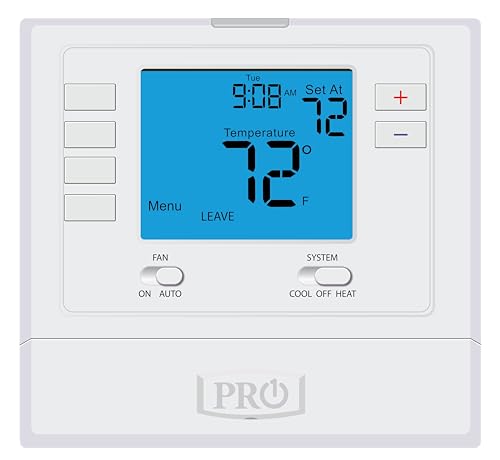
PRO1 T715 Multi-Stage Programmable Gas Thermostat

PRO1 T721 Non-Programmable Heat Pump/Conventional Thermostat

White-Rodgers 1E78-144 Single Stage Thermostat

BN-LINK Reptile Thermostat Temperature Controller
PRO1 T805 Single Stage Programmable Wall Thermostat
Meet The Standout Selections
If your home runs on a heat pump with auxiliary strip heat but the old thermostat keeps short-cycling, the T725 steps in as a thoughtful reset. It speaks both heat pump (2 heat/1 cool) and conventional (1 heat/1 cool) wiring, so swapping equipment later doesn’t always force a new control. The 4 sq. in. blue backlit screen is large enough to read across the room, and the 7-day or 5/1/1 schedule options let weekday and weekend routines run separately.
For households that want a real schedule without paying for app connectivity, this lands in a practical middle ground. Compared to the simpler non-programmable PRO1 units later in the list, the T725 adds the scheduling piece without overcomplicating the on-wall experience.
Where It Delivers
- Supports both heat pump and conventional systems in a single unit
- 7-day and 5/1/1 programming handles separate weekday and weekend routines
- 4 sq. in. blue backlit display stays readable in dim hallways
- Built on the shared T700 platform, simplifying future replacements
Things To Consider
- No Wi-Fi, so remote adjustment requires a separate add-on
- Wiring compatibility should be verified before installation to avoid returned units
Key Specs
Made For
Owners with mixed heat pump and conventional HVAC who want scheduling without smart-home integration.
A Better Fit Elsewhere
The PRO1 T805 suits anyone needing a larger 7 sq. in. display for accessibility reasons.
A detached garage, a backyard shed, or a workshop usually needs reliable on/off control, not a smartphone app. The T771 brings a 25°F to 90°F setpoint range, which matters because most residential thermostats bottom out at 40°F or 50°F. That wide range covers uninsulated spaces where winter dips can damage water lines or stored materials.
The non-programmable design is a feature, not a missing one. There are fewer buttons to press, fewer schedules to forget, and less to break. Swing adjustment and calibration let a careful installer dial the temperature closer to a remote sensor.
Features That Help
- Wide 25°F to 90°F setpoint range covers specialty spaces
- Simple non-programmable layout reduces user error
- Swing adjustment and calibration options for finer tuning
Worth Noting
- Single-stage only, so multi-speed equipment won’t get the most from it
- No scheduling capability means manual adjustments for temperature swings
Right Fit For
Garage, shed, or workshop owners who need freeze-protection control rather than comfort scheduling.
Look Elsewhere When
The Honeywell TH1100DH1004 fits heat-only indoor living spaces better with its backlit display and dual-power design.
The Honeywell PRO 1000 series has been a familiar sight on basement walls for years, and the TH1100DH1004 keeps that legacy intact. Heat-only operation with a backlit display suits a single-fuel home that runs on a furnace or boiler without central air. The horizontal layout fits standard switch-box footprints, which simplifies replacement.
Dual power capability means it can pull a small current from the heating system itself or run on batteries. Owners with older wiring sometimes find the battery option easier than tracking down a common wire.
Practical Pluses
- Backlit display remains readable in low-light basements
- Dual-power design supports both hardwire and battery operation
- Adjustable temperature scale accommodates garage-style low settings
Trade Offs
- Heat-only model won’t suit homes with central cooling
- No scheduling, so users adjust the setpoint by hand as needed
Who It Suits Best
Homeowners with heat-only HVAC who want a backlit, dependable control without app features.
Consider Something Else When
The PRO1 T721 handles both heat pumps and conventional systems in one non-programmable unit.
Tomato and pepper seeds sulk in cold soil, which is why serious growers run a heat mat under their trays. The BN-LINK mat maintains roughly 70°F to 85°F at the root zone, the sweet spot for most vegetable and herb germination. Far-infrared heating distributes warmth more evenly than older wire-coil designs.
The 10″ by 20.75″ footprint matches a standard 1020 nursery tray, so no awkward overhang or wasted coverage. Reinforced heating film tends to hold up to repeated unrolls across seasons.
Notable Upsides
- Maintains 70-85°F root zone for faster germination
- Reinforced film improves durability over multiple seasons
- Standard tray footprint simplifies placement under nursery flats
Room For Improvement
- No built-in thermostat, so pairing with a controller is wise
- Should be used with a moisture barrier and proper drainage to avoid damage
Perfect Match For
Home gardeners starting vegetable or herb seeds indoors during late winter and early spring.
Not Your Match When
The BN-LINK Reptile Thermostat Temperature Controller suits anyone needing active temperature regulation for a heat mat.
For most standard 1 heat/1 cool homes, a non-programmable thermostat like the T701 covers the daily case without complication. The 4 sq. in. blue backlit display pairs with a glow-in-the-dark light button, so locating it during a midnight adjustment doesn’t require flipping on a hallway lamp. Gas or electric compatibility covers the two most common fuel types in suburban homes.
Compared to the programmable T725 reviewed earlier, the T701 skips the scheduling layer for users who prefer the same temperature around the clock. Battery or hardwire power options give installers flexibility when a C-wire isn’t present.
Everyday Advantages
- Glow-in-the-dark button simplifies nighttime adjustments
- Gas or electric compatibility covers most suburban homes
- Battery or hardwire power options for older wiring
Small Caveats
- No scheduling, so setpoint changes happen manually
- Single-stage only, limiting use with multi-speed equipment
Feature Snapshot
Best Suited To
Standard 1H/1C homeowners who want a no-fuss wall control with a large readable screen.
Skip It When
The PRO1 T725 fits anyone needing 7-day scheduling in a similar single-stage package.
Two-stage gas furnaces and matching two-stage air conditioners need a thermostat that can call for low or high fire, and the T715 handles 2 heat/2 cool systems with room to grow. Owners who upgraded their HVAC equipment often find older thermostats limit staging. The 7-day, 5/1/1, or non-programmable modes give flexibility across user preferences.
The shared T700 platform display design means the layout feels familiar if you’ve handled other PRO1 units. For homeowners running modern variable-speed equipment, multi-stage support can reduce temperature swings and shorten run times.
The Good Stuff
- 2H/2C multi-stage support matches modern two-stage HVAC
- Three operating modes: 7-day, 5/1/1, or non-programmable
- Glow-in-the-dark button aids late-night navigation
Points To Keep In Mind
- More wiring terminals require careful installer attention
- Larger feature set may be overkill for basic single-stage homes
Key Attributes
Built With In Mind
Homeowners with two-stage gas HVAC who want scheduling flexibility and multi-stage operation.
Reach For A Different Pick When
The PRO1 T725 covers single-stage heat pump systems with simpler wiring requirements.
Some homes run a heat pump for part of the year and switch to a conventional furnace for the deep cold, or have a hybrid system that needs a flexible controller. The T721 covers 2H/1C heat pump or 1H/1C conventional systems without forcing a choice at the wall. The 4 sq. in. blue backlit display and glow-in-the-dark button make sense in hallways and bedrooms.
AA battery or hardwire power options keep install straightforward in older homes. Unlike the programmable T725, the T721 stays manual, which some owners prefer for its predictability.
The Practical Payoff
- Handles heat pump or conventional systems with one model
- Glow-in-the-dark button aids low-light adjustments
- AA battery or hardwire install covers most wiring setups
A Few Limitations
- No scheduling capability for set-and-forget routines
- Single-stage cooling limits staging benefits
At A Glance
Whose Shelf It Belongs On
Owners of hybrid or dual-fuel homes who want one non-programmable thermostat for either system.
Swap It Out When
The PRO1 T725 fits the same households better when 7-day scheduling is desired.
Older homes with 24-volt or millivolt heating systems sometimes reject modern smart thermostats, and the White-Rodgers 1E78-144 sidesteps that problem. The backlit digital display offers readability without overcomplicating the on-wall experience. It’s been a familiar replacement part for contractors, which means parts and support remain accessible.
For a household that doesn’t want app control or scheduling, this model covers heating, cooling, and heat pump (without aux) systems in a no-nonsense format. Owners with electric baseboard heat should look elsewhere, since compatibility excludes that system type.
Notable Gains
- Compatible with 24-volt and millivolt systems for older homes
- Backlit digital display readable in low light
- Supports heating, cooling, and heat pump without auxiliary heat
Potential Drawbacks
- Not compatible with electric baseboard heat systems
- Limited feature set compared to programmable PRO1 models
Who Should Grab It
Owners of older homes with 24-volt or millivolt systems who need a reliable single-stage replacement.
Another Choice May Suit
The PRO1 T701 fits homeowners with standard 1H/1C conventional setups and a preference for newer platforms.
Reptile keepers, home brewers, and incubation projects need a controller that switches heating devices on and off based on a probe reading. The BN-LINK controller covers a 40°F to 108°F range and handles up to 1000 watts, which suits most heat mats, heat lamps, and seedling setups. Three-button programming keeps the learning curve short.
The hanging tab on the back simplifies mounting inside a terrarium or grow tent. ETL listing provides a third-party safety check for heating-device applications, which matters for unattended overnight operation.
A Few Highlights
- 40-108°F range covers reptiles, incubation, and brewing
- 1000W capacity handles most home heat mats and lamps
- ETL listing for heating-device safety
- Three-button interface simplifies programming
Honest Caveats
- Heating-only design, not suited for cooling devices
- Probe placement affects accuracy, so positioning matters
Who Will Love This
Reptile keepers, brewers, and incubation hobbyists who need active temperature regulation for a heating element.
Where A Sibling Pick Shines
The BN-LINK Seedling Heat Mat fits gardeners who just need consistent warmth without active control.
For users with vision concerns or anyone who reads the wall from across a large living room, the T805’s 7 sq. in. display is almost double the size of the standard T700 platform. It runs 1 heat/1 cool conventional systems with 7-day, 5/1/1, or non-programmable modes, so the same model adapts as routines change. The glow-in-the-dark light button keeps the experience consistent across the lineup.
The T800 platform behind it offers a slightly more refined aesthetic, which matters for visible walls in finished spaces. Compared to the T701 covered earlier, this model adds scheduling without the complexity of a touchscreen.
A Few Strong Suits
- 7 sq. in. display for accessibility and large-room readability
- Three operating modes for varied schedules
- T800 platform offers a more refined aesthetic
Where It Is Less Suited
- Larger footprint may not fit shallow electrical boxes
- Conventional-only support excludes heat pump households
Feature Card
Right Fit For
Homeowners with conventional 1H/1C systems who want a large display and scheduling flexibility.
Not Your Match When
The PRO1 T725 covers heat pump systems better with a comparable feature set.
Picking The Right Thermostat Without Regret
Match The Thermostat To The System, Not The Other Way Around
The first filter is the system itself: single-stage conventional, multi-stage, heat pump, or heat-only. A thermostat’s terminals need to match the wires in the wall, so knowing whether the home has a C-wire (common wire) or runs on batteries changes the install path. A quick photo of the current wiring before ordering saves a return trip.
Decide If Scheduling Actually Helps
Programmable thermostats shine when weekday and weekend routines differ, or when nobody is home for eight hours a day. In households where the setpoint barely moves, a non-programmable model removes a layer of buttons and confusion. The T725 and T805 reviewed above serve the scheduling case, while the T701 and T771 stick to manual control.
Think About Where The Thermostat Lives
A dark hallway rewards a glow-in-the-dark button and a backlit display. A garage or shed benefits from a wide setpoint range like the 25°F to 90°F on the T771. A living room with the unit across the room needs a larger display, which is where the T805’s 7 sq. in. screen pays off. Specialty projects, such as seedling germination or reptile keeping, point toward the BN-LINK options.
Factor In Wiring And Power Constraints
Older homes without a C-wire often run battery-powered thermostats without issue. Multi-stage systems usually require a common wire to power the more complex circuitry. Verifying wire count before purchase prevents a stuck installation halfway through.
Key Considerations Across These Picks
Common Buying Slip Ups To Sidestep
The most frequent mistake is buying a thermostat based on display size or app features while ignoring system compatibility. A multi-stage thermostat on a single-stage system wastes capability and money, while a single-stage unit on multi-stage equipment prevents the HVAC from modulating properly. Verify wire count and HVAC type before adding anything to the cart.
When The Higher Tier Is Worth It
Multi-stage systems like the PRO1 T715 cost more because they call for low or high fire and manage more nuanced temperature swings. For homes with modern two-stage furnaces, the upgrade cuts short cycling and often improves comfort. In homes with single-stage equipment, the extra cost rarely pays back in noticeable comfort gains.
Frequently Asked Questions
What Is A C-Wire And Why Does It Matter?
A C-wire, or common wire, delivers continuous 24-volt power to the thermostat. Smart and multi-stage thermostats often need it, while battery-powered models like the T701 and T771 do not. Without a C-wire, look for a thermostat that runs on batteries or includes a power adapter.
Are Non-Programmable Thermostats Still Worth Buying?
Yes, especially in homes where the setpoint rarely changes or where simplicity matters. Non-programmable models have fewer buttons to confuse guests, kids, or older family members, and they tend to cost less than programmable equivalents. The T771, T701, and T721 are all solid non-programmable picks.
How Do I Know If My Home Has A Heat Pump Or A Conventional System?
Heat pumps typically run year-round and switch between heating and cooling modes from the same outdoor unit. Conventional systems usually have a separate furnace (gas, oil, or electric) and air conditioner. Checking the outdoor unit label or the furnace documentation confirms which system is installed.
Can One Thermostat Handle Both Heating And Cooling?
Yes, most modern thermostats support both functions as long as the system includes both. Single-stage units like the T701, T721, and T805 handle one heating and one cooling stage, while multi-stage models like the T715 handle two of each.
What Is ETL Listing And Why Does It Matter For Specialty Controllers?
ETL listing means the product was tested by a third-party lab against a published safety standard. For heating devices that may run unattended overnight, such as reptile heat mats or seedling mats, that independent check offers meaningful peace of mind. The BN-LINK controller carries this listing for that reason.
Final Verdict
The right thermostat depends less on flashy features and more on the system already in your wall. For most standard homes, the PRO1 T701 or T805 covers daily comfort, while specialty spaces point toward the T771 or BN-LINK controller. Match the wiring, match the fuel type, and the rest falls into place.