The wall thermostat you grew up with, the little beige box with two mercury switches and a sliding lever, is rapidly going extinct. Connected thermostats now read the weather, learn your schedule, and trim your utility bill while you’re not looking. For anyone replacing a clunky dial, juggling uneven room temperatures, or wanting voice-controlled comfort, the upgrade matters more than the spec sheet suggests.
The Lineup, Simplified

PRO1 T725 Heat Pump/Conventional Programmable Thermostat

Heagstat NonProgrammable Thermostat 1 Heat/1 Cool

PRO1 T701 Single Stage Non-Programmable Thermostat
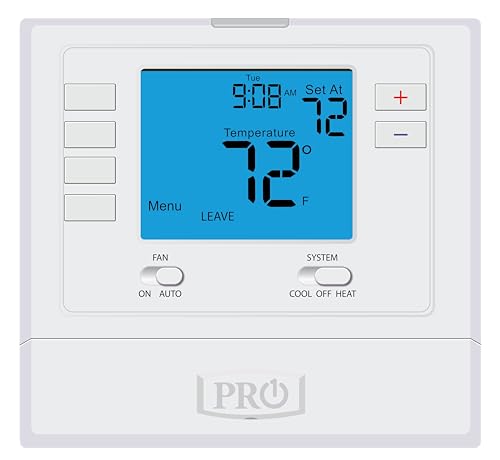
PRO1 T715 Multi-Stage Programmable Gas Thermostat

ecobee Smart Thermostat Premium with Smart Sensor
Google Nest Temperature Sensor 3-Pack

PRO1 T721 Non-Programmable Heat Pump Thermostat

ecobee SmartSensor 2-Pack

ecobee Smart Thermostat Enhanced (WiFi)
PRO1 T805 Single Stage Programmable Thermostat
The Details Behind The Selections
Heating and cooling setups don’t always follow a clean single-stage script, and the PRO1 T725 was designed for households living that reality. It covers both 2 heat/1 cool heat pump configurations and standard 1 heat/1 cool conventional systems, which means a hybrid home doesn’t need a second wall unit.
The 4-square-inch blue backlit display is the kind of detail that sounds small until you try to read a dim hallway thermostat at 6 a.m. Compared to the stripped-down Heagstat unit later in this list, the T725 gives you actual scheduling rather than just a setpoint knob.
Where It Excels
- Dual compatibility with heat pump and conventional HVAC, useful for homes that run both setups.
- 7-day or 5/1/1 programmability supports varied schedules, like a work-from-home Tuesday that doesn’t match Monday’s pattern.
- Backlit screen improves nighttime readability without forcing you to tap the wall.
- Sits on the proven T700 platform, giving owners an established firmware lineage.
Things To Consider
- No WiFi, so this functions as a programmable upgrade rather than a smart upgrade.
- Limited wiring configurations may not suit every existing install, so checking the C-wire situation is worthwhile.
Quick Facts
Who It Suits Best
Owners of hybrid HVAC systems who want scheduled savings without committing to a full smart-home overhaul.
Look Elsewhere When
The ecobee Smart Thermostat Premium is the better match if you actually want app control and voice integration.
Not every wall needs to become a smart speaker. The Heagstat keeps the experience focused, a single-stage 1 heat/1 cool thermostat for a straightforward furnace and AC setup. The white backlight is bright enough to read without flooding the room.
For someone replacing a dying mechanical unit in a guest room, garage conversion, or older rental, this kind of no-frills install often makes more sense than wrestling with WiFi credentials. Compared to the PRO1 T701 that follows, the Heagstat leans even harder into minimalism.
The Value In It
- Clean, low-cost replacement for legacy mercury or mechanical thermostats.
- Compatible with gas, oil, and electric forced-air setups paired with an outdoor AC condenser.
- White backlight improves readability without aggressive brightness.
Points To Note
- The base accepts only 2 to 5 wires, so existing 6 to 8 wire installs will need a different pick.
- Will not work with heat-only systems, multi-stage equipment, or systems requiring a C-wire beyond standard 24VAC configurations.
- Lacks any programmable scheduling, so temperature stays at the last manual setting.
Right Fit For
Homeowners with simple single-stage forced-air systems who want a competent wall swap at minimal cost.
Not Your Match When
The PRO1 T715 is the better route for two-stage gas furnaces needing scheduling depth.
The PRO1 T701 is the kind of unit you’d install in a basement apartment or mother-in-law suite and basically forget about. It handles 1 heat/1 cool conventional systems with a clear 4-square-inch blue backlit display and a glow-in-the-dark light button for late-night adjustments.
There’s no scheduling to mess with, and that’s the point. Compared to the Heagstat above, the T701 trades a slimmer price position for the larger T700 platform footprint and the glow button, which can be a real win in a windowless interior hallway.
Strengths Worth Knowing
- Glow-in-the-dark light button locates the controls during a midnight wakeup.
- 4-square-inch backlit display gives more usable screen real estate than typical budget units.
- Suitable for gas or electric conventional setups in residential properties.
Honest Caveats
- No scheduling, so energy-conscious households chasing automated setbacks won’t find it here.
- Not designed for heat pumps, multi-stage systems, or systems that demand a common wire for power.
Made For
Landlords and homeowners with basic conventional HVAC setups who value simple operation over connectivity.
Skip It When
The ecobee Smart Thermostat Enhanced is worth the jump if app control and learning algorithms matter for your main living space.
Two-stage gas systems are where single-stage thermostats start to feel underbaked. The PRO1 T715 steps in with 2 heat/2 cool support and a flexible schedule structure, including 7-day, 5/1/1, or non-programmable modes if you’d rather set it and forget it.
The 4-square-inch blue backlit display and glow button carry over from the T701, so existing PRO1 owners will recognize the visual language. Compared to the heat-pump-friendly T725 earlier in the list, the T715 leans into multi-stage gas furnace territory specifically.
A Few Highlights
- 2 heat/2 cool staging lets the furnace modulate output rather than blasting on full.
- Three operating modes, programmable, 5/1/1, or fully manual, cover most homeowner preferences.
- Common-wire or battery power gives flexibility when running wires through older walls.
Worth Bearing In Mind
- Lacks WiFi, so no remote adjustment from a phone.
- Programming depth takes longer to learn than a basic dial thermostat, especially for first-time installers.
Best Suited To
Owners of two-stage gas furnaces who want better temperature modulation without smart-home features.
Consider Something Else When
The ecobee Smart Thermostat Premium is the more ambitious choice if you want air quality monitoring alongside scheduling.
This is the thermostat for someone who wants the thermostat to actually think. The ecobee Smart Thermostat Premium ships with an included SmartSensor, has WiFi, and accepts voice commands through Siri and Alexa directly on the unit. Geofencing reads your phone’s location to start warming the house before you pull into the driveway.
Built-in air quality monitoring and smoke alarm detection push it well beyond the PRO1 units earlier in the list. For a family room where comfort disputes happen nightly, the room sensor alone justifies the jump.
What Pays Off
- Included SmartSensor tackles hot and cold spots by prioritizing the rooms you actually use.
- Voice assistants are built into the wall unit itself, no extra speaker required.
- Geofencing adjusts the system automatically based on whether anyone’s home.
- Air quality monitoring adds a layer of awareness most thermostats skip.
Practical Considerations
- Setup requires a C-wire in most cases, so older homes may need a power adapter or a new wire run.
- The premium feature set matters less in a small studio where a single thermostat already covers the space.
Quick Facts
Perfect Match For
Tech-forward households that want voice control, room sensors, and air quality visibility from a single wall unit.
Reach For A Different Pick When
The ecobee Smart Thermostat Enhanced is a better match if you want most of these features at a lower entry tier.
The Google Nest Temperature Sensor isn’t a thermostat on its own, it’s the missing piece that makes a compatible Nest thermostat smarter. Drop one in a baby’s room, one in the living area, and one upstairs, and the system weighs all three readings before deciding when to fire the furnace.
Low Energy Bluetooth keeps the sensors sipping battery, and they communicate to the parent thermostat up to roughly 50 feet away. For homes where the hallway thermostat lies about bedroom comfort, this is the cleanest fix.
Benefits That Matter
- Three-pack covers a typical whole-home layout without buying extra units.
- Compatible with Nest Learning Thermostat and Nest Thermostat E, the two flagships from the same brand.
- Long battery life thanks to the low-power Bluetooth design.
Trade-Offs To Consider
- Requires a compatible Nest thermostat to function, so it isn’t useful as a standalone purchase.
- Doesn’t work with non-Nest smart thermostats, which limits cross-brand flexibility.
Whose Shelf It Belongs On
Nest thermostat owners fighting room-to-room temperature swings who want better averaging across the house.
Swap It Out When
The ecobee SmartSensor 2-Pack suits ecobee households with similar goals on a different platform.
The PRO1 T721 covers a useful middle ground: 2 heat/1 cool heat pump or 1 heat/1 cool conventional. Households that don’t need a full weekly schedule but do need heat pump compatibility find this unit surprisingly capable.
It shares the T700 platform with the T725 and T701, so the glow-in-the-dark light button and 4-square-inch blue backlit display feel familiar. Compared to the programmable T725, the T721 sacrifices scheduling for a simpler interface that’s easier for guests or older family members to operate.
Notable Gains
- Supports both heat pump and conventional systems in one unit.
- Glow button makes it easy to locate in low-light rooms.
- AA battery or hardwired power offers installation flexibility.
Possible Compromises
- No programmability, so anyone chasing energy-saving setbacks will need a different pick.
- Single-stage behavior in conventional mode means it won’t modulate multi-stage furnaces.
Built With In Mind
Heat pump owners who want straightforward manual control without learning curves or app dependency.
Where A Sibling Pick Shines
The PRO1 T725 suits households that want heat pump support plus a real programmable schedule.
The ecobee SmartSensor doesn’t just read temperature; it detects occupancy through infrared and reports back to the parent thermostat. A two-pack covers an upstairs bedroom and a home office, the two rooms where comfort arguments tend to happen.
With a wireless range around 60 feet, the sensors reach most rooms without range extenders. Compared to the Nest Temperature Sensor 3-Pack, this unit is a tighter, two-room solution on the ecobee platform.
What Makes Sense
- Occupancy detection means the system focuses energy on rooms people are actually using.
- Two-pack suits small to mid-size homes without overspending.
- Wireless communication keeps installation simple, no extra wiring through walls.
Small Limitations
- Only works with ecobee thermostats, so non-ecobee households won’t benefit.
- Battery replacements become a recurring ownership task across multiple sensors.
Who Will Love This
Existing ecobee homeowners with two specific rooms that consistently run too warm or too cold.
A Better Fit Elsewhere
The Google Nest Temperature Sensor 3-Pack covers larger homes with three rooms on the Nest platform.
The ecobee Smart Thermostat Enhanced sits one tier below the Premium but still pulls real weight. WiFi connectivity, occupancy-based scheduling, and energy optimization through eco+ features all ship in the standard package.
For households that want smart-thermostat behavior without the Premium’s air quality monitor or built-in voice assistants, this is the more measured entry. Compared to the Premium above, you lose the speaker hardware but keep the scheduling intelligence.
Useful Strengths
- Automatic energy savings through eco+ features that adjust temperatures when you’re asleep or away.
- Occupancy-aware scheduling learns patterns and suggests improvements over time.
- Plays nicely with Apple Watch, Apple HomeKit, and other major smart-home platforms.
A Few Limitations
- Lacks the built-in voice assistants of the Premium model.
- No included SmartSensor, so room-level balancing requires a separate purchase.
Quick Facts
Who Should Grab It
First-time smart-thermostat owners who want learning behavior without paying for voice hardware they won’t use.
Where Another Pick Suits Better
The ecobee Smart Thermostat Premium is the stronger choice if built-in voice and air quality monitoring matter.
The PRO1 T805 closes the list with a generous 7-square-inch backlit display, the largest in this lineup. For anyone squinting at smaller screens across a room, the extra real estate is genuinely useful.
It supports 7-day, 5/1/1, or non-programmable operation, so the same unit can grow with you from manual to fully scheduled. Built on the newer T800 platform, it carries forward the glow-in-the-dark light button that defines the PRO1 lineup.
What Stands Out
- 7-square-inch display is the largest on this list, helpful for aging eyes or large living spaces.
- Three operating modes give installers and end users a path from manual to programmable.
- Glow button ensures nighttime operation without fumbling.
Where It Is Less Suited
- Single-stage only, so multi-stage gas setups need the T715 instead.
- No WiFi, keeping it in the programmable but not smart category.
The Right Fit
Conventional HVAC homeowners who want flexible scheduling and a notably readable display without smart-home features.
Another Choice May Suit
The PRO1 T715 is the better fit for multi-stage gas furnaces needing similar scheduling depth.
Choosing A Thermostat That Actually Matches Your Home
Confirm Your HVAC Configuration First
The single biggest reason thermostats end up returned is a mismatch between the wall unit and what’s behind the panel. A quick photo of your current wiring, especially the presence or absence of a C-wire (the common wire that delivers continuous 24VAC power), tells you almost everything. Heat pumps, multi-stage gas systems, and standard forced-air setups each demand different terminals. Skipping this step turns a Saturday project into a Monday return.
Decide How Connected You Want To Be
Connected thermostats span a wide spectrum. Units like the PRO1 T725 are programmable but not WiFi-equipped, so they still run on a schedule but don’t talk to your phone. Smart thermostats like the ecobee Enhanced and Premium add app control, learning, and often voice. For renters or short-term owners, a programmable non-connected model often hits the sweet spot of comfort without landlord complications.
Sensor Add-Ons Expand Comfort Zones
Most central thermostats sit in hallways that nobody actually lives in, which means the reading rarely matches the bedroom or nursery. Add-on sensors, like the Google Nest Temperature Sensor 3-Pack and the ecobee SmartSensor 2-Pack, push comfort to the rooms that matter. For households with consistent hot-or-cold room complaints, this is usually where the biggest lifestyle gain comes from.
Think Long Term About Power And Maintenance
Battery-powered units need fresh cells every year or so, and smart thermostats often demand a hardwired C-wire. Either route works, but it’s worth matching to the wiring already in your wall. Common-wire adapters exist for homes lacking a C-wire, though they add a small install step.
Key Considerations Across These Picks
Where Shoppers Go Wrong
The most common slip-up is grabbing a feature-rich smart thermostat for a system that doesn’t support multi-stage staging or heat pump logic. Without the right compatibility, half the features stay locked behind settings menus. Another trap is overlooking wiring. A smart thermostat that needs a C-wire but finds only R, W, Y, and G in the wall will need an adapter or a wire pull, and that adds real cost.
The Case For Spending Up
Higher-tier thermostats like the ecobee Premium earn their position through room sensors, air quality monitoring, and built-in voice assistants that lower-tier units skip. For a primary living space where you spend most of your day, the upgrade typically pays back through finer temperature control and better room averaging. For a guest room or workshop, the budget tier delivers nearly the same comfort at a fraction of the spend.
Frequently Asked Questions
Do all internet connected thermostats require a C-wire?
Not all of them, but most smart thermostats do because WiFi radios and color displays draw steady power. The PRO1 T725 and similar programmable models can run on AA batteries, while ecobee units typically need a C-wire or the included adapter.
Can a thermostat work with both a heat pump and a furnace?
Some units, including the PRO1 T725 and T721, are specifically designed to handle heat pump and conventional systems in a single device. You configure the thermostat to match whatever equipment is actually installed.
Will room sensors replace a second thermostat?
In practice, room sensors do the work of averaging temperatures across zones, which is what most people actually want. A multi-zone system with dampers is more precise but also significantly more expensive.
How hard is installation for a non-programmable wall swap?
Most homeowners with a screwdriver and a phone photo of their old wiring can handle a direct swap in under thirty minutes. The harder part comes when the new thermostat needs a C-wire the old one didn’t require.
Do smart thermostats actually save money?
They can, primarily through scheduled setbacks during sleeping and away hours, plus occupancy-based adjustments. The savings depend on your existing habits and local energy rates.
Bottom Line
The right thermostat depends less on bells and whistles and more on the HVAC system already mounted in your wall. Match the wiring and staging first, then layer on smart features where they actually improve daily comfort. From the budget-friendly Heagstat to the room-aware ecobee Premium, each pick on this list solves a specific problem, and that’s the part worth getting right.