Hunting for current deals on Nest thermostat setups usually means looking past the headline unit itself. The real value often hides in compatible accessories, room sensors, and budget-friendly programmable controls from sibling brands. This roundup mixes Google Nest hardware with affordable alternatives that pair cleanly with Nest-style systems. Runners, parents, and home office workers all show up in different slots here, since temperature control rarely fits a single persona.
A Snapshot Of The Selections

PRO1 T725 Heat Pump/Conventional Programmable Thermostat
PRO1 T771 Single Stage Non-Programmable Thermostat

Petrichor Nest Thermostat Wall Plate (Snow)

Google Nest Thermostat with Trim Kit (Snow)

PRO1 T701 Single Stage Non-Programmable Thermostat
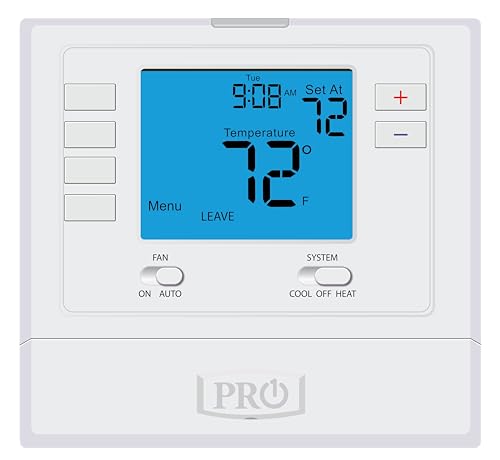
PRO1 T715 Multi-Stage Programmable Gas Thermostat

Heagstat NonProgrammable Thermostat 1 Heat/1 Cool

PRO1 T721 Non-Programmable Wall Thermostat
Google Nest Temperature Sensor 3-Pack
PRO1 T805 Single Stage Programmable Thermostat
A Breakdown Of The Leading Choices
The PRO1 T725 earns its slot by speaking two languages at once. It handles 2 heat/1 cool heat pump setups and falls back to 1 heat/1 cool conventional wiring without forcing you to commit. For households weighing a future system swap, that flexibility shortens the upgrade path later.
Programmability runs 7-day or 5/1/1, which covers most work-and-weekend routines. Compared with the basic T701 later on this list, you get more scheduling depth without stepping into multi-stage territory. The blue backlit display stays readable from across a hallway, which matters more than spec sheets suggest.
What It Does Well
- Dual compatibility lets one thermostat survive a system change.
- 7-day and 5/1/1 scheduling fit rotating work weeks.
- Backlit 4 sq. in. display reads clearly from a few feet away.
- Compact footprint works in tight retrofit boxes.
Trade Offs
- No smart or app-driven control layer.
- Owners commonly report the interface taking a few cycles to learn.
Built With In Mind
Homeowners running heat pump systems who still want scheduled weekday-versus-weekend control without learning curves.
Swap It Out When
You prefer the app-driven experience of the Google Nest Thermostat, which suits connected households better.
Garages, workshops, and sheds rarely want a smart thermostat. They want a wide setpoint range and predictable behavior, which is exactly where the T771 positions itself. The 25°F-to-90°F span reaches low enough for cold-weather storage spaces.
Single-stage simplicity keeps wiring painless in utility zones. Unlike the PRO1 T725 covered earlier, this one skips scheduling entirely, since most detached spaces follow manual habits. Swing adjustment and calibration help fine-tune comfort where the thermostat lives next to a drafty door.
Useful Touches
- Wide setpoint range handles both cold storage and occupied rooms.
- Calibration controls compensate for placement quirks.
- Backlit display aids low-light garages and basements.
Things To Weigh
- No scheduling means manual setpoint changes through weather swings.
- Single-stage only, so two-stage HVAC owners must look at the T715 instead.
- Dust-prone workshop environments may need occasional display wiping.
Right Fit For
Anyone outfitting a garage, shed, or basement workshop with basic single-stage heating and cooling needs.
Consider Something Else When
You need scheduled routines inside the main living space, where the PRO1 T725 earns its keep.
The Petrichor wall plate solves a problem most smart thermostat owners forget until installation day. Older thermostats leave paint scars, anchor holes, and uneven patches that no white Nest unit can hide. This trim plate covers the mess and adds a clean color frame.
It’s built for the 2020 Nest Thermostat (model numbers GA01334-US, GA02082-US, GA02081-US, and GA02083-US). Fingerprint-resistant finish helps it stay tidy in busy hallways. If you already own the Google Nest Thermostat covered later, this plate is the finishing touch that completes the swap.
What Works In Its Favor
- Covers old holes, repaint gaps, and uneven drywall around the mount.
- Snow finish matches the Google Nest Thermostat colorway cleanly.
- Flush-mount design sits close to the wall for a built-in look.
Possible Compromises
- Compatibility is locked to the 2020 Nest generation, so older units won’t fit.
- Single-color option limits matching alternative wall finishes.
Who Should Grab It
Anyone upgrading to the 2020 Nest Thermostat from a chunky older unit and wanting a clean visual finish without drywall repair.
Look Elsewhere When
You don’t already own the 2020 Nest Thermostat, since the plate has no function on its own.
The Google Nest Thermostat anchors this list because it does the most with the least effort. It creates energy-efficient schedules through the Google Home app, which means you build routines from a phone rather than fiddling with on-device menus. Auto-away behavior drops the temperature when the house empties.
The trim plate and steel plate ship in the box, covering most retrofit installs in one package. Pair it with the Petrichor plate covered earlier if your walls need extra coverage, or with the Nest Temperature Sensor later in this roundup for multi-room accuracy.
Good Reasons To Consider
- ENERGY STAR certified for documented efficiency gains.
- Google Home app scheduling removes on-device button work.
- Auto-away feature cuts conditioning when nobody is home.
- Trim and steel plates included for standard retrofit installs.
A Few Limitations
- Wi-Fi dependency means loss of remote features during outages.
- Some legacy HVAC systems require a C-wire adapter that isn’t included.
Key Product Details
Made For
Connected households that want app-driven scheduling, remote control, and auto-away behavior without a steep learning curve.
Where Another Pick Suits Better
Shops and garages needing only basic dial control should choose the PRO1 T771 instead, which fits detached spaces at lower cost.
The PRO1 T701 is the “less is more” pick in this lineup. No schedules to set, no app to install, no Wi-Fi password to remember. It suits households where the family just wants a bigger screen and a glow-in-the-dark light button for nighttime tweaks.
Built on the T700 platform, it shares the spacious 4 sq. in. blue backlit display found on the T725 covered earlier. Gas or electric compatibility widens the install options across older homes. For a parent or short-term renter, this unit removes the friction that scheduling thermostats often introduce.
The Case For It
- Glow-in-the-dark light button helps night-time adjustments.
- Big backlit display eases reading for older eyes.
- Gas or electric compatibility opens older-home installs.
- AA-battery or hardwire power gives install flexibility.
Where It Is Less Suited
- No scheduling means you adjust setpoints manually each season.
- Lacks multi-stage support for two-stage HVAC systems.
Who Will Love This
Short-term renters, parents, and minimalists who want predictable dial control without app-driven complexity.
Reach For A Different Pick When
You run a multi-stage gas system, where the PRO1 T715 earns its slot instead.
The PRO1 T715 handles 2 heat/2 cool gas systems, which is the territory most basic thermostats avoid. Two-stage heating and cooling lets the equipment ramp gradually, which often translates to quieter operation and longer system life. That alone can justify the upgrade for whole-home installs.
Programmability spans 7-day, 5/1/1, or non-programmable, depending on how much control you want. Battery or hardwire options suit both retrofits and fresh installs. Compared with the T701 covered earlier, this one adds serious HVAC muscle without abandoning the same T700 display language.
Where It Delivers
- Two-stage heating and cooling support suits complex HVAC systems.
- Three scheduling modes match varied routines.
- Glow-in-the-dark light button supports low-light rooms.
- Battery or hardwire power adapts to old or new wiring.
Practical Considerations
- Single-system homeowners don’t need the second stage and may overspend.
- Programming depth can feel heavy to first-time thermostat shoppers.
Feature Snapshot
Best Suited To
Homeowners with multi-stage gas HVAC who want scheduled control and quieter staged ramp-ups.
Not Your Match When
You run a simple single-stage system, where the PRO1 T701 covers the same ground at lower cost.
The Heagstat lands here as the lowest-friction replacement option for aging dial thermostats. It targets 24VAC conventional single-stage systems with 2 to 5 wires, which covers most older forced-air setups. If your existing thermostat died mid-winter, this one keeps the install simple.
The white backlight aids nighttime visibility in hallways. Compatibility stops at conventional systems, so heat pump owners need to walk past this and pick up the PRO1 T721 instead. For a DIY replacement on a fixed budget, the wire-count constraint is the key thing to verify first.
Well-Handled Touches
- Affordable replacement for aging dial thermostats.
- White backlight improves nighttime readability.
- Compatible with gas, oil, and electric forced-air systems.
Worth Bearing In Mind
- Limited to 2-to-5 wire installs, so 6-to-8 wire homes must look elsewhere.
- Not compatible with heat pump or multi-stage systems.
- No scheduling layer beyond manual setpoints.
Whose Shelf It Belongs On
DIY shoppers replacing a worn-out single-stage thermostat on a tight budget and a short timeline.
Where Another Pick Suits Better
Heat pump households should grab the PRO1 T721, which covers both heat pump and conventional setups.
The PRO1 T721 fits homes where the HVAC setup itself isn’t quite settled. It covers 2 heat/1 cool heat pump or 1 heat/1 cool conventional configurations in a single body, which means a system change doesn’t force a thermostat swap. Mixed-equipment homes benefit most from that flexibility.
The T700 platform returns with its 4 sq. in. blue backlit display and glow-in-the-dark light button. AA-battery or hardwire power opens install paths. Compared with the Heagstat covered earlier, this one adds heat pump support without adding scheduling weight.
What Helps Most
- Heat pump plus conventional compatibility in one body.
- Glow-in-the-dark button helps nighttime adjustments.
- AA-battery or hardwire power for flexible installs.
Some Limits To Know
- No scheduling layer means manual setpoint changes through the year.
- Heat pump support tops out at 2H/1C configurations.
Quick Facts
Perfect Match For
Mixed-system homeowners who want dial simplicity without committing to a single HVAC configuration.
A Better Fit Elsewhere
Schedulers should look at the PRO1 T725 instead, since that one adds 7-day and 5/1/1 programming on the same platform.
Most thermostats measure temperature near the hallway, not where you actually sleep. The Nest Temperature Sensor 3-pack fixes that with wireless room sensors that communicate back to the main Nest unit. Place one in a nursery, one in a living room, and one wherever drafts hit hardest.
These sensors work with compatible Nest thermostats, communicating over low-energy Bluetooth up to about 50 feet. They pair cleanly with the Google Nest Thermostat covered earlier in this roundup, expanding that base unit into a multi-zone setup. For parents managing nursery comfort, that kind of precision is the whole point.
Useful Highlights
- Multi-room temperature reporting for mixed comfort zones.
- Wire-free placement removes install complexity.
- Low-energy Bluetooth communication extends battery life.
- Three-sensor pack covers a typical whole-home layout.
Points To Keep In Mind
- Requires a compatible Nest thermostat to function.
- Bluetooth range may shorten through dense interior walls.
Who Will Love This
Nest thermostat owners with hot and cold spots who want readings from the rooms they actually use.
Skip It When
You don’t own a compatible Nest thermostat yet, since the sensors have no standalone function.
The PRO1 T805 closes this list by upgrading what a single-stage thermostat can do. It shares the conventional 1H/1C focus of the T701 covered earlier but adds 7-day, 5/1/1, and non-programmable scheduling options on the larger T800 platform. For someone whose routine truly changes day-to-day, that depth matters.
The 7 sq. in. display is the biggest backlit screen in this roundup, which makes setpoint navigation easier at a glance. Glow-in-the-dark button support returns. For households that want programmable control without stepping into smart or multi-stage territory, the T805 fits that specific middle ground.
Positive Points
- Largest backlit display in the PRO1 lineup.
- Three scheduling modes including a fully non-programmable option.
- Glow-in-the-dark light button helps low-light rooms.
- Single-stage focus keeps wiring approachable.
Honest Caveats
- No app-driven or remote control layer for connected households.
- Single-stage support only, so multi-stage systems need the T715 instead.
Technical Highlights
The Right Fit
Schedule-driven households with single-stage HVAC who want the biggest dial-style display available in this category.
Where A Sibling Pick Shines
Connected households wanting app scheduling should pick up the Google Nest Thermostat earlier in this roundup.
Picking A Thermostat That Suits Your Home
Before any deals on Nest thermostat listings get compared, get honest about the HVAC system in place. A 1 heat/1 cool conventional setup, a multi-stage gas furnace, and a heat pump each pull the recommendation in a different direction. Wire count matters more than brand hype, since mismatched thermostats simply won’t power up.
Smart versus dial comes next. Connected households tend to gain the most from the Google Nest Thermostat plus sensor pack, while utility rooms and guest suites often do better with a no-frills unit like the PRO1 T701 or Heagstat. Schedules drive real efficiency gains, but only when the routines themselves are predictable.
Compatibility closes the decision. Heat pump owners should stay on the PRO1 T721 or T725 path, while conventional households can spread across the wider PRO1 lineup. Check wire count before checkout, since older homes with 6-to-8 wire setups rule out a few of the budget-friendly picks. Pair the unit with accessories like the Petrichor wall plate if the retrofit leaves wall damage behind.
Key Considerations Across These Picks
Where Shoppers Go Wrong
The most common slip-up in this category is buying a smart thermostat without confirming the HVAC system actually supports it. Heat pump homes sometimes get handed a conventional-only unit, and the wiring never matches up. Another pitfall is overlooking the C-wire requirement, which leaves the thermostat constantly low on power. Measure the existing wall opening before assuming any trim plate will cover the gap.
When Paying More Pays Off
Higher-tier thermostats earn their premium by handling multi-stage systems, wider setpoint ranges, or app-driven scheduling that cheaper units skip. In a household where summer cooling runs in two stages, a single-stage thermostat ends up cycling the compressor hard and shortening its life. The PRO1 T715 or Google Nest Thermostat can save money over the long run by gentler ramp-ups and auto-away behavior. For minimal HVAC setups, the premium tier is often overkill.
Frequently Asked Questions
Are deals on Nest thermostat units worth chasing outside of major sales?
The base Nest Thermostat often sees steady discounts through the year, since the hardware has been on the market long enough for retailers to compete on price. The bigger value tends to land in accessory bundles like trim plates and sensor packs.
Can a Nest thermostat work without a C-wire?
Some installations work with the included internal battery or a power-stealing setup, but many older homes need a C-wire adapter for stable operation. Check existing wiring before installing any Nest unit to avoid constant low-battery alerts.
Do Nest Temperature Sensors replace the main thermostat?
No, the sensors only report temperature back to a compatible Nest thermostat. They don’t drive the system on their own, so they only make sense once the main unit is already installed.
Are non-programmable thermostats still useful in 2026?
Yes, especially for detached spaces, rental units, and households that don’t follow a regular routine. The PRO1 T701 and T771 cover these cases at lower cost than smart alternatives.
How do I know if my system is heat pump or conventional?
Heat pump systems usually have an outdoor unit that runs year-round and an indoor air handler. Conventional systems separate heating (furnace) and cooling (AC condenser) into distinct equipment. When in doubt, the indoor air handler label or the system documentation will clarify.
The Takeaway
Choosing among deals on Nest thermostat gear comes down to matching the HVAC system first, the comfort priorities second, and the smart features last. Heat pump owners should stay on the PRO1 T721 or T725 path, while conventional households can spread across the wider PRO1 lineup depending on staging needs. The Google Nest Thermostat earns its slot wherever app scheduling and auto-away behavior save real energy, and the sensor pack extends that benefit to specific rooms. Pick the unit that fits the system, then layer accessories like the Petrichor wall plate if the retrofit needs a clean finish.