Whether your old wall thermostat finally gave up, you’re upgrading a garage workshop, or you’re tinkering with a seed-starting setup that needs steady warmth, the right controller makes everyday comfort feel effortless. This roundup gathers nine solid options that cover cars, homes, heat pumps, garages, and garden projects, so you can zero in on what actually fits your situation without overspending.
The Essentials At A Glance

GM Genuine Parts 131-71 Engine Coolant Thermostat

PRO1 T725 Heat Pump/Conventional Programmable Thermostat
PRO1 T771 Single Stage Non-Programmable Thermostat

BN-LINK 10″ x 20.75″ Seedling Heat Mat

PRO1 T701 Single Stage Non-Programmable Thermostat
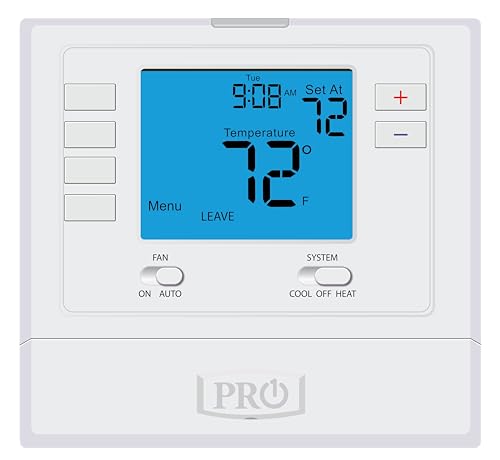
PRO1 T715 Multi-Stage Programmable Gas Thermostat

PRO1 T721 Non-Programmable Heat Pump Thermostat

BN-LINK Reptile Thermostat Temperature Controller
PRO1 T805 Single Stage Programmable Thermostat
The Details Behind The Selections
Kicking off the list is one of the few automotive entries, and it earns its spot by doing exactly what an engine thermostat is supposed to do: regulate coolant flow so the motor reaches its proper operating temperature and stays there. Unlike the wall-mounted units you’ll see later in this roundup, this GM Genuine Parts 131-71 lives inside the cooling system and talks to the radiator rather than to you.
It’s a factory-style replacement designed for GM vehicles, which means the fit and calibration are meant to match what originally shipped in your engine. For a weekend mechanic swapping out a failing unit, that kind of match removes a lot of the guesswork. You install it, refill the coolant, and the engine should settle into its normal temperature range within a typical drive cycle.
The Value In It
- Factory-spec fit designed specifically for GM engines, removing compatibility guesswork
- Direct replacement that supports normal operating temperature regulation through proper coolant flow
- Helps restore fuel efficiency and cabin heat, both of which can suffer when the thermostat sticks open
- A trusted match for owners who prefer original-equipment parts over aftermarket alternatives
Things To Consider
- Coolant thermostat replacement typically requires draining some coolant, so plan for proper disposal and a refill
- Specific fit varies by GM model and year, so confirm the part number matches your application before ordering
Who Should Grab It
GM vehicle owners comfortable with basic under-hood work who want an OE-style replacement thermostat without hunting through aftermarket options.
Where Another Pick Suits Better
For anyone managing indoor climate control, the PRO1 T701 Single Stage Non-Programmable Thermostat is the obvious home alternative.
Stepping inside the house, the PRO1 T725 is the kind of wall thermostat that earns a place on a shortlist when your HVAC setup doesn’t fit a single category. It handles 2 heat/1 cool heat pump systems and 1 heat/1 cool conventional systems, meaning one thermostat can cover more equipment configurations than most budget models.
Programming follows a familiar 7-day or 5/1/1 schedule with wake, leave, return, and sleep-style blocks, all readable on a 4 sq. in. blue backlit screen. For households that want set-it-and-forget-it scheduling, that daily rhythm is the main reason to pick a programmable unit over a simpler option.
Positive Points
- Dual compatibility with heat pump and conventional systems in one unit, sparing the cost of separate thermostats
- 7-day and 5/1/1 scheduling supports real work-and-school routines, not just weekday/weekend splits
- Blue backlit display keeps settings readable in dim hallways and basements
- Part of the established T700 platform, so installers tend to recognize the wiring layout
Worth Noting
- Programming a weekly schedule takes patience on first setup, especially across multiple time blocks
- Heat pump owners should verify the auxiliary heat settings match their specific equipment
- Battery-powered operation means occasional swaps, though many owners report this is rare
Built With In Mind
Households running a heat pump who want scheduled comfort control without paying for premium smart features.
Skip It When
Anyone running a simple 1 heat/1 cool conventional system may find the PRO1 T771 Single Stage Non-Programmable Thermostat easier to live with.
Where the T725 leans into scheduling, the PRO1 T771 takes the opposite route: a single-stage non-programmable unit built for straightforward on-demand adjustments. It’s a natural fit for spaces where schedules don’t really matter, and where the lowest temperature setting is more important than peak features.
The setpoint range stretches down to 25°F, which is unusually cold for a wall thermostat and opens up uses in garages, sheds, and outbuildings where winter freeze protection matters. The 4 sq. in. blue backlit display is shared with other PRO1 units, so anyone familiar with the brand already knows what they’re looking at.
The Helpful Details
- Setpoint range starting at 25°F supports cold-space applications like unheated garages
- Non-programmable interface means no weekly setup, just up and down on the temperature
- Swing adjustment and calibration help fine-tune cycling behavior to match the space
- Compatible with standard 1 heat/1 cool conventional HVAC systems in most homes
Trade Offs
- Lacks any scheduling, so energy savings rely entirely on manual adjustments
- Single-stage support means it’s not suited to multi-speed equipment or heat pumps
Best Suited To
Garage, shed, and workshop owners who want basic temperature control without programming overhead.
Look Elsewhere When
Main living areas with predictable routines benefit more from the PRO1 T725 Heat Pump/Conventional Programmable Thermostat.
Pivoting away from wall thermostats entirely, the BN-LINK Seedling Heat Mat is a flat warming pad that sits beneath seed trays to keep root zones in the sweet spot for germination. It’s not a thermostat in the traditional sense, but it acts like one, holding a steady low-level warmth that seedlings rely on.
Far-infrared heating film and a reinforced surface spread warmth evenly across the 10″ x 20.75″ footprint, which is enough for a standard 1020 tray. The target range of 70°F to 85°F covers most of what tomatoes, peppers, and herbs want during their early days. Without it, germination slows down and damping-off becomes more likely.
What Works In Its Favor
- Holds root-zone temperatures in the 70°F to 85°F range that most seedlings need for reliable sprouting
- Standard 1020 tray sizing means it slots under typical seed-starting setups without trimming
- Far-infrared film distributes warmth more evenly than basic wire-style mats
- Doubles as a propagation mat for cuttings that need gentle bottom heat
Points To Note
- Requires pairing with a thermostat controller for precise temperature management, such as the BN-LINK Reptile Thermostat Temperature Controller
- Should never be used indoors on carpet without a barrier, since it can mark surfaces over time
Whose Shelf It Belongs On
Home gardeners starting vegetables and herbs indoors who want faster, more uniform germination in late winter.
Swap It Out When
Indoor climate control calls for the PRO1 T701 Single Stage Non-Programmable Thermostat instead.
The PRO1 T701 sits in the comfortable middle of the lineup: a non-programmable wall thermostat built for typical 1 heat/1 cool conventional systems. Where the T771 stretches into cold-space territory, this one focuses on the everyday living room and bedroom.
You get the same 4 sq. in. blue backlit display as other PRO1 models, plus a glow-in-the-dark light button that comes in handy during a midnight adjustment. Gas or electric configuration support covers most home HVAC setups, and the T700 platform footprint keeps wiring familiar for installers who have worked with the brand before.
Practical Advantages
- Gas or electric compatibility covers the bulk of residential HVAC equipment
- Glow-in-the-dark light button makes the unit easy to find in a dark hallway
- 4 sq. in. display offers a clear read-out without taking up much wall space
- Non-programmable design removes weekly setup for households that prefer manual control
Minor Gripes
- No scheduling means more manual adjustments across the week, which can affect energy use
- Single-stage only, so multi-speed or two-stage systems need a different unit
Made For
Everyday homeowners running standard gas or electric HVAC who want a no-fuss wall thermostat they can adjust on the fly.
Consider Something Else When
Anyone needing scheduled comfort should step up to the PRO1 T725 Heat Pump/Conventional Programmable Thermostat.
Homes with two-stage heating and cooling often hit a wall when shopping for budget thermostats, since most inexpensive units only support single-stage equipment. The PRO1 T715 solves that problem by handling 2 heat/2 cool gas systems in a wall unit that’s still approachable.
Programming follows the same 7-day, 5/1/1, or non-programmable options seen elsewhere in the lineup, which is unusual for a thermostat at this tier. The shared 4 sq. in. blue backlit display and glow-in-the-dark button keep the physical experience consistent with the T701 and T721, so swapping between PRO1 units feels familiar.
Practical Pluses
- 2 heat/2 cool support covers two-stage gas furnaces and air conditioners in a single wall unit
- Switchable between 7-day, 5/1/1, and non-programmable modes for flexible scheduling
- Shared T700 platform with sibling units, simplifying wiring for installers
- Battery or hardwire power gives flexibility during installation
Honest Caveats
- Two-stage programming adds complexity on first setup, so allow time to dial in each stage
- Heat pump households will need a different unit, since this is gas-system focused
Perfect Match For
Two-stage gas system owners who want scheduled comfort control without upgrading to a premium smart thermostat.
Reach For A Different Pick When
Heat pump households should consider the PRO1 T721 Non-Programmable Heat Pump Thermostat instead.
The PRO1 T721 is the heat pump sibling of the T701, sharing the same simple interface while adding support for 2 heat/1 cool heat pump systems in addition to 1 heat/1 cool conventional setups. For homeowners running a heat pump without any need for weekly scheduling, it keeps the wall control uncluttered.
Power options include AA batteries or a hardwire setup with common-wire detection, which matters in older homes where running new wire isn’t practical. The 4 sq. in. blue backlit screen and glow-in-the-dark button carry over from the rest of the T700 family, so the on-wall experience stays consistent.
Features That Help
- Dual heat pump and conventional compatibility reduces the chance of buying the wrong unit
- Glow-in-the-dark light button simplifies nighttime adjustments
- Common-wire detection supports cleaner installation in retrofit projects
- Simple non-programmable interface is approachable for guests and older household members
Points To Keep In Mind
- No weekly scheduling means more hands-on temperature management across the week
- Heat pump owners should confirm auxiliary and emergency heat settings match their equipment
Right Fit For
Heat pump homeowners who prefer simple manual adjustments over weekly programming and want a wall unit that doesn’t overwhelm.
A Better Fit Elsewhere
Programmable scheduling seekers may prefer the PRO1 T725 Heat Pump/Conventional Programmable Thermostat for the same system.
The BN-LINK Reptile Thermostat steps into territory the wall thermostats can’t reach: enclosed tank and project environments where steady warmth makes the difference between thriving and struggling. Despite the name, it works with seedling mats, greenhouse heaters, incubators, and brewing setups, not just reptile habitats.
Three buttons handle programming and the Fahrenheit-to-Celsius toggle, which keeps the interface approachable. The 40°F to 108°F range covers tropical reptile species, fermentation temperatures, and most germination heat, and the 1000W rating handles a wide variety of heating mats and lamps.
Why It Works Well
- Wide 40°F to 108°F range spans reptile care, fermentation, and seed-starting applications
- 1000W handling covers most heating mats and small heat lamps without tripping limits
- Simple three-button interface reduces the learning curve for first-time setup
- Hang-tab design lets it mount on tank rims, greenhouse walls, or brew room pegboards
A Few Limitations
- Designed for heating devices only, so it cannot control cooling equipment
- Probe placement matters: owners commonly report inconsistent readings when the probe isn’t near the basking spot or root zone
Who It Suits Best
Hobbyists running reptile tanks, small greenhouses, brew rooms, or seed-starting setups that need a dedicated temperature controller.
Not Your Match When
Whole-home heating should rely on the PRO1 T701 Single Stage Non-Programmable Thermostat for conventional HVAC systems.
Closing out the wall-thermostat side of the roundup is the PRO1 T805, which keeps the simple 1 heat/1 cool conventional focus of the T701 but adds a noticeably bigger screen. The 7 sq. in. display sits on the T800 platform, distinct from the T700 family, which is worth noting if you’re mixing units across rooms.
Programming runs through the same 7-day, 5/1/1, or non-programmable options seen on other PRO1 models, so anyone upgrading from a T701 won’t face a steep learning curve. For households with aging eyes or anyone who reads the thermostat from across the room, the larger screen is the main reason to pick this over its T700 cousins.
Where It Delivers
- 7 sq. in. display is roughly 75% larger than the T701 screen, improving readability from across a room
- Switchable 7-day, 5/1/1, and non-programmable modes for flexible household routines
- Glow-in-the-dark button supports nighttime use in dim hallways
- Standard 1 heat/1 cool conventional compatibility covers most home HVAC setups
Possible Compromises
- T800 platform means wiring layout differs slightly from T700 units like the T701, which may matter during multi-room installs
- Single-stage only, so two-stage systems need a different unit
The Right Fit
Vision-conscious homeowners and anyone who wants a larger, easier-to-read screen without stepping up to a smart thermostat.
Another Choice May Suit
Households running heat pumps should look at the PRO1 T721 Non-Programmable Heat Pump Thermostat for better equipment match.
What To Weigh Before Choosing Thermostats Under 100
Know Your System Before Anything Else
The single biggest decision factor is the equipment you already have. Single-stage conventional systems work with the broadest range of budget thermostats, while heat pumps and two-stage systems narrow the field considerably. Check the wiring at your current thermostat, count the wires, and confirm whether your system uses a common wire (the “C” wire) for steady power. The wrong match here means returning the unit, so it’s worth a few extra minutes before ordering.
Match Features to Your Routine
Scheduling makes sense for households with predictable work or school hours, since automatic set-back routines can shave real dollars off heating and cooling over a year. Non-programmable units cost less and feel less intimidating, but they hand the energy savings back to your memory. Backlit displays and glow-in-the-dark buttons sound like small touches until you find yourself squinting at a dim hallway at 2 a.m.
Consider Where It Will Actually Live
A bedroom thermostat gets touched in the dark and should be readable from bed. A garage or workshop unit needs a wide temperature range and doesn’t need fancy scheduling. Seed-starting and reptile setups live in a different category entirely, where probe-style controllers replace wall thermostats. The honest read is that the “best” thermostat is the one matched to the room and the routine, not the one with the most features on paper.
Plan for Installation Reality
Battery-powered units are easier to retrofit in older homes without a common wire, but they need occasional battery swaps. Hardwire installations stay powered continuously but require either an existing C-wire or a workaround. For automotive and gardening setups, plan on basic tools, a clean workspace, and proper disposal of any drained coolant.
Key Considerations Across These Picks
Where Shoppers Go Wrong
The most common slip-up in this category is matching the thermostat to the wrong system type. Buying a single-stage conventional unit for a heat pump setup, or grabbing a heat-only controller for a system with central air, leads to wiring frustration and a return trip. Always confirm system type, stage count, and whether you have a common wire before settling on a unit. Another trap is overpaying for features you won’t use. Smart connectivity and learning algorithms make sense for some households, but a simple programmable wall thermostat handles the basics for far less.
When Paying More Pays Off
Spending up in this category typically buys three things: multi-stage support, a more forgiving installation process, and a better display. Two-stage systems need thermostats built for two-stage equipment, and attempting to control them with a single-stage unit usually results in comfort complaints. Larger backlit screens and glow-in-the-dark buttons cost a little more but make a real difference in everyday use. For households with two-stage gas equipment or anyone tired of squinting at a small screen, the upgrade pays back quickly in daily comfort.
Frequently Asked Questions
Are wall thermostats under $100 reliable enough for daily use?
Yes, for most households. The PRO1 units in this roundup come from an established brand with a recognizable installer presence, and the BN-LINK controllers are widely used in reptile and seed-starting communities. Reliability tracks more closely with proper system matching and installation than with the price tag itself.
Can I install a thermostat myself, or do I need a professional?
Most wall thermostats are designed for DIY replacement if you’re comfortable working with low-voltage wiring. Turn off the HVAC breaker, label the existing wires, and match them to the new terminals. Heat pump and multi-stage systems sometimes have more complex wiring diagrams, so the manufacturer’s manual is worth reading carefully before starting.
What is a “common wire” and do I need one?
A common wire, labeled “C,” provides continuous low-voltage power to the thermostat. Battery-powered thermostats don’t need one, but many hardwire setups do, especially for backlit displays. If your existing thermostat doesn’t have a C-wire and your new unit requires one, you may need a power adapter or a wire pulled through the wall.
How do I know if I have a single-stage or two-stage system?
Check the documentation for your furnace and air conditioner, or look at how many cycles the system runs. Single-stage equipment either runs at full output or off, while two-stage equipment can run at a lower output for milder days. The number of wires at the thermostat is also a clue, since two-stage systems typically need more conductors.
Do seedling heat mats and reptile thermostats overlap with home thermostats?
They serve completely different purposes. Wall thermostats control whole-home HVAC equipment, while seedling mats and reptile controllers regulate the temperature of a localized heating element. The BN-LINK Reptile Thermostat pairs naturally with the BN-LINK Seedling Heat Mat, but neither replaces a home wall thermostat.
Wrap Up
The thermostat that earns its place in your home or workspace is the one matched to the system you actually have and the routine you actually live. Take a few minutes to confirm equipment type, count your wires, and decide whether scheduling will earn its keep in your week, then pick the unit that lines up. The rest is just fine-tuning once it’s on the wall or under the tray.