Most folks don’t replace a thermostat until something acts up. Maybe the old unit finally gave out, or the energy bill keeps climbing without explanation. Either way, picking a new wall thermostat that fits your actual HVAC setup matters more than chasing the flashiest smart-home label. This list covers programmable and non-programmable wall units, plus a couple of accessories that solve specific headaches like covering old paint lines behind a Google Nest Thermostat 2020 or diagnosing a wiring fault without firing up the whole system.
A Quick View Of The Lineup

PRO1 T725 Programmable Heat Pump Thermostat
PRO1 T771 Non-Programmable Wall Thermostat

Supco Tradefox Jumper King Bypass Tool
elago Wall Plate Cover Plus for Nest 2020
elago Wall Plate Cover Plus 2 for Nest 2020

Spigen Wall Plate for Google Nest

PRO1 T701 Non-Programmable Wall Thermostat
PRO1 T715 Multi-Stage Programmable Thermostat

PRO1 T721 Non-Programmable Heat Pump Thermostat
PRO1 T805 Programmable Wall Thermostat
More On The Choices That Made The List
The PRO1 T725 sits in a useful middle ground for households that run a heat pump during shoulder seasons but switch to a gas or electric furnace when temperatures drop. A heat pump is a system that moves heat rather than generating it, so the T725’s ability to handle both 2 heat/1 cool heat pump configurations and 1 heat/1 cool conventional setups means most homeowners won’t need to think twice about compatibility.
The 4 sq. in. blue backlit screen shows the four-mode schedule (wake, leave, return, sleep), which keeps day-to-day operation legible in a dim hallway. Owners with predictable weekly routines tend to get the most out of the seven-day programming, and the T700 platform that this unit sits on tends to behave reliably across a wide range of HVAC equipment.
Practical Pluses
- Handles both heat pump and conventional systems, so the same unit fits most households without swapping
- 7-day or 5/1/1 programming matches the kind of weekly schedule real families actually keep
- The backlit screen is easy to read from across the room at night
- Part of the T700 platform, which has a track record of solid behavior in residential installs
- Real-world benefit: setting four daily periods can shave meaningful dollars off heating bills over a winter
Honest Caveats
- The four-period schedule adds setup time the first week compared to a simple non-programmable unit like the PRO1 T701
- Compatibility checking matters; mismatched wiring is the most common installation snag
Right Fit For
Heat pump owners in mixed-climate regions who want scheduled comfort control without paying smart-thermostat prices.
Swap It Out When
You only run a single-stage conventional furnace and don’t need schedules; the PRO1 T701 covers that simpler setup for less effort.
The T771 exists for spaces where a programmable schedule makes no sense at all. Garages, sheds, basements, and hobby rooms don’t follow a Monday-to-Friday routine, and the T771’s wide setpoint range from 25°F to 90°F lets you dial in lower temperatures for overwintering tools or plants without the display yelling at you.
Like the rest of the T700 family, the blue backlit display stays readable at a glance, and swing adjustment plus calibration help fine-tune the actual room temperature against the reading on the wall. If you’ve ever fought a thermostat that thinks 65°F is 58°F, those two settings earn their keep.
Good Reasons To Consider
- The 25°F to 90°F setpoint range covers cold-storage and unheated-space applications regular home thermostats ignore
- Swing adjustment and calibration let you match the reading to a separate thermometer in tough spots
- Non-programmable design means a single set-and-forget dial that anyone in the household can operate
- Real-world benefit: stops you from fighting a thermostat that “feels wrong” in an outbuilding with poor insulation
Less Ideal Details
- No scheduling, which is a real downside in a main living area but irrelevant in a workshop
- Limited to single-stage conventional systems; it won’t run a heat pump
Built With In Mind
Homeowners with detached garages, sheds, or workshops needing cold-tolerant temperature control.
Consider Something Else When
You’re controlling a heat pump system; the PRO1 T721 handles both heat pump and conventional wiring in the same form factor.
The Supco Tradefox Jumper King isn’t a thermostat in the usual sense. It’s a diagnostic bypass tool that lets you jump a low-voltage thermostat circuit and energize specific leads at will. When the furnace won’t kick on and you’re trying to figure out whether the thermostat or the system itself is at fault, this tool cuts straight to the answer.
The multi-jumper with a single selector hookup is designed to prevent compressor short-cycling (when a compressor restarts too quickly after shutting off, which can damage it) and lets you bring the system up safely on your own schedule. The included interchangeable adapters cover most residential low-voltage HVAC terminals, which is the difference between diagnosing the problem in five minutes versus an hour of fiddling with paperclips.
What Helps Most
- Bypasses any low-voltage thermostat to test the actual HVAC circuit without leaving the wall open
- Interchangeable adapters fit most residential terminals out of the box
- Compressor short-cycling protection keeps the equipment safe during troubleshooting
- Real-world benefit: saves a service call by letting you isolate the thermostat as the failed component
Points To Watch
- This is a service tool, not a permanent thermostat; it has no role in normal day-to-day operation
- Working with live HVAC circuits requires basic comfort with low-voltage wiring, and the device itself doesn’t include a manual in the source data
Who It Suits Best
DIY-leaning homeowners who want to isolate thermostat failures before calling in an HVAC technician.
Look Elsewhere When
You just need a wall thermostat to mount and forget; the PRO1 T701 handles single-stage conventional homes with zero diagnostic complexity.
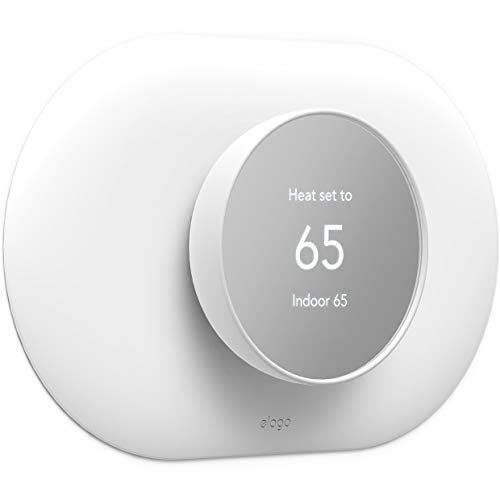
Replacing an old thermostat with the Google Nest Thermostat 2020 leaves most folks staring at a paint rectangle the size of a small picture frame. The elago Wall Plate Cover Plus is a circular polycarbonate trim ring that hides those marks without repainting the wall. It was designed in-house to fit the Nest 2020 footprint precisely, which matters because off-brand plates tend to leave visible gaps.
The Snow finish blends into most light-colored walls, and the polycarbonate material is light enough to mount with standard hardware without pulling away from drywall over time. If you’ve ever tried to spackle and color-match a wall behind a wall-mounted thermostat, the plate covers that mistake in under five minutes.
What Works In Its Favor
- Designed specifically for the Google Nest Thermostat 2020, so the fit hugs the device closely
- Polycarbonate material is durable without feeling bulky on the wall
- Real-world benefit: hides old paint lines, screw holes, and wallpaper seams without repainting
- Snow color reads clean against most white or off-white walls
Some Limits To Know
- Only fits the Nest Thermostat 2020 model; older Nest versions or Nest Learning thermostats need a different plate
- A white finish can read as “too white” against warm-toned walls, in which case the larger Plus 2 model below may suit better
Perfect Match For
Nest Thermostat 2020 owners upgrading from an older rectangular thermostat and wanting a clean wall.
A Better Fit Elsewhere
If your old wall opening is wider than the Plus covers, the elago Wall Plate Cover Plus 2 offers more coverage with the same finish family.
The Plus 2 is the wider sibling of the original elago Wall Plate Cover, built for situations where the hole behind the old thermostat was bigger than usual. Some older thermostats, especially heat-only units or commercial-style wall plates, leave a footprint the regular Plus plate can’t fully cover. That’s exactly what this version was made for.
The circular shape follows the same design language as the original, so the wall still ends up with a tidy, intentional look rather than a square plate on a circular thermostat. Installation is the same straightforward process, with the polycarbonate body keeping things light enough to mount with basic hardware.
Useful Strengths
- Larger coverage area hides oversized holes left by older or commercial thermostats
- Matches the circular design of the Google Nest Thermostat 2020 for a clean visual line
- Polycarbonate build stays light and resists cracking during installation
- Real-world benefit: lets you skip drywall patching on bigger retrofit projects
Where It Is Less Suited
- Oversized coverage can look oversized on small walls or in narrow hallways, depending on placement
- Same Nest 2020-only compatibility as the original Plus plate
Made For
Homeowners with larger wall openings from a previous thermostat that the original Plus plate can’t fully hide.
Reach For A Different Pick When
Your existing hole is already small enough for a standard cover; the elago Wall Plate Cover Plus offers a tighter footprint.
The Spigen wall plate goes one step further than most Nest trim plates by including a metal backplate and four screws in the box. That’s a meaningful upgrade for anyone who’s ever stripped a plastic anchor or had a cover plate slowly pull away from drywall over months of seasonal HVAC cycling.
The urethane coating on the plate helps it shrug off fingerprints and any splashes that happen during installation, and the flush-mount design sits tight against the wall rather than floating out a few millimeters. Spigen is better known for phone accessories, and you can see that build attention translated here.
A Strong Showing
- Metal backplate plus four screws provides a sturdier mount than plastic-only kits
- Urethane coating resists smudges and dust in high-traffic hallways
- Flush fit keeps the plate tight against the wall for a built-in look
- Real-world benefit: holds up better on drywall that flexes slightly with seasonal humidity changes
Trade Offs
- White finish only in the source data, which limits color-matching on darker walls
- Includes screws but may require a drill if your wall opening is unusually large or uneven
Who Should Grab It
Nest 2020 owners who want a flush-mounted, metal-reinforced plate and don’t mind grabbing a drill for installation.
Where A Sibling Pick Shines
Prefer a polycarbonate-only plate that installs with lighter hardware? The elago Wall Plate Cover Plus is the lighter-weight alternative.
The T701 is the unit you buy when you want to set a temperature and walk away. It’s built around the same T700 platform as the programmable siblings on this list, but skips the weekly schedule entirely. For a vacation home, a rental unit, or any house where nobody’s routine is consistent enough to plan around, that’s a feature rather than a limitation.
The 4 sq. in. blue backlit display shows the current temperature at a glance, and the glow-in-the-dark light button means fumbling for the unit at 2 a.m. doesn’t wake the whole house. Single-stage conventional systems (one heating stage and one cooling stage) are the most common residential setup, and the T701 handles them cleanly.
What Pays Off
- Set-and-forget operation is ideal for rental properties and inconsistent schedules
- Glow-in-the-dark light button avoids flipping on a hallway light at night
- Backed by the same T700 platform reliability as more expensive siblings
- Real-world benefit: fewer buttons mean fewer accidental setting changes by kids or guests
Potential Compromises
- Single-stage only, so it won’t work with multi-stage equipment like the PRO1 T715 supports
- No scheduling means missing the energy savings that even a basic programmable unit can deliver
Best Suited To
Owners of rental properties, guest houses, or households that simply prefer manual temperature control.
Skip It When
You want automated schedules and a multi-stage system; the PRO1 T715 handles both without overcomplicating the install.
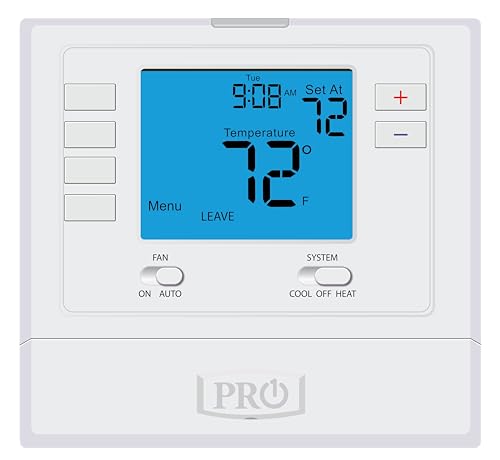
The T715 is the most feature-heavy unit in the PRO1 lineup covered here. It’s designed for 2 heat/2 cool gas systems, meaning the furnace and air conditioner each have two operating stages (low and high) for more precise temperature control. Multi-stage systems run more efficiently at low stage most of the time, only ramping up to high stage during extreme weather.
The 4 sq. in. display matches the rest of the T700 family, but the T715 layers in 7-day, 5/1/1, and non-programmable modes for households that want scheduling flexibility. Battery or hardwire power gives you an installation option depending on what the existing wiring supports.
The Helpful Details
- 2 heat/2 cool compatibility covers the most common multi-stage residential setups
- Three operating modes (7-day, 5/1/1, non-programmable) fit any household routine
- Battery or hardwire power adapts to whatever wiring is already in the wall
- Real-world benefit: lets a two-stage furnace run at low fire most of the winter, which uses less fuel and runs more quietly
Possible Drawbacks
- More configuration options mean a longer first-time setup than a single-stage unit
- Wiring mismatch is the most widely reported installation snag with multi-stage thermostats
Whose Shelf It Belongs On
Two-stage system homeowners who want scheduled control and the efficiency gains low-stage operation offers.
Another Choice May Suit
Single-stage conventional systems are better served by the PRO1 T701 or PRO1 T805, both of which are simpler to configure.
The T721 is a heat pump and conventional unit rolled into one without the programming layer. For households that don’t follow a weekly schedule but still need flexibility for system type, the T721 covers 2 heat/1 cool heat pump systems plus 1 heat/1 cool conventional systems in a single wall unit.
Like the rest of the T700 family, the 4 sq. in. blue backlit display and glow-in-the-dark light button keep things visible day or night. Power comes from AA batteries or a hardwire connection, depending on what the existing wall wiring can support.
The Good Stuff
- Dual compatibility with both heat pump and conventional configurations
- Non-programmable design keeps daily operation to a simple set-and-forget dial
- Battery or hardwire power gives installers flexibility during retrofits
- Real-world benefit: lets a homeowner swap heating systems later without re-buying a thermostat
A Few Limitations
- No scheduling, which limits its appeal in main living areas with predictable routines
- Less common configurations (3 heat, multi-stage cooling) require a more capable unit like the PRO1 T715
Right Fit For
Households with heat pump setups who want flexibility to switch system types without buying a new thermostat later.
Not Your Match When
You want scheduled comfort that adjusts automatically across the week; the PRO1 T725 covers heat pump systems with full scheduling.
The T805 closes the list with the largest screen in the PRO1 lineup at 7 sq. in., which is a meaningful upgrade for anyone who finds themselves squinting at smaller displays from across the room. It’s part of the newer T800 platform and sits at the top of PRO1’s single-stage offerings.
Single-stage conventional systems remain the most common residential setup, and the T805 supports 7-day, 5/1/1, and non-programmable modes so you can pick how much scheduling fits your life. Glow-in-the-dark light button and blue backlit display handle visibility across hours of the day.
The Value In It
- 7 sq. in. display is roughly 75% larger than the 4 sq. in. screens on T700-platform units
- Three operating modes let you keep scheduling or run it as a basic manual thermostat
- T800 platform design brings updated ergonomics over the older T700 family
- Real-world benefit: easier to read from across a large living room or for anyone with vision concerns
Factors To Consider
- Single-stage only; multi-stage heating or cooling requires a unit like the PRO1 T715
- Larger display takes up more wall space, which may be a concern in narrow hallways
Made For
Single-stage conventional homeowners who want scheduling flexibility and a noticeably larger display.
Consider Something Else When
You run a heat pump system; the PRO1 T725 covers heat pump setups with the same scheduling range.
What To Weigh Before Picking A New Wall Thermostat
System compatibility comes first. A heat pump (a system that transfers heat between indoors and outdoors rather than burning fuel to create it) needs a thermostat that supports the auxiliary or emergency heat wiring your equipment uses, and a multi-stage furnace needs terminals for low and high fire. Mismatched wiring is the single most common reason a new thermostat doesn’t behave correctly after installation.
Display size matters more than people expect. A 4 sq. in. screen works fine in a hallway, but in a large living room or for anyone with less-than-perfect vision, a 7 sq. in. display like the PRO1 T805’s reads cleanly from across the room.
Scheduling versus simplicity is the next fork. Households with predictable routines usually save meaningful energy with even a basic 5/1/1 schedule. Households with constantly shifting days often prefer a non-programmable unit like the PRO1 T701 or T771 that just holds the set temperature.
Power source and wall condition round out the practical checks. Battery-only units install easily on any wall, while hardwire units pull continuous power from the HVAC system but require a common wire (a “C-wire” that completes the 24V circuit) for stable operation. If you’re switching from a Nest 2020 to a wall thermostat, or vice versa, a wall plate from elago or Spigen hides the old paint lines without repainting.
Key Considerations Across These Picks
Where Shoppers Go Wrong
The most common mistake is grabbing a thermostat without checking the existing system’s stage count and type. A unit rated for 1 heat/1 cool conventional won’t run a heat pump correctly, and a single-stage thermostat can’t drive a two-stage furnace through both operating levels.
Another slip is assuming any thermostat will fit the existing wall opening. The Google Nest Thermostat 2020 has a smaller footprint than many older rectangular thermostats, which is why wall plates from elago and Spigen exist. Measure the hole before ordering.
What The Higher Tier Buys
Multi-stage programmable units like the PRO1 T715 cost more because they handle equipment that runs at multiple output levels, not just on or off. That extra capability translates into quieter operation and more efficient fuel use during mild weather.
Larger displays and glow-in-the-dark buttons aren’t lifesavers, but for anyone who adjusts the temperature without turning on a light, the upgrade is worth a few dollars. Newer platform designs (T800 versus T700) typically bring updated ergonomics and slightly cleaner interfaces, though core functionality stays comparable.
Frequently Asked Questions
How do I know whether my home uses a heat pump or a conventional system?
Heat pump systems usually have an outdoor unit that runs year-round and an indoor air handler, while conventional systems have a separate furnace (gas, electric, or oil) and air conditioner. Look at your outdoor unit; if it runs even in winter, it’s almost certainly a heat pump.
Can I install a programmable thermostat myself?
Most homeowners with basic electrical comfort can install a wall thermostat themselves, but the wiring must match the terminals on the new unit exactly. If you’re switching from single-stage to multi-stage, or adding a C-wire, professional help is usually worth it.
Why does a Google Nest Thermostat 2020 need a wall plate?
The Nest 2020 has a smaller footprint than most older rectangular thermostats, leaving visible paint lines, screw holes, or wallpaper seams around the new installation. A trim plate covers those marks without repatching or repainting the wall.
What does “C-wire” mean and do I need one?
The C-wire, or common wire, completes the 24-volt circuit that powers a thermostat continuously. Smart and some programmable units need one for stable operation, while simpler battery-powered units like the PRO1 T701 don’t.
How often should a wall thermostat be replaced?
Most wall thermostats last 10 to 15 years before the internal sensors drift or the buttons wear out. If your current unit is older than that, or if temperatures stop matching your standalone thermometer, replacement is usually the right call.
Bottom Line
A new thermostat only earns its place when it matches the system behind your wall and the routine of the household using it. Heat pump owners get the most from a programmable unit like the PRO1 T725, while single-stage conventional homes run cleanly on the PRO1 T701 or T805. For Nest installations, a wall plate from elago or Spigen solves the cosmetic side of the upgrade without a paintbrush. Pick the unit that fits your equipment, and the rest of the decision tends to fall into place.