Managing climate across offices, server rooms, storefronts, or multi-zone rentals gets messy fast when each space runs on its own dial. The right connected thermostat keeps temperatures steady, logs runtimes, and trims energy bills without constant babysitting. This list breaks down ten solid options worth your attention this year, from simple wall units to learning smart thermostats.
How The Shortlist Stacks Up

PRO1 T725 Heat Pump/Conventional Programmable Wall Thermostat (2 Heat/1 Cool)
PRO1 T771 Single Stage Non-Programmable Wall Thermostat
Honeywell TH1100DV1000 PRO 1000 Vertical Thermostat

PRO1 T701 Single Stage Non-Programmable Wall Thermostat
PRO1 T715 Multi-Stage Programmable Gas Thermostat (2 Heat/2 Cool)

Heagstat NonProgrammable Thermostat 1 Heat/1 Cool (White Backlight)

PRO1 T721 Non-Programmable Wall Thermostat (2H/1C Heat Pump)
PRO1 T805 Single Stage Programmable Wall Thermostat

Google Nest Learning Thermostat (4th Gen) + Temperature Sensor (Obsidian)

Google Nest Learning Thermostat (4th Gen) + Temperature Sensor (Silver)
A Breakdown Of The Leading Choices
The PRO1 T725 walks the line between heat pump and conventional control without forcing a second device. It supports 2 heat/1 cool heat pump systems as well as 1 heat/1 cool conventional setups, making it a useful bridge for properties where the equipment has been upgraded piecemeal over time.
Compared with the simpler T701 covered later, this unit adds full 7-day or 5/1/1 programmability, which matters for offices that follow weekday schedules. The 4 sq. in. blue backlit screen stays readable in dim hallways, and the schedule presets (wake, leave, return, sleep) give installers a familiar framework.
Good Reasons To Consider
- Dual-mode compatibility removes the need to swap thermostats when a heat pump replaces a furnace.
- 7-day or 5/1/1 programming trims runtime in unoccupied zones, cutting utility overhead over a billing cycle.
- Backlit display remains legible in storage rooms, basements, and dim retail back offices.
- Sits on the proven T700 platform shared with other PRO1 units, simplifying training for maintenance crews.
Things To Consider
- Not a connected thermostat on its own, so you miss remote monitoring unless paired with a separate gateway.
- Setup menus can feel dense for first-time installers who rarely touch multi-stage equipment.
Key Specs
Built With In Mind
Light commercial spaces with mixed heat pump and conventional equipment, especially where scheduling flexibility matters.
Look Elsewhere When
The PRO1 T715 Multi-Stage Programmable Gas Thermostat suits properties running true 2H/2C gas systems needing broader staging control.
The PRO1 T771 is built for spaces most thermostats ignore: uninsulated garages, utility sheds, and workshops. Its 25°F to 90°F setpoint range handles freeze-protection duty where other residential units refuse to go low.
For commercial property managers overseeing mixed-use buildings, this unit fills the gap between occupied offices and storage zones that still need temperature monitoring. The non-programmable design keeps adjustments manual, which works fine when occupants change daily.
Noteworthy Benefits
- Wide low-temperature range protects pipes and equipment in unheated outbuildings.
- 4 sq. in. blue backlit display gives clear readouts in dim utility rooms.
- Swing adjustment and calibration controls let installers fine-tune cycling behavior.
Points To Keep In Mind
- No scheduling means manual setpoint changes for shift patterns.
- Lacks connectivity, so off-site monitoring requires a separate sensor system.
The Right Fit
Garages, sheds, workshops, and similar outbuildings needing reliable single-stage heating or cooling control.
Reach For A Different Pick When
The Heagstat NonProgrammable Thermostat covers 1H/1C forced-air systems with cleaner white backlighting for finished interiors.
The Honeywell TH1100DV1000 takes a different path with its vertical orientation and heat-only focus. At roughly 4.7 inches tall by 2.9 inches wide, it fits narrow wall cavities common in older buildings and baseboard-heated spaces.
Premier white housing and a straightforward dial keep the interface approachable for occupants who don’t want to learn a touchscreen. For landlords managing rental units with conventional boilers or electric baseboards, this unit does the job without extra wiring complications.
What Earns Its Place
- Vertical layout fits tight wall pockets where horizontal thermostats crowd the trim.
- Heat-only design streamlines installation in baseboard and boiler-fed properties.
- Premier white finish blends with most commercial interiors without custom painting.
Some Limits To Know
- No cooling stage means it cannot control AC circuits on its own.
- Owners commonly report the lack of scheduling requires daily manual adjustment in shared spaces.
Quick Facts
Whose Shelf It Belongs On
Property managers maintaining older buildings with heat-only baseboard or boiler systems and tight wall cavities.
A Better Fit Elsewhere
The PRO1 T701 Single Stage Non-Programmable Wall Thermostat handles 1H/1C conventional systems with a horizontal layout and glow-in-the-dark button.
The PRO1 T701 keeps things simple for owners who want set-and-forget control without learning curves. It targets 1H/1C conventional systems, the most common configuration in small offices, storefronts, and mixed-use buildings.
A glow-in-the-dark light button is a small touch that pays off in storage rooms and back offices where lights stay off. Compared with the Honeywell TH1100DV1000 covered above, this unit adds cooling support and uses a horizontal layout familiar to most installers.
Everyday Wins
- Glow-in-the-dark button keeps adjustments possible during a power blip or in dark utility rooms.
- 4 sq. in. blue backlit screen balances readability with a compact wall footprint.
- Non-programmable operation avoids schedule drift when tenants come and go.
Worth Bearing In Mind
- No remote access means off-site temperature checks require a separate sensor.
- Single-stage design caps performance on properties with multi-speed equipment.
Best Suited To
Small offices, shops, and rental units with straightforward 1H/1C conventional HVAC and minimal occupant turnover.
Swap It Out When
The PRO1 T805 Single Stage Programmable Wall Thermostat offers scheduling and a larger display for spaces where visibility matters.
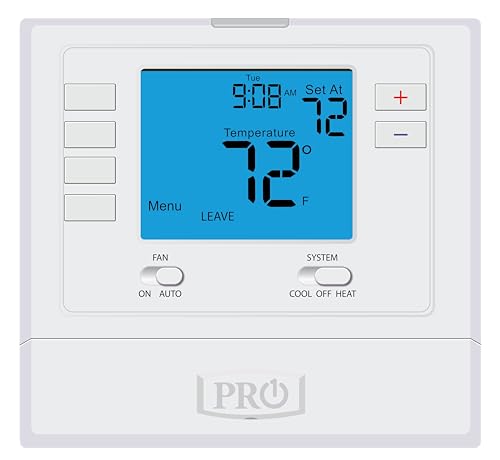
The PRO1 T715 steps up for buildings running two-stage heating and cooling, common in mid-size offices with zoned gas furnaces. It supports 2H/2C gas systems with flexible 7-day, 5/1/1, or non-programmable modes depending on how the space is used.
For property teams managing multiple tenants, the ability to flip between programmable and manual operation per unit simplifies tenant turnover. The T700 platform carries the same 4 sq. in. blue backlit display found on the T701, so visual consistency helps across portfolios.
Useful Highlights
- Multi-stage support reduces temperature swings by staging equipment rather than hard-cycling.
- Flexible scheduling modes suit both owner-occupied and tenant-managed properties.
- Battery or hardwire power options ease retrofit installations without rewiring.
Practical Considerations
- Setup requires familiarity with multi-stage wiring, which can extend install time.
- Overkill for properties running single-stage HVAC where the T701 already covers the load.
Feature Snapshot
Who Should Grab It
Mid-size commercial properties with two-stage gas furnaces seeking finer temperature modulation and flexible scheduling.
Consider Something Else When
The PRO1 T725 Heat Pump/Conventional Programmable Wall Thermostat fits buildings mixing heat pump and conventional equipment on a single stage.
The Heagstat NonProgrammable Thermostat targets the most common residential and light commercial setup: 24VAC forced-air systems with one heating and one cooling stage. It supports gas, oil, and electric furnaces paired with a separate outdoor AC condenser.
For owners replacing outdated mercury-bulb units, the white backlight brings a modern feel without adding app-based complexity. Compatibility tops out at five wires, which covers most pre-2020 installs but excludes more elaborate multi-stage retrofits.
Notable Upsides
- Lower cost than PRO1 alternatives while still covering standard 1H/1C installations.
- White backlighting reads cleanly against neutral wall finishes in lobbies and waiting rooms.
- Five-wire compatibility matches the majority of legacy residential and light commercial setups.
Potential Drawbacks
- Not compatible with heat pump or multi-stage systems, limiting future HVAC upgrades.
- No remote access means off-site adjustments still require someone on premises.
Who It Suits Best
Budget-conscious owners replacing basic thermostats in homes, small shops, or offices running standard forced-air HVAC.
Where Another Pick Suits Better
The PRO1 T721 Non-Programmable Wall Thermostat serves properties mixing heat pump and conventional equipment on the same wall plate.
The PRO1 T721 bridges the gap for properties transitioning between heat pump and conventional systems. It supports 2H/1C heat pump or 1H/1C conventional setups, giving installers flexibility when the equipment on site doesn’t match the building’s original specs.
AA battery or hardwire power options keep retrofit jobs simple, and the 4 sq. in. blue backlit display matches the T700 family covered earlier. For mixed-use buildings where some units heat with heat pumps and others run conventional furnaces, the T721 keeps the wall hardware consistent.
Bright Spots
- Dual-mode capability handles heat pump or conventional wiring without a different SKU on the truck.
- Glow-in-the-dark light button aids adjustments in dim mechanical rooms.
- Battery or hardwire power accommodates older buildings lacking a C-wire.
Honest Caveats
- Non-programmable operation requires manual setpoint changes between occupied and vacant hours.
- Not a learning or connected thermostat, so energy reports require third-party monitoring.
Made For
Property managers handling hybrid HVAC installations where heat pumps and conventional systems share wall hardware.
Skip It When
The PRO1 T725 Heat Pump/Conventional Programmable Wall Thermostat adds 7-day scheduling for spaces needing automated shifts.
The PRO1 T805 belongs to the larger T800 platform, and the difference shows up immediately in its 7 sq. in. blue backlit display. That extra screen real estate helps occupants read setpoints and schedules from across a waiting room or large office.
It targets 1H/1C conventional systems with 7-day, 5/1/1, or non-programmable modes, giving installers one SKU for both scheduled and manual properties. Compared with the T701 covered earlier, the upgrade brings scheduling plus a substantially larger display without changing the system compatibility.
Strong Points
- Extra-large 7 sq. in. display improves readability in spacious interiors and high-traffic areas.
- Flexible programming modes suit owner-occupied, tenant-managed, and shared-use properties alike.
- Glow-in-the-dark light button keeps the device usable during overnight maintenance checks.
Less-Strong Areas
- No Wi-Fi connectivity, so remote monitoring requires an additional gateway device.
- Larger display consumes more wall space, which can crowd narrow baseboard trim.
Feature Card
Perfect Match For
Lobbies, waiting rooms, and open-plan offices where occupants need to read the thermostat at a glance.
Where A Sibling Pick Shines
The PRO1 T715 Multi-Stage Programmable Gas Thermostat handles 2H/2C systems for properties running larger two-stage equipment.
The Google Nest Learning Thermostat (4th gen) marks a noticeable jump from the wall-mount units covered above. It builds a schedule around your routines over time, adjusting heating and cooling based on when spaces are actually in use rather than fixed clocks.
Including a Nest Temperature Sensor (2nd gen) in the kit adds secondary readings from another room, helping the thermostat balance hot and cold spots. The Obsidian finish gives it a polished look suitable for design-conscious offices and showrooms.
The Good Stuff
- Adaptive learning trims wasted runtimes by matching output to actual occupancy patterns.
- Remote app access lets property managers check and adjust temperature from anywhere.
- Included temperature sensor extends balanced comfort to a second zone or hard-to-reach room.
Trade-Offs To Consider
- Learning behavior takes a couple of weeks to settle, so early savings appear modest.
- Wi-Fi dependency means a network outage removes remote access until service returns.
Who Will Love This
Connected offices, showrooms, and design-driven spaces where remote monitoring and adaptive scheduling justify the price jump.
Not Your Match When
The PRO1 T715 Multi-Stage Programmable Gas Thermostat suits properties that need 2H/2C staging without app-based control.
The Silver edition of the Google Nest Learning Thermostat (4th gen) delivers identical core functionality to the Obsidian version covered above, just in a lighter finish that suits clinical, retail, and minimalist interiors.
Pairing the thermostat with the included Nest Temperature Sensor (2nd gen) makes it useful for offices where one room always runs hot or cold relative to the main wall location. Sensor placement can be moved as layouts shift, which matters in coworking spaces and rotating tenant configurations.
Where It Helps
- Sensor-driven zoning balances temperatures across rooms with uneven sun exposure or insulation.
- Light Silver finish blends with clinical, retail, and modern industrial interiors.
- Remote monitoring keeps managers aware of HVAC behavior even off-site.
Factors To Consider
- Single included sensor covers one secondary zone; larger properties may need additional units.
- Full functionality depends on a stable Wi-Fi connection and a working common wire for power.
Right Fit For
Multi-room offices, clinics, and retail interiors where one wall reading doesn’t represent the whole space.
Where Another Pick Suits Better
The PRO1 T805 Single Stage Programmable Wall Thermostat handles 1H/1C conventional systems without requiring Wi-Fi or app connectivity.
Choosing Commercial Wifi and Wall Thermostats That Actually Fit
Start by matching the thermostat to the equipment, not the other way around. Count the wires at the existing wall plate, identify whether the system is heat pump or conventional, and confirm how many heating and cooling stages the equipment supports. Picking a unit that exceeds the system’s capacity adds cost without adding comfort.
Think about who adjusts the thermostat and how often. In tenant-managed rentals, a non-programmable unit like the PRO1 T701 or the Honeywell TH1100DV1000 keeps things simple and prevents schedule drift. Owner-occupied offices benefit from programmable options such as the PRO1 T725 or T805, which trim runtime when the building sits empty.
Decide whether remote monitoring matters more than scheduling. Connected thermostats like the Google Nest Learning Thermostat add convenience through app control and learning behavior, but they require a stable Wi-Fi connection, a common wire (the “C-wire” that delivers continuous power), and tolerance for cloud dependency. Buildings with spotty internet or strict IT policies may prefer hardwired units that operate entirely on the local network.
Key Considerations Across These Picks
Mistakes Worth Dodging
The most common error is buying a thermostat with more stages than the equipment supports. A 2H/2C unit on a single-stage system wastes money and may behave unpredictably during staging transitions. Verify your HVAC configuration before choosing.
Another pitfall is overlooking the C-wire requirement. Many Wi-Fi thermostats draw continuous power and need a common wire, which older buildings often lack. Pulling a new cable adds labor cost, so check existing wiring before committing to a connected model.
The Upgrade Payoff
Higher-tier picks like the Google Nest Learning Thermostat earn their premium through adaptive scheduling, remote access, and sensor-based zoning. For owners juggling multiple properties or those simply wanting app-based control, that combination trims energy bills and oversight time.
Multi-stage programmable units like the PRO1 T715 justify their step up over single-stage models by reducing temperature swings. Two-stage heating and cooling modulates output rather than hard-cycling, which extends equipment life and improves comfort in extreme weather.
Frequently Asked Questions
Do commercial thermostats require Wi-Fi to work?
No, only connected models need Wi-Fi. Units like the PRO1 T701 and Honeywell TH1100DV1000 run entirely on local wiring, making them reliable in buildings with restricted networks or spotty internet.
How do I know if I have a heat pump or conventional system?
Heat pumps typically run both heating and cooling from a single outdoor unit, while conventional systems pair a furnace with a separate AC condenser. Check the outdoor unit label or your original install paperwork, or consult an HVAC technician before purchasing.
What is a C-wire and why does it matter?
A C-wire, or common wire, delivers continuous 24VAC power to the thermostat. Connected models often require it to stay online without draining batteries. Buildings without a C-wire may need a power adapter or a new wire run during installation.
Can I install these thermostats myself?
Most wall-mount units are designed for straightforward DIY replacement on standard low-voltage systems. However, multi-stage or heat pump configurations benefit from professional installation to confirm wiring and staging behavior.
How does a temperature sensor improve comfort?
A remote sensor reports the temperature from a different room, letting the thermostat prioritize that zone. This helps spaces where the main wall location sits in a hallway or near a draft, while the actual occupied room runs hot or cold.
Closing Remarks
The right thermostat comes down to your equipment, your occupants, and how much remote oversight you actually want. Walk the building, count the wires, and pick a unit that matches what’s already on the wall. Comfort and efficiency follow naturally when the hardware fits the system.