Running a commercial space means juggling comfort, efficiency, and the inevitable question of whether anyone can actually read the thermostat from across the room. Picking a wall control that holds up to daily use, syncs with the wider HVAC system, and keeps tenants happy requires more than just grabbing the first familiar brand on a shelf. The lineup below covers both straightforward wired units and full app-connected models, so office managers, property supervisors, and small-facility owners can match hardware to their actual equipment.
The Picks In Brief
Honeywell TH1100DV1000 PRO 1000 Heat Only Thermostat

PRO1 T725 Heat Pump/Conventional Programmable Thermostat

Heagstat Non-Programmable Thermostat 1 Heat/1 Cool

Honeywell TL7235A1003 Line Volt Pro 240V Thermostat

PRO1 T701 Single Stage Non-Programmable Thermostat
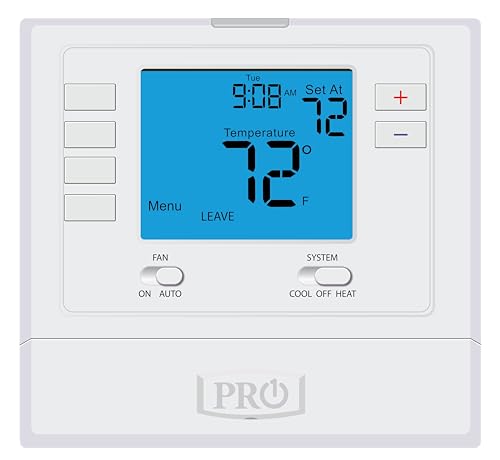
PRO1 T715 Multi-Stage Programmable Gas Thermostat

ecobee Smart Thermostat Premium with Smart Sensor

PRO1 T721 Heat Pump/Conventional Non-Programmable Thermostat

ecobee SmartSensor 2-Pack

ecobee Smart Thermostat Enhanced
Why These Options Stand Out
The Honeywell TH1100DV1000 PRO 1000 keeps things deliberately simple, a vertical-strip layout that suits narrow wall placements behind a door or inside a service corridor. It’s a single-stage heat-only unit, so it’s most useful for boiler rooms, storage closets, or back-office mechanical spaces that only need one temperature call.
The premier white face and roughly 1 1/8 inch depth let it sit nearly flush against drywall, which matters in tight commercial interiors where protrusions snag on carts. Maintenance crews tend to favor it because the absence of programming removes the most common source of tenant complaints: a schedule that no longer matches office hours.
Noteworthy Benefits
- Vertical layout fits narrow wall sections that standard horizontal thermostats cannot cover
- Premier white finish blends with standard commercial wall paint for a discreet look
- Heat-only design strips away scheduling complexity, which reduces tenant tampering
- Compact 1 1/8 inch depth keeps the unit close to the wall, reducing snag risk in service corridors
Honest Caveats
- No cooling capability, so it cannot replace a thermostat in mixed heating and cooling zones
- Lacks any wireless connectivity, which limits remote management across multi-tenant properties
Feature Snapshot
Made For
Facility managers running single-stage heating systems in utility rooms, storage closets, or any commercial space where cooling is handled elsewhere.
Where Another Pick Suits Better
Offices that need both heating and cooling should look at the Heagstat Non-Programmable Thermostat 1 Heat/1 Cool for a straightforward single-stage upgrade with broader system coverage.
The PRO1 T725 sits on the T700 platform, which is a shared base of components that PRO1 uses across several wall models, making parts and service documentation relatively consistent. It supports both 2 heat/1 cool heat pump systems and 1 heat/1 cool conventional setups, which is a welcome feature for older buildings that have been retrofitted with mixed equipment over the years.
The roughly 4 square inch blue-backlit screen is large enough to glance at from across a conference room, and the wake, leave, return, sleep schedule blocks are built for commercial workdays. Programming options include 7-day or 5/1/1 schedules, the latter meaning weekdays share one routine while Saturday and Sunday each get their own.
Notable Gains
- Handles heat pump and conventional wiring in one unit, simplifying retrofit decisions
- 5/1/1 programming matches typical commercial weekday plus weekend scheduling needs
- Backlit display remains readable from across a larger office or waiting area
Trade-Offs To Consider
- Two heat stages is the cap, so properties with three-stage equipment should look elsewhere
- No built-in WiFi, which limits remote scheduling for off-site facility managers
Right Fit For
Buildings running mid-size heat pump equipment with conventional backup, where a maintenance team prefers a familiar wall-mounted controller over a full app-based system.
A Better Fit Elsewhere
Owners who want app-based scheduling and remote access will find the ecobee Smart Thermostat Enhanced a more suitable WiFi-connected alternative.
The Heagstat Non-Programmable unit targets a very specific niche: 24-volt AC conventional single-stage systems with up to five wires. That rules out heat pumps and multi-stage equipment, but for small offices running a standard gas furnace matched with a separate air-conditioning condenser, the fit is direct and uncomplicated.
The white backlight is a small touch that pays off in dim hallways or after-hours when a maintenance worker checks the setpoint. Since there is no scheduling layer, the wall thermostat behaves more like a digital thermometer with up and down arrows than a programmable unit, which some property managers specifically request to discourage tenant tinkering.
Where It Excels
- Two-to-five wire compatibility covers the most common small-office HVAC wiring layouts
- Single-stage design keeps the installation and setup process straightforward
- White backlight improves readability in low-lit commercial hallways
Some Limits To Know
- Six-to-eight wire configurations are not supported, which excludes many newer multi-stage installs
- Heat pump systems are explicitly incompatible, so this is not a swap-in for those properties
- No scheduling or wireless connectivity, limiting energy-management potential
Feature Card
Best Suited To
Small business owners with a basic single-stage furnace and air-conditioner setup who want a no-frills digital wall control without app overhead.
Skip It When
Properties running heat pump or multi-stage conventional equipment should choose the PRO1 T725 for its broader compatibility.
The Honeywell TL7235A1003 lives in a different electrical world from the low-voltage models earlier in this list. It is a 240-volt line-voltage thermostat, the kind wired directly to electric baseboard heaters or other 240V heating circuits. For older commercial spaces with electric resistance heat and no central air handler, this is often the only compatible choice without major rewiring.
The on-demand backlight is practical in low-light mechanical rooms, and the soundproof operation reduces the audible click that traditional mechanical thermostats produce when relays engage. The at-a-glance heating indicator gives technicians a quick visual confirmation without needing a multimeter.
Reasons It Performs
- Direct 240V control eliminates the need for a separate relay panel on electric baseboard zones
- On-demand backlight activates only when needed, saving wear on the display
- Heating indicator light confirms call-for-heat at a glance during service checks
- Silent relay operation suits offices where thermostat clicking is a complaint
Points To Keep In Mind
- 240V installation carries higher electrical risk and may require a licensed installer
- Not designed for cooling circuits, so cooling-only zones need a different model
- Lacks scheduling or app features, which limits automated setback strategies
Whose Shelf It Belongs On
Contractors and maintenance teams handling electric baseboard heating in offices, studios, or converted retail spaces where 240V circuits already exist.
Look Elsewhere When
Buildings with central forced-air HVAC should consider the PRO1 T701 Single Stage Non-Programmable Thermostat for a standard low-voltage wall solution.
The PRO1 T701 sticks to the basics on purpose. It’s a non-programmable single-stage wall unit for 1 heat/1 cool conventional systems, designed for properties that already have a working furnace and air-conditioner and just want a clean, reliable wall control without the complication of WiFi pairing.
The roughly 4 square inch blue-backlit display is shared across the T700 line, so anyone familiar with the larger PRO1 family will recognize the layout. A glow-in-the-dark light button is a small but thoughtful addition for after-hours service checks or emergency adjustments during a power-restored situation.
The Helpful Details
- Glow-in-the-dark light button improves usability during nighttime service visits
- Common T700 platform simplifies cross-training for maintenance staff
- Backlit display offers clear visibility in low-lit back offices
Room For Improvement
- Conventional systems only, so heat pump buildings cannot use this unit
- No scheduling, which limits automated energy savings during unoccupied hours
Quick Facts
Who Should Grab It
Property supervisors who manage simple conventional HVAC systems and prefer a no-app wall thermostat that tenants cannot accidentally de-program.
Consider Something Else When
Buildings that need scheduling flexibility should pick the PRO1 T715 Multi-Stage Programmable Gas Thermostat for weekly scheduling support.
The PRO1 T715 climbs up the capability ladder with 2 heat/2 cool support, meaning it can manage two-stage gas furnaces and two-stage cooling compressors. That gives it room to grow with buildings that have heavier HVAC equipment or zoning valves, a common scenario in mid-size offices and multi-suite commercial floors.
The same T700 backlit screen carries over, and the unit supports 7-day, 5/1/1, or non-programmable modes, which is unusual: most programmable thermostats lock you into scheduling, but here you can switch off scheduling entirely if a particular tenant prefers a manual hold.
What Works In Its Favor
- 2 heat/2 cool stage support covers heavier commercial HVAC equipment
- Three scheduling modes give flexibility for tenant preferences
- Battery or hardwire power options ease installation in retrofits without a common wire
- Backlit glow button improves usability during after-hours service work
Factors To Consider
- Multi-stage wiring can complicate replacement if the existing thermostat used fewer wires
- Lacks WiFi, so remote scheduling still requires a separate smart controller
Who It Suits Best
Mid-size office buildings with two-stage gas furnaces and variable-speed cooling that need precise temperature staging without jumping to a full smart platform.
Reach For A Different Pick When
Smaller properties with single-stage equipment can save complexity by choosing the PRO1 T701 Single Stage Non-Programmable Thermostat instead.
The ecobee Smart Thermostat Premium is the most feature-laden unit in this roundup, built for offices where the wall control does more than just hold a temperature. It includes a built-in air quality monitor, smoke alarm detection through the connected smoke detector sound signature, and a doorbell Live View that pulls from a compatible video doorbell onto the thermostat screen.
The included SmartSensor extends comfort control into the rooms that matter most, so a corner office no longer runs cold while the open floor plan overheats. Built-in Siri and Alexa voice control mean hands-free adjustments during a meeting are possible, which is a notable upgrade over touch-only competitors.
Real Benefits
- Built-in air quality monitor tracks airborne particulates without separate hardware
- Doorbell Live View consolidates front-door awareness onto the wall screen
- Voice assistant support offers hands-free temperature changes during calls
- Included SmartSensor corrects hot and cold spots in partitioned offices
Worth Bearing In Mind
- Premium feature set comes with a steeper learning curve during initial setup
- WiFi dependency means the thermostat loses some smart functions during network outages
Perfect Match For
Tech-forward office suites and managed workspaces where air quality data and voice control are valued alongside standard scheduling.
A Better Fit Elsewhere
Smaller offices that only need reliable WiFi scheduling should consider the ecobee Smart Thermostat Enhanced as a more economical connected alternative.
The PRO1 T721 shares the T700 platform display but trades programmability for broader system compatibility, handling both 2 heat/1 cool heat pumps and 1 heat/1 cool conventional setups in a single SKU. That dual-mode design is genuinely useful in mixed-equipment buildings where some zones use a heat pump and others rely on a conventional furnace.
Power options include AA batteries or a hardwire common wire, which simplifies installation in older buildings where pulling a new common may be impractical. For property managers standardizing on one wall thermostat model across a portfolio, the T721’s dual compatibility reduces the spare-parts inventory they have to keep on hand.
The Value In It
- Dual heat pump and conventional compatibility reduces inventory across mixed portfolios
- Battery or hardwire power eases retrofit work in older buildings
- Backlit display carries over the familiar T700 interface
Where It Is Less Suited
- Non-programmable operation limits automatic setback during unoccupied hours
- Two heat stages is the upper limit, excluding larger commercial HVAC systems
Feature Rundown
Who Will Love This
Multi-property managers who want one thermostat model that covers both heat pump and conventional zones without keeping two SKUs in stock.
Swap It Out When
Facilities that want weekly scheduling should pick the PRO1 T725 instead for full programmable control over the same equipment range.
The ecobee SmartSensor 2-Pack is not a thermostat on its own; it pairs with a compatible ecobee main unit to extend sensing into additional rooms. Each sensor uses infrared technology to detect whether a space is occupied and reports that information wirelessly to the main thermostat from up to roughly 60 feet away.
For offices divided into private offices, conference rooms, and open collaboration zones, two extra sensors can move the temperature decision from the wall where the main thermostat lives to the room people are actually using. Occupancy-based adjustments also help reduce conditioning of unused rooms during irregular commercial workdays.
Practical Pluses
- Infrared occupancy detection triggers temperature adjustments without manual input
- 60-foot wireless range covers typical commercial floor plans
- Two-pack value lets you instrument both a corner office and a meeting room
Practical Considerations
- Requires a compatible ecobee main thermostat, which adds to total project cost
- Battery-operated sensors need occasional cell replacement, depending on usage patterns
Built With In Mind
Offices already running an ecobee main thermostat who want better temperature accuracy in hard-to-reach corners and meeting rooms.
Another Choice May Suit
Properties without an existing ecobee base unit should start with the ecobee Smart Thermostat Enhanced for the main control plus expand later.
The ecobee Smart Thermostat Enhanced is the more approachable sibling to the Premium model, dropping the built-in air quality monitor and voice assistants in favor of core WiFi scheduling at a friendlier entry point. It works with Apple Watch, smart home platforms like Apple HomeKit, and most voice assistants through the cloud.
The eco+ features automatically nudge temperatures down when the building is unoccupied or when the system detects everyone has left, which is a small but meaningful shift for offices with irregular occupancy. Schedule suggestions and occupancy-based learning reduce the manual tuning many property managers do after every season change.
A Strong Showing
- eco+ features provide automatic setback during unoccupied hours without manual scheduling
- Apple Watch support lets facility staff adjust setpoints from a wrist device
- Schedule suggestions adapt as office routines change across seasons
- Lower entry cost than the Premium model while retaining core WiFi scheduling
Points To Note
- No built-in air quality monitoring, unlike the Premium sibling
- WiFi-dependent features are reduced during network outages
The Right Fit
Small and mid-size offices that want connected scheduling and occupancy-based adjustments without paying for premium extras like built-in voice control.
Not Your Match When
Buildings that need air quality tracking or on-device voice control should step up to the ecobee Smart Thermostat Premium instead.
What To Weigh Before Choosing Wifi Thermostats For Commercial Buildings
Match The Thermostat To The HVAC System First
Before any feature comparison, confirm what equipment the wall control will actually manage. Single-stage conventional, multi-stage conventional, heat pump, and 240-volt line-voltage electric heat each demand a different terminal count and wiring pattern. A 2H/1C heat pump controller is not a drop-in replacement for a basic 1H/1C conventional wall unit, and forcing the wrong match is the most common cause of HVAC short-cycling or failed installation. Count the wires at the existing wall first, since some non-programmable models reject six-to-eight wire configurations entirely.
Decide How Much Scheduling You Actually Need
Programmable thermostats earn their keep in buildings with predictable weekday hours, while non-programmable units tend to serve multi-tenant properties where individual occupants set their own comfort level. For offices open roughly nine-to-five, scheduling layers and app-driven automation can noticeably reduce conditioning of empty rooms after hours. For 24-hour facilities or co-working spaces with rotating tenants, manual hold often makes more sense than an automated schedule that fights the people inside.
Weigh Connectivity Against Complexity
WiFi-connected units like the ecobee line add remote management, occupancy learning, and integration with broader smart building platforms, but they also add network dependency and a slightly steeper setup curve. Wired non-programmable models are simpler to install and service, and they continue working when the office network goes down. Match connectivity to the size of the facility management team: a single owner-operator might benefit more from app alerts, while a contracted maintenance crew may prefer a wall unit that does not require app pairing at every tenant turnover.
Plan For Multi-Zone Comfort Where It Matters
Larger commercial floors often have a single thermostat controlling one zone while another zone runs too hot or cold. SmartSensor add-ons let you extend sensing into problem rooms without rewiring the whole HVAC system, and the main thermostat makes the final call based on weighted averages or active occupancy. For offices with corner suites, server closets, or glass-walled conference rooms, that extra sensor layer usually pays for itself in fewer comfort complaints.
Key Considerations Across These Picks
Common Buying Traps To Sidestep
The most frequent mistake is selecting a thermostat based on the storefront display without checking the equipment label on the existing furnace or air handler. Buyers sometimes assume a WiFi thermostat will work with any 24V system, only to discover the building lacks a common wire, also known as a C-wire, which provides continuous power for WiFi radios. Another trap is overlooking 240V electric baseboard heat, which requires a line-voltage thermostat like the Honeywell TL7235A1003 instead of any low-voltage wall unit on this list. Always confirm wire count, voltage, and stage count before committing.
When Paying Up Earns Its Keep
Premium thermostats like the ecobee Smart Thermostat Premium bundle features that standalone sensors and accessories cannot fully replace, including on-device voice control and air quality monitoring built into the wall unit itself. Spending more generally makes sense when the building has multiple problem rooms, irregular occupancy patterns, or a need for off-site management through a connected app. For simpler single-stage buildings with predictable schedules, the added cost of premium features often goes unused, and a mid-tier wired unit delivers more value per dollar.
Frequently Asked Questions
Do any of these thermostats work with 240V electric baseboard heaters?
Yes, the Honeywell TL7235A1003 Line Volt Pro is designed specifically for 240V line-voltage circuits like electric baseboard heaters. The other models on this list are low-voltage 24VAC units intended for central forced-air systems and will not directly control baseboard heating.
Can ecobee sensors work without an ecobee main thermostat?
No, the SmartSensor 2-Pack is an accessory that requires a compatible ecobee thermostat to function. The sensors report back to the main unit, so without that hub they have nothing to communicate with and will not adjust any HVAC equipment on their own.
What is the difference between 5/1/1 and 7-day programming?
A 5/1/1 schedule uses one shared program for the five weekdays and two separate programs for Saturday and Sunday, which is plenty for most offices. A 7-day schedule assigns a unique program to every day of the week, useful only when each day genuinely needs a different routine.
Will a non-programmable thermostat save energy compared to a programmable one?
Not automatically. A non-programmable unit will hold whatever setpoint someone last left on the wall, so energy performance depends on occupant behavior. A properly programmed unit can reduce conditioning during unoccupied hours, but a programmable thermostat left on a stale schedule can actually waste more energy than a non-programmable unit held at a sensible setpoint.
How many wires does a typical commercial thermostat installation need?
Most low-voltage commercial thermostats need between two and five wires for single-stage systems, and up to eight wires for multi-stage or heat pump setups. The wire count is the single biggest factor in compatibility, and verifying it before ordering avoids the most common retrofit mistake.
The Takeaway
Choosing the right wifi thermostat for a commercial building comes down to matching equipment first, then layering in scheduling and connectivity based on how the space is actually used. Wired non-programmable units serve simpler buildings with predictable comfort expectations, while connected platforms like the ecobee line unlock remote management and occupancy-aware adjustments for offices with more complex rhythms. Whatever the building size, the wall control is only as good as the system it manages, so start with the HVAC hardware and work outward from there.