Older homes and light commercial spaces often run on simplified wiring that newer smart thermostats simply can’t talk to. Two-wire programmable thermostats fit that gap, handling basic heating and cooling without demanding a common wire from the wall. Picking the right one comes down to system type, scheduling needs, and whether you need anything beyond a reliable wall control.
The Shortlist At A Glance

PRO1 T725 Heat Pump/Conventional Programmable Digital Thermostat
PRO1 T771 Single Stage Non-Programmable Wall Thermostat

PRO1 T701 Single Stage Non-Programmable Wall Thermostat
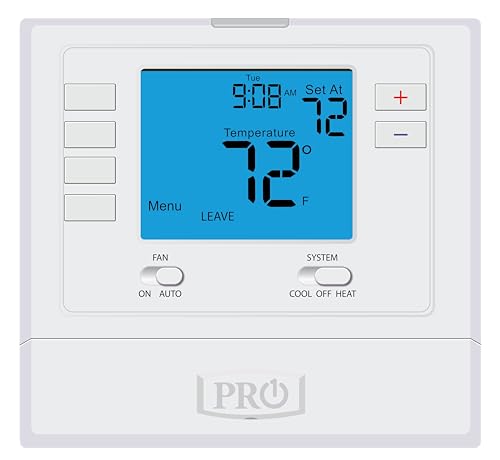
PRO1 T715 Multi-Stage Programmable Gas Thermostat

Heagstat NonProgrammable Thermostat 1 Heat/1 Cool

PRO1 T721 Non-Programmable Wall Thermostat
Google Nest Temperature Sensor 3-Pack

Ventamatic XXFIRESTAT Adjustable Programmable Thermostat
PRO1 T805 Single Stage Programmable Wall Thermostat

Google Nest Learning Thermostat (4th Gen) + Sensor
A Deeper Look At The Lineup
Older homes with a heat pump usually need a thermostat that speaks both pump and conventional language, and the PRO1 T725 handles that dual role without drama. It covers 2 heat/1 cool heat pump setups as well as 1 heat/1 cool conventional systems, which makes it a strong match for households that may switch fuel sources down the road.
The blue backlit display measures roughly four square inches, large enough to read schedules at a glance from across the room. Programming follows a 7-day or 5/1/1 layout, so weekdays, weekends, and individual days can each follow their own routine.
The Case For It
- Supports both heat pump and conventional wiring without needing a different model
- 7-day scheduling lets you tune each day instead of repeating a single weekday plan
- Backlit screen remains readable in dim hallways and night-time checks
- Sits on the proven T700 platform, which tends to simplify installation
Things To Consider
- Not a fit for systems requiring more than 2 heat/1 cool stages
- Programmed schedule can take a session to learn, so first-week setup feels slower than basic dials
Quick Facts
Whose Shelf It Belongs On
Heat pump homeowners who want a single thermostat that handles both heating modes and a modest cooling stage without extra adapters.
Look Elsewhere When
Multi-stage gas furnace owners should reach for the PRO1 T715 Multi-Stage Programmable Gas Thermostat instead, since its 2H/2C support handles the extra stage this unit leaves out.
Not every wall thermostat needs a built-in schedule, and the PRO1 T771 leans into that simplicity. Designed for single-stage conventional systems, it skips scheduling altogether in favor of a wide setpoint range that reaches down to 25°F.
That low-temp ceiling makes it a natural fit for unconditioned spaces where freeze protection matters more than precision. Garages, workshops, and sheds typically run simple furnaces or unit heaters, which is exactly the use case this thermostat targets.
Real Benefits
- 25°F setpoint minimum helps prevent frozen pipes in unheated spaces
- Non-programmable design means no schedule to forget or reprogram after power outages
- Backlit display keeps the readout visible in dim garage lighting
Points To Keep In Mind
- No scheduling means manual adjustment when temperatures shift across seasons
- Limited to 1 heat/1 cool systems, so it won’t serve heat pump or multi-stage setups
Right Fit For
Owners of detached garages, workshops, and sheds who need straightforward freeze protection without the complexity of a weekly schedule.
Skip It When
Main living areas benefit more from the PRO1 T805 Single Stage Programmable Wall Thermostat, which adds 7-day scheduling and an oversized display for daily household routines.
Some households just want a thermostat they can adjust and forget, and the PRO1 T701 delivers exactly that experience. Built for 1 heat/1 cool conventional systems, it skips scheduling in favor of large buttons and a glow-in-the-dark light button for low-light operation.
Compared to the PRO1 T771 reviewed above, this model shares the same T700 platform DNA but targets primary living spaces instead of garages. The wider range of compatible applications makes it a safer default for whole-home use.
The Practical Payoff
- Glow-in-the-dark light button makes nighttime adjustments easier in hallways
- Large 4 sq. in. backlit display reads cleanly from several feet away
- Simple up/down setpoint keeps the controls approachable for less tech-oriented households
Trade Offs
- No programmable scheduling means the same setpoint runs day and night
- Single-stage only, so homes with multi-stage furnaces will need a different thermostat
Who It Suits Best
Minimalist homeowners with a basic furnace-and-air setup who prefer manual control over any sort of weekly programming.
Swap It Out When
Households that want weekend and weekday temperature shifts should pick the PRO1 T805 Single Stage Programmable Wall Thermostat instead, which adds 7-day scheduling to the same single-stage foundation.
Two-stage gas furnaces need a thermostat that understands both low and high fire, and the PRO1 T715 answers that call directly. Built for 2 heat/2 cool systems, it can coordinate a furnace that ramps up gently before kicking to full output on cold mornings.
You get the same T700 platform footprint as earlier picks on this list, but with extra stage capacity and three operating modes: 7-day, 5/1/1, and non-programmable. That flexibility matters for households that want schedules for part of the year and manual control the rest.
Why It Works Well
- 2H/2C support handles two-stage furnaces that single-stage thermostats leave idle on the low stage
- Three programming modes cover households that prefer schedules some months and manual control others
- Glow-in-the-dark light button helps locate the controls during nighttime power blips
- Can run on batteries or hardwired common, simplifying retrofit installs
Honest Caveats
- Programming setup takes longer than the non-programmable PRO1 T701 in the lineup above
- Heat pump owners won’t see full benefit since the unit targets gas furnace systems
Feature Snapshot
Built With In Mind
Households with two-stage gas furnaces who want scheduling flexibility and the option to run the system manually during shoulder seasons.
Reach For A Different Pick When
Heat pump households should consider the PRO1 T725 Heat Pump/Conventional Programmable Digital Thermostat, which addresses the staging logic that a heat pump actually uses.
The Heagstat thermostat fills a specific niche that many modern smart thermostats overlook: it works on systems with only 2 to 5 wires. For older properties where pulling a new common wire through finished walls isn’t realistic, that constraint actually defines who this product serves.
Compatibility covers 24VAC conventional single-stage setups, including gas, oil, and electric furnaces paired with a separate air-conditioning condenser. A white backlight keeps the display readable during evening checks without flooding the room.
A Strong Showing
- Designed for 2 to 5 wire installations where most smart thermostats would refuse to pair
- Works with gas, oil, and electric furnaces on a single-stage conventional setup
- White backlight offers softer nighttime visibility than blue alternatives
Potential Drawbacks
- Connections with 6 to 8 wires won’t fit, so it won’t serve multi-stage retrofits
- Non-programmable design requires manual setpoint changes across the seasons
Perfect Match For
Owners of older single-stage homes with thin thermostat wire bundles who can’t easily run a common wire through finished walls.
Consider Something Else When
Households with proper 5 or 6 wire bundles and weekly routines should pick the PRO1 T805 Single Stage Programmable Wall Thermostat for its 7-day scheduling and oversized display.
Households that may eventually convert from a conventional system to a heat pump often want one thermostat that handles both, and the PRO1 T721 covers that ground without locking you into a single mode. It supports 2H/1C heat pump setups or 1H/1C conventional setups from the same wall unit.
The non-programmable design trades scheduling depth for simplicity, but the glow-in-the-dark light button helps locate the controls during overnight adjustments. AA batteries or hardwired common give you flexibility during the install.
Features That Help
- Heat pump and conventional compatibility from a single thermostat body
- Glow-in-the-dark light button speeds up nighttime interaction in hallways
- Battery or hardwired power accommodates older walls without a common wire
- Backlit display keeps temperature readings clear in low-light conditions
Where It Is Less Suited
- No scheduling means same setpoint runs 24/7 unless adjusted manually
- Single cool stage won’t help households running two-stage AC compressors
Who Will Love This
Homeowners planning a future heat pump conversion who want a thermostat that will keep working through the transition.
A Better Fit Elsewhere
Households that already run 7-day routines should consider the PRO1 T725 Heat Pump/Conventional Programmable Digital Thermostat, which adds scheduling to a similar dual-system foundation.
Single-point thermostats always miss something: a nursery that runs cold at night, a home office that bakes under afternoon sun. The Google Nest Temperature Sensor 3-pack fixes that by reporting room-by-room temperature back to a compatible Nest thermostat.
These sensors don’t replace a wall thermostat, they extend one. You pair them over low-energy Bluetooth (a wireless standard designed for low-power devices) with a Nest Learning Thermostat or Nest Thermostat E, and the system prioritizes the room you care about most at any given time.
What Makes Sense
- Three sensors let you cover a nursery, office, and living room without buying singles
- Low-energy Bluetooth keeps the sensors running for years on small batteries
- Sensor placement takes seconds with no wiring to fish through walls
Practical Considerations
- Requires a compatible Nest thermostat already installed
- Doesn’t function as a standalone wall control, so it supplements rather than replaces
Best Suited To
Existing Nest households that want better comfort in specific rooms without adjusting the main thermostat multiple times per day.
Where A Sibling Pick Shines
Households without a Nest thermostat should pick the PRO1 T725 Heat Pump/Conventional Programmable Digital Thermostat instead, since it operates independently of any smart ecosystem.
Attic ventilation sits outside the normal thermostat conversation, but the Ventamatic XXFIRESTAT earns its place by doing one thing well: controlling power attic ventilators. A built-in firestat cuts power when temperatures climb to 183°F, which protects against the kind of heat buildup that can warp ductwork and damage roofing.
The adjustable bi-metallic switch (a temperature-sensitive mechanical strip that bends as it heats) lets you set the activation range anywhere from 50°F to 120°F using a simple screwdriver. Up to three ventilator units can run off one thermostat, capped at 10 amps total draw.
Practical Pluses
- Built-in firestat at 183°F adds a thermal safety layer that ordinary thermostats lack
- Screwdriver-adjustable setpoint gives precise control over attic fan activation
- Drives up to three ventilator units under a 10-amp shared load
- Wide 50°F to 120°F adjustment range covers most climate zones
Some Limits To Know
- Specialized for attic ventilators, so it won’t replace a living-area thermostat
- Mechanical adjustment requires a screwdriver rather than digital input
Feature Rundown
Who Should Grab It
Homeowners with power attic ventilators who need a replacement thermostat that handles both scheduling and a hard thermal safety cutoff.
Not Your Match When
Households looking for living-area comfort control should pick the PRO1 T701 Single Stage Non-Programmable Wall Thermostat, which targets indoor conventional HVAC instead.
For households where wall thermostat text feels cramped, the PRO1 T805 takes a different approach: a 7 sq. in. backlit display that’s roughly 75 percent larger than the T700 series siblings reviewed earlier. Reading temperatures and schedule entries becomes effortless from across the room.
On the T800 platform, it supports 7-day, 5/1/1, and non-programmable modes for 1 heat/1 cool conventional systems. The glow-in-the-dark light button helps locate the controls during late-night walks to the hallway.
The Upside
- Oversized 7 sq. in. display improves readability for aging eyes or large living spaces
- Three programming modes let you choose between full schedules and manual override
- Glow-in-the-dark light button speeds up late-night adjustments
- Single-stage 1H/1C focus suits most residential conventional HVAC setups
Less Ideal Details
- Larger footprint may not align with previous thermostat mounting marks
- Single-stage only, so multi-stage furnace households should look elsewhere
Made For
Households with vision-impaired members who need a thermostat with text they can actually read from a distance.
Another Choice May Suit
Multi-stage gas furnace homes should pick the PRO1 T715 Multi-Stage Programmable Gas Thermostat, which supports the extra heating stage that this T805 leaves on the table.
The Google Nest Learning Thermostat (4th gen) takes the opposite path from the simple wall controls on most of this list: it learns your routine over time and builds a schedule without manual programming. The included 2nd-generation Nest Temperature Sensor adds room-level priority when a single room matters more than the hallway average.
The Obsidian finish and trim-ring design give it a noticeably different look from the PRO1 plastic shells earlier in the lineup. That’s not for everyone, but for households already running Google Home, the integration is harder to match elsewhere.
Strengths Worth Knowing
- Learning algorithm builds a custom schedule based on your actual temperature changes
- Bundled 2nd-gen sensor addresses the specific room you care about most
- Obsidian finish offers a different aesthetic from typical white thermostat bodies
- Works within the Google Home ecosystem for voice and app-based control
Things To Weigh
- Requires a C-wire (common wire, providing continuous low-voltage power) for full functionality in most installations
- Learning period takes a few weeks before the schedule reflects your preferences
- Higher category positioning than the rest of the picks on this list
Technical Sheet
Whose Shelf It Belongs On
Smart-home enthusiasts already running Google Home who want the thermostat to learn their patterns rather than rely on fixed programming.
Skip It When
Owners of older two-wire homes without a common wire should pick the PRO1 T725 Heat Pump/Conventional Programmable Digital Thermostat, which runs on a simpler 2H/1C foundation without smart-home dependencies.
What To Weigh Before Choosing a Two-Wire Programmable Thermostat
Two-wire programmable thermostats cover a wide range of system types, and the right pick depends mostly on what your HVAC unit actually needs from the wall.
A heat pump home behaves differently from a conventional gas furnace, and that difference shapes which thermostat makes sense. Heat pump owners should look for explicit “2H/1C heat pump” or similar wording, while conventional furnace owners need a unit that lists the same stage count in conventional terms. Mismatches are the most common reason a new thermostat never fires the system correctly.
Wire count matters as much as system type. Many older homes run only two conductors to the thermostat, and pulling a common wire through finished walls isn’t always realistic. The Heagstat model on this list targets exactly that scenario, accepting anywhere from 2 to 5 wires, while most programmable units expect a 5-wire bundle.
Scheduling depth divides the category into two camps. Schedulers like the PRO1 T725 and PRO1 T715 let you set different temperatures for each weekday plus the weekend. Non-programmable picks like the PRO1 T701 and PRO1 T771 keep one setpoint day and night. Households with predictable routines benefit from scheduling; set-and-forget households prefer simpler controls.
Display readability is a smaller but real factor for households with aging members or large living spaces. The PRO1 T805’s 7 sq. in. screen addresses this directly, while the rest of the T700 family sticks to 4 sq. in.
Smart Shopping Habits for Two-Wire Programmable Thermostats
Common Shopping Slip Ups
The most common mistake is choosing a thermostat based on looks rather than system compatibility. A beautiful display means nothing if your two-stage furnace never reaches the second stage. Always confirm the system type and stage count on the existing equipment label before picking a model.
Another trap is assuming every modern thermostat works on two wires. Many smart thermostats need a C-wire for continuous power, and that older two-wire bundle won’t satisfy them. The PRO1 T771 and Heagstat models on this list target that exact scenario.
Where The Extra Money Goes
Higher-tier models like the Google Nest Learning Thermostat (4th gen) add scheduling intelligence and room-level sensing through the bundled sensor. That learning engine saves real adjustment work over time, and the sensor integration addresses a comfort gap that single-point thermostats can’t fill.
The premium also covers ecosystem compatibility, app control, and a more refined build quality. For households already running Google Home, those integrations can justify the step up. For simpler households, the PRO1 T725 or T805 delivers the same core function at a more accessible tier.
Frequently Asked Questions
Can a two-wire programmable thermostat run without a common wire?
Yes, many two-wire programmable thermostats run on battery power or draw small amounts through the heating circuit itself. Models like the PRO1 T715 and PRO1 T721 explicitly support battery operation, which sidesteps the common-wire problem entirely.
Will these thermostats work with a heat pump system?
Some will, but only if the model lists heat pump support. The PRO1 T725 and PRO1 T721 both support 2H/1C heat pump configurations, while the PRO1 T701 and PRO1 T771 are designed for conventional systems only.
How does a programmable thermostat save energy?
A programmable thermostat lets you set higher temperatures during the day when nobody’s home, then cool the house before everyone returns. That kind of routine shift tends to reduce HVAC runtime across an entire heating or cooling season.
Do all programmable thermostats need batteries?
Most battery-powered models use AA cells that typically last a year or longer under normal use. Units with a common-wire connection run on the HVAC system power and don’t require battery changes.
Can I install a two-wire programmable thermostat myself?
Many homeowners handle the swap themselves with basic tools, but the wiring varies by system. If the existing wires aren’t clearly labeled or the system type isn’t obvious, a quick call to an HVAC technician avoids miswiring.
The Takeaway
Two-wire programmable thermostats cover a quieter corner of the HVAC world, the homes that can’t easily run new wires but still want better control than an analog dial delivers. The right pick depends on your system type, scheduling needs, and whether you want smart-home integration or simpler standalone operation.
A heat pump home points toward the PRO1 T725, a garage or shed leans toward the PRO1 T771, and a smart-home household ready for the upgrade lands on the Google Nest Learning Thermostat (4th gen). Match the thermostat to the system first, and the rest of the decision gets much easier.