A thermostat quietly runs the show in most homes, yet it rarely gets attention until the system acts up. Auto changeover thermostats take that decision out of your hands by switching between heat and cool based on the room temperature and your setpoint. For households with central HVAC, that means fewer manual tweaks between seasons and steadier comfort year-round. The ten picks below cover common system types, from single-stage conventional setups to multi-stage gas and heat pump equipment. There’s also a commercial-grade option for light commercial spaces and a line-voltage model for electric baseboard or radiant systems. Browse based on the equipment you already have wired into the wall, and you’ll likely find a clean fit in this list.
A Closer Look At The Lineup

PRO1 T725 Heat Pump/Conventional Programmable Digital Wall Thermostat
PRO1 T771 Single Stage Non-Programmable Wall Thermostat
Honeywell TH1100DV1000 PRO 1000 Heat Only Vertical Thermostat

PRO1 T701 Single Stage Non-Programmable Wall Thermostat
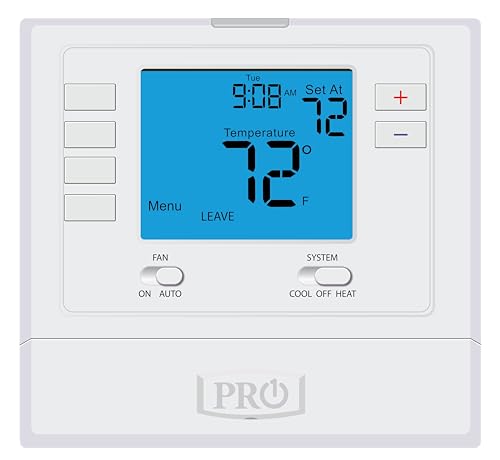
PRO1 T715 Multi-Stage Programmable Gas Thermostat

Heagstat NonProgrammable Thermostat 1 Heat/1 Cool

Honeywell TL7235A1003 Line Volt Pro 240-Volt Thermostat

PRO1 T721 Non-Programmable Wall Thermostat

Venstar T2800 Commercial Platinum Slimline Thermostat
PRO1 T805 Single Stage Programmable Wall Thermostat
Taking A Closer Look At The Options
The PRO1 T725 covers more equipment types than most thermostats in its price range, which is the first thing that sets it apart from picks like the Honeywell TH1100DV1000. It handles 2 heat/1 cool heat pump configurations as well as 1 heat/1 cool conventional setups, so a homeowner who switches fuel sources or replaces a heat pump with a furnace won’t need a new wall unit.
A 4 sq. in. blue backlit screen sits at the heart of the interface, and the schedule mode walks through wake, leave, return, and sleep periods on a 7-day or 5/1/1 plan. For most households, that means the thermostat learns your weekly rhythm and dials in comfort automatically without daily tinkering.
The Value In It
- Dual-mode compatibility covers heat pump and conventional equipment on a single wall unit, sparing you a replacement if the system changes.
- Programmable scheduling with 7-day and 5/1/1 options gives flexibility for shift workers or households with rotating routines.
- The blue backlit display improves low-light legibility for hallway or bedroom installations.
- Schedule presets (wake, leave, return, sleep) make the programming workflow straightforward for first-time users.
Things To Consider
- Auto changeover behavior should be confirmed in the installer menu for heat pump setups, since the default mode may differ from conventional operation.
- Some homeowners report a learning curve when navigating the schedule programming on a small screen.
Key Specs
Best Suited To
Homeowners running a 2 heat/1 cool heat pump who want scheduled control and a backlit display for late-night tweaks.
Where Another Pick Suits Better
Garage and shed owners with unconditioned spaces will get more mileage from the PRO1 T771 and its wider setpoint range.
Most thermostats cap their setpoint at 60°F or so on the cool side. The PRO1 T771 stretches that range from 25°F to 90°F, which puts it in a different category altogether. Garages, sheds, workshops, and even unconditioned basements benefit from that wider span, since these spaces often need frost-watch temperatures during winter or ventilation-friendly setpoints during summer.
The interface skips scheduling entirely, leaning instead on a clean digital readout and physical controls. Compared with the PRO1 T725 reviewed above, this unit is far simpler but trades programmability for that specialty setpoint range. A 4 sq. in. blue backlit display provides the visibility you’d expect from the T700 platform.
What Pays Off
- The 25°F to 90°F setpoint range handles frost protection, summer ventilation, and specialty storage rooms.
- Non-programmable layout keeps operation minimal for guests, renters, or anyone who dislikes complicated menus.
- Swing adjustment and calibration controls help fine-tune comfort in spaces with poor insulation.
- Digital readout and backlit screen reduce guesswork in low-light shops and garages.
Worth Noting
- Single-stage conventional only, so heat pump owners will need to look at the PRO1 T721 instead.
- Owners sometimes find the swing adjustment less intuitive than a simple differential dial.
Who It Suits Best
Workshop and garage owners who need a wide setpoint range without programming complexity.
Look Elsewhere When
Heat pump households looking for staging flexibility will get more from the PRO1 T715 multi-stage model reviewed below.
The Honeywell TH1100DV1000 is a wall unit that knows exactly what it is and does not pretend otherwise. It’s a heat-only vertical thermostat, sized at roughly 4 11/16 in. tall by 2 7/8 in. wide, and it works on single-stage conventional systems where cooling isn’t part of the equation. Think hydronic baseboard, a small furnace-only setup, or a basement addition.
Honeywell’s PRO 1000 series has long been a workhorse for replacement installs, and this unit keeps that tradition intact. Premier white finish, simple up/down temperature control, and no menus to learn. Where the PRO1 T725 offers scheduling and dual-mode flexibility, this Honeywell trades those features for a smaller footprint and rock-bottom complexity.
Strengths Worth Knowing
- The vertical layout fits narrow wall sections and older retrofit boxes where horizontal units won’t sit cleanly.
- Premier white finish blends with most trim, making it less visually intrusive in hallways.
- Single-purpose design simplifies installation for DIYers new to thermostat wiring.
- Honeywell’s PRO 1000 platform has a long track record in replacement installs.
Trade Offs
- Heat-only, so it cannot handle a central air conditioning system.
- No backlit display, which can make late-night adjustments harder in dark hallways.
Made For
Homeowners replacing a worn heat-only thermostat in a basement, garage, or single-purpose addition.
A Better Fit Elsewhere
Households needing cooling control as well should consider the PRO1 T701 single-stage conventional model for combined heating and cooling.
The PRO1 T701 lands in the middle of the T700 lineup as the no-frills daily driver for conventional 1 heat/1 cool systems. It skips the programmability of the T725 above and keeps the same 4 sq. in. blue backlit display, so households upgrading from an aging analog thermostat get a familiar look with cleaner controls.
A glow-in-the-dark light button helps you find the controls during a midnight adjustment, and the unit accepts gas or electric conventional configurations. For rentals, in-law suites, or homes where the occupants rarely use the schedule features, this thermostat covers the basics without dragging along extras that may go untouched.
A Few Strong Suits
- The glow-in-the-dark light button makes the unit locatable in a power outage or late-night trip down the hall.
- Blue backlit display reads clearly across the room, even in partially lit spaces.
- Gas or electric conventional compatibility keeps installation flexible across common fuel types.
- Non-programmable layout prevents tenant confusion in rental properties.
Soft Spots
- No scheduling means manual setpoint adjustments throughout the day for energy-conscious households.
- Conventional only, so heat pump owners should consider the PRO1 T721 instead.
Who Should Grab It
Landlords and homeowners with simple 1 heat/1 cool systems who want reliable digital control without scheduling menus.
Skip It When
Schedulers aiming to trim utility bills will get more value from the PRO1 T805, which combines programming with a larger display.
The PRO1 T715 is built for homeowners with two-stage gas furnaces and matching air conditioning, where a basic single-stage thermostat would leave efficiency on the table. It handles 2 heat/2 cool configurations and adds 7-day, 5/1/1, or non-programmable modes, so the same unit works whether you want scheduling or set-and-forget behavior.
Multi-stage staging is a meaningful upgrade for most households, since low-fire operation during milder weather reduces temperature swings and short cycling. The T700 platform here includes the 4 sq. in. backlit display and glow-in-the-dark button shared with the T701, plus battery or hardwire power options for older wiring setups.
Where It Excels
- 2 heat/2 cool staging supports high-efficiency two-stage gas furnaces and dual-stage cooling, which improves comfort during shoulder seasons.
- Three programming modes (7-day, 5/1/1, non-programmable) suit both power users and minimalists on the same hardware.
- Battery or hardwire power accommodates older homes without a C-wire common in retrofits.
- Glow-in-the-dark button helps locate the controls during a power outage.
Room For Improvement
- Multi-stage setup requires accurate wiring during installation, and mistakes can prevent staging from engaging.
- The display, while clear, is smaller than the 7 sq. in. screen on the PRO1 T805 reviewed later.
Perfect Match For
Owners of two-stage gas furnaces who want scheduling flexibility and proper staging behavior.
Another Choice May Suit
Heat pump owners with single-stage outdoor units will find the PRO1 T721 a closer match for their equipment.
The Heagstat non-programmable thermostat targets the cost-conscious end of the market without dropping the equipment support entirely. It runs on 24VAC conventional single-stage systems (1 heat/1 cool), which covers gas, oil, and electric furnaces paired with an outdoor AC condenser. For homeowners who never touch the schedule on their current thermostat, paying for programming would feel like waste.
Compatibility is the catch, however. The base accepts 2 to 5 wires, so homes with 6 to 8 wire configurations should look elsewhere. Within that constraint, the white backlight keeps the display readable, and the controls stay simple enough for anyone who wants to adjust the temperature and move on.
Real-World Strengths
- Lower cost than programmable alternatives makes it a sensible pick for tight replacement budgets.
- White backlight improves display visibility over unlit analog units.
- Simple controls reduce the learning curve for renters and older homeowners alike.
- Compatible with gas, oil, and electric forced-air systems.
Points To Note
- Limited to 2 to 5 wire configurations, so multi-stage or heat pump systems are out of reach.
- No scheduling capability for households that want setpoint automation.
Key Specs
Whose Shelf It Belongs On
Homeowners with a basic 1 heat/1 cool system who want a simple, affordable replacement.
Reach For A Different Pick When
Properties with 6 or more wires or multi-stage equipment should consider the PRO1 T715 for proper staging support.
The Honeywell TL7235A1003 leaves the 24VAC world behind and steps into 240-volt territory. Line-voltage thermostats like this one are designed for electric baseboard heaters, convection units, and radiant ceilings, where each heater typically gets its own wall control rather than a central low-voltage system.
That’s an entirely different installation than anything else on this list, and it carries real safety implications. Working with 240V requires caution, proper wire gauges, and in many jurisdictions, a licensed electrician. The TL7235A1003 compensates with thoughtful touches like an on-demand backlight, a soundproof relay that reduces the clicking heard with conventional mechanical thermostats, and a heating indicator that confirms at a glance whether the element is drawing power.
Useful Highlights
- On-demand backlight illuminates the display only when needed, keeping nighttime adjustments easy.
- Soundproof operation eliminates the audible relay clicks common in mechanical line-voltage thermostats.
- Heating indicator confirms at a glance that the element is actively drawing power.
- 240V compatibility fits electric baseboard and radiant ceiling installations directly.
Honest Caveats
- 240V wiring demands respect, and many homeowners will need a licensed electrician for safe installation.
- Not interchangeable with 24VAC systems like the rest of this lineup, so cross-shopping requires caution.
Built With In Mind
Owners of electric baseboard or radiant ceiling systems looking for a quiet, electronic line-voltage control.
Swap It Out When
Central forced-air households should default to the PRO1 T701 or T725 for conventional 24VAC compatibility.
The PRO1 T721 is a useful middle-ground pick for households that may move between heat pump and conventional equipment during a renovation, or for contractors stocking a versatile unit. It supports 2 heat/1 cool heat pump or 1 heat/1 cool conventional systems on the same hardware, which is a meaningful flexibility gain over the PRO1 T701 reviewed above.
Like the rest of the T700 platform, it carries a 4 sq. in. blue backlit display, a glow-in-the-dark button for late-night visibility, and AA battery or hardwire power options. Non-programmable layout keeps it approachable for homeowners who don’t want a weekly schedule, while still leaving room for an upgrade path to a programmable unit later if the household changes its mind.
Useful Strengths
- Dual-mode support for heat pump and conventional equipment simplifies stocking decisions for contractors.
- Glow-in-the-dark button makes the controls easy to find during a power outage.
- AA battery or hardwire power options ease retrofit installs in homes without a C-wire.
- Blue backlit display improves nighttime readability without flooding the room with light.
Some Limits To Know
- Non-programmable design means manual setpoint changes throughout the day.
- No multi-stage staging, so two-stage systems will need the PRO1 T715 for full staging.
Who Will Love This
Heat pump households on single-stage equipment who want flexible installation and simple controls.
Where A Sibling Pick Shines
Two-stage gas furnace owners will get more from the PRO1 T715 and its 2 heat/2 cool staging.
The Venstar T2800 stands apart as the only commercial-leaning thermostat in this lineup. It supports 3 heat/2 cool staging, configurable outputs for flexible wiring, and heat pump compatibility on top of conventional equipment. That’s a meaningful step up from residential units like the PRO1 T715, which handles 2 heat/2 cool at most.
For light commercial spaces such as offices, retail floors, or accessory dwelling units, the T2800 brings service reminders for filters and UV lights, color-coded backlit keys, and an LED indicator that glows green or red to show heating or cooling at a glance. The 7-day programmable schedule with smart fan operation adds energy management features typically reserved for light commercial controls.
Reasons It Performs
- 3 heat/2 cool staging with configurable outputs supports complex commercial HVAC setups.
- Service filter and UV light reminders keep maintenance on schedule for property managers.
- LED heating/cooling indicator provides at-a-glance status without reading the display.
- Non-volatile memory retains settings through power loss, useful in unattended spaces.
Worth Bearing In Mind
- Commercial feature set is overkill for a typical single-family home, depending on your comfort needs.
- Slimline commercial housing may require a deeper electrical box than residential thermostats use.
Quick Facts
The Right Fit
Small business owners and property managers running multi-stage commercial HVAC equipment.
Not Your Match When
Residential homeowners with basic 1 heat/1 cool systems will find the PRO1 T701 more appropriate for the application.
The PRO1 T805 closes the list by leaning hard into display size. Where most T700-series units offer a 4 sq. in. screen, the T805 stretches to 7 sq. in., which makes a real difference across a hallway or living room. For households where someone in the family has difficulty reading smaller displays, that extra real estate pays for itself in reduced squinting.
The T805 sits on the newer T800 platform rather than the T700, but it covers familiar ground: 1 heat/1 cool conventional systems with 7-day, 5/1/1, or non-programmable modes. A blue backlit display and glow-in-the-dark button round out the feature set. Compared with the PRO1 T725 reviewed earlier, the trade-off is a single-stage conventional focus in exchange for a noticeably larger screen.
Everyday Advantages
- The 7 sq. in. display improves readability from a distance, helpful for older eyes or open floor plans.
- Three programming modes accommodate both routine-driven households and set-and-forget users.
- Blue backlit display with glow-in-the-dark button maintains visibility during power outages.
- T800 platform foundation leaves room for future accessory compatibility within the same product family.
Trade-Offs To Consider
- Conventional 1 heat/1 cool only, so heat pump or multi-stage systems will need a different pick.
- The larger display requires a wider wall plate, which may not suit narrow retrofit boxes.
Feature Snapshot
Who Should Grab It
Homeowners with standard forced-air systems who prioritize a large, readable display over multi-stage support.
A Better Fit Elsewhere
Households with two-stage gas furnaces will get better staging behavior from the PRO1 T715 reviewed earlier.
Matching Your System To The Right Thermostat
Start by identifying the equipment behind the wall. The terminal block on the existing thermostat and the wires connected to it tell you whether you have a single-stage conventional setup, a multi-stage gas furnace, a heat pump, or a 240V line-voltage system. Buying a thermostat that supports the right number of heat and cool stages matters more than scheduling features, since mismatched staging simply won’t engage on the equipment.
Auto changeover is the next decision. If your climate swings between heating and cooling seasons and you want the thermostat to handle the transition automatically, confirm that the model supports manual or auto changeover in its settings. Heat pump owners should pay extra attention here, since some thermostats default to conventional changeover logic and may short-cycle the auxiliary heat strip.
Programming is optional for many households. If you rarely adjusted the schedule on your previous thermostat, a non-programmable unit like the PRO1 T701 or Heagstat model will save complexity. If you want energy savings through setback temperatures, the PRO1 T725, T715, or T805 give you 7-day or 5/1/1 flexibility. Wire count is the final gate. Count the wires connected to your existing thermostat and confirm compatibility before purchasing, since some units limit support to 2 to 5 wires.
Common Slip Ups And Where The Extra Money Goes
Pitfalls Shoppers Hit
The most common error is buying a thermostat that supports more stages than the equipment provides, which wastes money on unused features. The opposite mistake is just as costly: a single-stage thermostat installed on a two-stage furnace leaves efficiency on the table and causes wider temperature swings. Wire count catches a lot of homeowners off guard too, especially in homes where a C-wire was never run. Confirming compatibility before ordering saves a return trip.
What The Higher Tier Buys
Multi-stage staging is the meaningful upgrade in this category. Two-stage furnaces ramp up gradually, which reduces cold-blow at startup and trims fuel use during mild weather. Heat pump staging adds similar benefits on the cooling side. A larger display, like the 7 sq. in. screen on the PRO1 T805, is worth paying for if someone in the household struggles with smaller text or wants to read the temperature from across the room. For light commercial spaces, the Venstar T2800’s configurable outputs and service reminders pay back through maintenance scheduling rather than comfort gains alone.
Frequently Asked Questions
What does auto changeover actually do?
Auto changeover lets the thermostat switch between heating and cooling based on the room temperature and your setpoint, removing the need to flip a mode switch between seasons. It works best on systems with both heating and cooling available year-round.
Can I install any of these thermostats myself?
Low-voltage 24VAC models (everything except the Honeywell TL7235A1003) are typically within DIY range for someone comfortable with basic wiring and a screwdriver. The 240V Honeywell TL7235A1003 carries real shock risk and may require a licensed electrician depending on local codes.
Will a programmable thermostat save money on my utility bill?
Programmable setback temperatures can reduce run time when you’re asleep or away, which often translates to measurable savings over a heating or cooling season. The actual return depends on your climate, your setback schedule, and how consistently you use the programming.
How do I know if I have a heat pump or a conventional system?
Heat pumps typically have an outdoor unit that runs year-round, even in winter, while conventional systems separate heating (furnace) and cooling (condenser) into distinct units. Your existing thermostat’s wiring also gives it away: an O or B terminal usually indicates a heat pump reversing valve.
Do these thermostats need a C-wire?
Many modern thermostats, including most units in this list, accept battery power as an alternative to a common (C-wire) connection. AA battery operation works for many installs, though a hardwired C-wire typically delivers cleaner long-term power.
Final Verdict
Auto changeover thermostats earn their keep by removing the small daily decision of switching between heat and cool, which adds up to steadier comfort over a year. The PRO1 T725 leads for mixed-system households, while the PRO1 T715 delivers proper two-stage staging for serious gas furnace owners. Outbuilding owners and renters will find their match in the T771 and T701 respectively, and the Venstar T2800 brings commercial-grade capability where it’s needed. Pick based on your equipment first, then on the scheduling and display features that genuinely fit your routine.