Electric baseboard heaters ask more of a thermostat than most people expect. A wall unit meant for forced-air often cycles the wrong way, can’t carry the amperage, or simply doesn’t talk the same wiring language. Picking a control actually designed for line-voltage baseboard heating, or one that genuinely supports the system you own, turns a chilly spare room into comfortable. The ten models below cover the realistic mix: dedicated 120/240V baseboard controls, multi-stage gas and heat pump wall stats, and a couple of straightforward conventional thermostats for people who just need a swap-in replacement.
How The Shortlist Stacks Up

PRO1 T725 Heat Pump/Conventional Programmable Wall Thermostat

PRO1 T701 Single Stage Non-Programmable Wall Thermostat
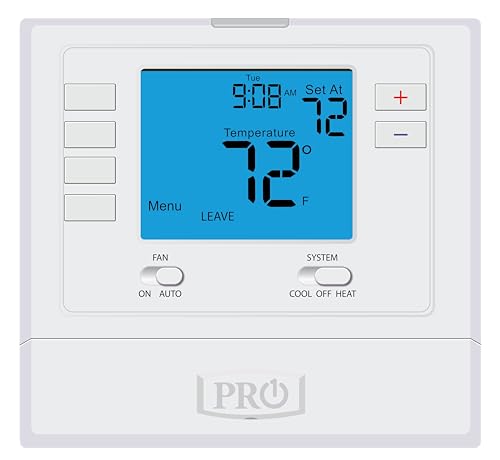
PRO1 T715 Multi-Stage Programmable Gas Thermostat

Reliance 9000507-045 Lower Electric Thermostat

PRO1 T721 Non-Programmable Wall Thermostat

YeloDeer 110V-265V 4-Wire Manual Baseboard Thermostat
YeloDeer 2-Pack 110V-265V Baseboard Thermostat
YeloDeer 4-Pack 110V-265V Baseboard Thermostat

White-Rodgers 1E78-144 Non-Programmable Thermostat
PRO1 T805 Programmable Wall Thermostat
A Breakdown Of The Leading Choices
Hybrid HVAC setups are common in older homes, and the PRO1 T725 is built for exactly that mix. It supports 2 heat/1 cool heat pump configurations and 1 heat/1 cool conventional systems, so the same wall plate covers most mid-sized homes with a backup heat strip or a furnace tie-in.
Programming comes in 7-day or 5/1/1 layouts, which is enough flexibility for shift workers and standard nine-to-five routines alike. The 4-square-inch blue backlit screen shows the active schedule block (wake, leave, return, sleep) at a glance, so nobody has to squint across the room.
Reasons It Performs
- Dual-mode design covers heat pump and conventional from a single wall unit
- Schedule choices fit both weekday-stable and rotating-shift households
- Readable schedule-mode display simplifies daily check-ins
- Programming depth rewards homeowners who want set-back routines
- T700 platform suggests cross-compatibility with other PRO1 accessories
Things To Consider
- Not a line-voltage control, so it does not directly swap into a baseboard heater circuit
- Programming setup takes longer than a non-programmable swap
- Larger feature footprint than renters or short-term users typically need
Who It Suits Best
Homeowners running a heat pump with conventional backup who want one programmable thermostat that handles both modes without a second control on the wall.
Skip It When
You heat a single baseboard-only room, where the YeloDeer 4-Wire Manual Baseboard Thermostat handles the job more directly.
Some rooms don’t need schedules, and the PRO1 T701 leans into that simplicity. It targets straightforward 1 heat/1 cool conventional systems, so a basic gas furnace with central air is its comfort zone. Like the T725 earlier, it is a low-voltage wall control, not a baseboard line-voltage replacement.
Setup is intentionally minimal: dial in the temperature and walk away. The 4-square-inch blue backlit display and glow-in-the-dark light button keep night adjustments painless for anyone navigating a dark hallway.
Key Advantages
- Set-and-forget operation with zero programming menus
- Backlit display and glow button aid low-light adjustments
- Sits on the same T700 platform as the T725, simplifying fleet replacements
- Compact footprint suits smaller wall sections
Points To Keep In Mind
- No schedule features, so set-back savings require manual nudges
- Conventional-only, so heat pump owners should look at the T721 instead
Made For
Rentals, guest rooms, and older homes where a single dial-style stat is all anyone needs to stay comfortable.
Consider Something Else When
You run a 2 heat/2 cool gas setup and want staged control, which is where the PRO1 T715 earns its keep.
Two-stage gas furnaces and compressors behave differently than single-stage gear, and the PRO1 T715 is tuned for that. It supports 2 heat/2 cool configurations and lets you toggle between 7-day, 5/1/1, or full non-programmable behavior, depending on how hands-on you want to be.
Power is flexible too, with battery or hardwire options, which helps in retrofits where pulling a common wire is inconvenient. The shared T700 platform means the same familiar 4-square-inch backlit layout as the T701 and T725.
Benefits That Matter
- True 2 heat/2 cool staging for variable-output furnaces and compressors
- Three operating modes cover schedulers and minimalists in one device
- Battery or hardwire power suits retrofit-friendly installs
- Visible schedule readouts reduce morning guesswork
Honest Caveats
- Programming depth adds a longer first-time setup
- Overkill for single-stage-only households, where the T701 already covers the basics
Right Fit For
Owners of multi-stage gas furnaces who want their thermostat to actually call for low and high fire rather than treating the system as on-or-off.
Look Elsewhere When
You heat a single baseboard-only zone and need a true line-voltage control, where the YeloDeer manual baseboard picks fit more naturally.
The Reliance 9000507-045 is a different breed entirely. It is a replacement lower thermostat intended for electric water heaters, not a wall-mounted room stat. Anyone scanning for room-temperature controls can skip this entry, but homeowners maintaining a dual-element electric water heater know this part matters.
It installs in the lower access panel of a standard electric water heater tank, where it senses tank-bottom water temperature and calls for heat as needed. Genuine Reliance-style replacement parts tend to match the OEM (original equipment manufacturer) spec closely, which reduces the cycling surprises that off-brand stats can introduce.
Advantages To Know
- OEM-style fit for many Reliance and compatible electric water heaters
- Direct replacement lowers the chance of a mismatched cycling curve
- Targets a frequently failed component in aging tanks
Room For Improvement
- Strictly a water-heater part; do not use it as a room thermostat
- Requires shutting off breaker power and draining a portion of the tank during replacement
Best Suited To
Homeowners diagnosing a water heater that produces short bursts of hot water or runs hotter than the dial suggests, both classic signs of a failed lower thermostat.
A Better Fit Elsewhere
Anyone replacing a wall-mounted room stat for a baseboard heater should choose the YeloDeer line-voltage baseboard models rather than this water-heer part.
The PRO1 T721 covers an unusual mix: 2 heat/1 cool heat pumps and 1 heat/1 cool conventional setups, all from a single non-programmable wall unit. That dual capability is genuinely useful for homes where the system type is ambiguous, such as older properties with mixed HVAC history.
Power flexibility comes via AA batteries or a hardwire C-wire, which is helpful when common-wire pulls are inconvenient. The display is the same family as the rest of the T700 line, with the glow button earning its keep during late-night tweaks.
The Value In It
- Heat pump and conventional modes share one wall plate
- Battery or hardwire power eases retrofit installs
- Non-programmable operation suits renters and set-and-forget households
- Backlit display with glow-in-the-dark button aids nighttime use
Small Caveats
- No scheduling, so efficiency-minded owners should consider the T725 or T715
- Low-voltage only; not a baseboard heater line-voltage swap
Who Should Grab It
Homeowners who want a simple wall stat but need flexibility between heat pump and conventional HVAC without buying two controls.
Reach For A Different Pick When
You heat with electric baseboards and want a true line-voltage room stat, in which case the YeloDeer 4-Wire Manual Baseboard Thermostat fits the wiring on the wall.
This is where the list actually speaks to baseboard owners. The YeloDeer 4-wire manual thermostat is built for line-voltage heating, which is the high-amperage 120V or 240V wiring running directly to electric baseboard convectors. Compare that to the PRO1 wall stats above, which are 24V low-voltage controls meant for forced-air and heat pump systems.
Rated for up to 20 amps and 4800W at 240V (or 2400W at 120V), it covers most residential baseboard zones in a single unit. The 4-wire format, with two line and two load conductors, suits typical 240V baseboard installations where both legs of the circuit need switching.
The Practical Payoff
- True line-voltage compatibility, the right tool for baseboard heater circuits
- Wide 110V to 265V operating range supports 120V and 240V wiring
- Up to 20A / 4800W at 240V handles most single-zone baseboards
- Electronic sensing improves accuracy over traditional bi-metal mechanical dials
- Adjustable 40°F to 80°F range covers standard comfort and freeze-protection settings
Things To Weigh
- Single-pack purchase, so whole-home retrofits get pricey if you order several at once
- Manual-only operation with no app or scheduling layer
- Line-voltage wiring demands careful attention to breaker-off safety during install
Who Will Love This
DIYers upgrading a single malfunctioning baseboard thermostat who want a straightforward electronic replacement that matches the existing 4-wire hookup.
Swap It Out When
You need to replace stats in several rooms at once, where the YeloDeer 2-Pack or 4-Pack saves money and keeps spares on hand.
Same control as the single-pack above, doubled. The 2-pack version exists because most homes don’t have just one baseboard thermostat; they have three, four, or more, and the per-unit cost drops noticeably when buying in pairs. Stocking a spare also helps when an older mechanical stat finally gives up mid-winter.
Specs mirror the single unit: 20A / 4800W at 240V, 110V to 265V compatibility, and 4-wire installation. Owners commonly report that having a backup on the shelf turns a future failure into a quick swap rather than a same-day hardware store run.
What Pays Off
- Two-unit convenience pack reduces per-stat cost
- Spare unit on hand for future room additions or failures
- Line-voltage ready, the correct category for baseboard heater wiring
- Wide voltage range covers 120V and 240V baseboards in one SKU (stock keeping unit)
Practical Considerations
- Still no scheduling, which matters for set-back efficiency seekers
- Each install is still line-voltage work, requiring breaker-off caution
Perfect Match For
Two-bedroom homes or apartments where exactly two baseboard zones need a control refresh at the same time.
Consider Something Else When
You only need one stat right now, in which case the single-pack YeloDeer avoids paying for an unused spare.
For homeowners refreshing every baseboard stat in the house at once, the 4-pack drops the per-unit cost further. The specs match the single and 2-pack versions: 110V to 265V, up to 20A, 4800W at 240V, electronic sensing, and a 40°F to 80°F control range.
Think of it as a project bundle. Anyone renovating a whole floor, finishing a basement, or replacing aging mechanical dials room-by-room benefits from buying once and being done. The 4-wire format aligns with most 240V baseboard hookups.
The Case For It
- Best per-stat value across the YeloDeer line
- Covers a full-floor retrofit in a single order
- True line-voltage compatibility for electric baseboards
- Electronic accuracy improves over aging bi-metal mechanical stats
- Wide 110V to 265V input covers 120V and 240V circuits
Worth Bearing In Mind
- Bulk buy only makes sense for multi-zone homes or renovations
- Manual-only control with no scheduling layer
- Line-voltage installation safety remains the installer’s responsibility
The Right Fit
Whole-home baseboard retrofits and landlords standardizing stats across rental units where uniformity matters as much as function.
Another Choice May Suit
Single-room replacements where the single-pack YeloDeer or a programmable PRO1 wall stat makes more sense.
The White-Rodgers 1E78-144 is a longstanding single-stage digital stat, the kind of model HVAC techs grab for a quick swap. It works with single-stage heating, cooling, and heat pump systems (without auxiliary heat), and runs on standard 24V or millivolt (low-voltage signaling) systems.
The critical note for shoppers: it is not designed for electric baseboard heat. Trying to use it on a 120V or 240V baseboard circuit is a safety and equipment mismatch. For 24V forced-air or single-stage heat pump homes, however, it remains a reliable, no-fuss replacement.
What Stands Out
- Time-tested design with widespread HVAC pro familiarity
- Backlit digital display is easy on aging eyes
- Millivolt and 24V compatibility suits older and newer systems
- Non-programmable operation eliminates schedule confusion
Potential Drawbacks
- Not rated for line-voltage baseboard heat, a hard limit for this list’s main topic
- Single-stage only, so multi-stage owners should consider the T715
- Older platform without modern app or voice integrations
Whose Shelf It Belongs On
Homeowners with 24V forced-air or single-stage heat pump systems who want a clean, dependable wall stat without learning curves.
Where A Sibling Pick Shines
True baseboard heater owners should choose the YeloDeer line-voltage models, which match the actual wiring on the wall.
The PRO1 T805 closes the list by upgrading display real estate. It targets 1 heat/1 cool conventional systems and supports 7-day, 5/1/1, or fully non-programmable modes, the same scheduling flexibility as the T715 but in a single-stage package.
The T800 platform swaps the T700’s 4-square-inch screen for an extra-large 7-square-inch blue backlit display, which reads cleanly from across the room. For homeowners who want programming depth without straining to see numbers, that bigger screen is the headline feature.
Practical Advantages
- Largest display in the PRO1 lineup, easier on aging eyes and long hallways
- Three operating modes cover schedulers and set-and-forget users
- Glow-in-the-dark light button keeps nighttime tweaks simple
- T800 platform suggests room for future accessory compatibility
Less-Strong Areas
- Conventional-only, so heat pump owners should pick the T725 or T721
- Larger footprint than the T701, which may dominate a small wall section
Built With In Mind
Conventional HVAC homeowners who want full programming flexibility and a display that’s readable without glasses or squinting.
Not Your Match When
You run a multi-stage system, where the PRO1 T715 unlocks actual two-stage behavior.
Picking The Right Control For A Baseboard Circuit
Buying a thermostat for electric baseboard heat starts with one foundational question: is the existing wiring line voltage or low voltage? Line-voltage thermostats switch the full 120V or 240V current running to the heater, while low-voltage models send a small 24V signal to a furnace or air handler. Mismatching the two is the most common reason a brand-new stat fails to power up.
Baseboard heaters in North American homes typically run at 240V with a 4-wire hookup, two hot legs, a neutral, and a load wire. A proper baseboard thermostat must be rated for the wattage of the heater it’s controlling; the YeloDeer line here, rated for up to 4800W at 240V, covers the majority of single-zone residential baseboards. Low-voltage wall thermostats like the PRO1 T701, T715, T721, T725, and T805, or the White-Rodgers 1E78-144, are designed for forced-air, heat pump, or hydronic systems, not direct baseboard control.
Voltage And Amperage First
Always confirm the heater’s voltage and wattage before choosing a stat. A 240V baseboard on a 120V circuit (or vice versa) is a mismatch that can damage the heater, the stat, or both. The total controlled wattage should sit comfortably under the thermostat’s rated capacity, with roughly 20% headroom for safety.
Match The System Type
Heat pump homes benefit from stats that explicitly support heat pump staging, like the PRO1 T725 or T721. Multi-stage gas furnaces pair naturally with the T715, while single-stage conventional systems are well-served by the T701, T805, or White-Rodgers 1E78-144. Putting a single-stage stat on a multi-stage system means losing the efficiency benefits of low-fire operation.
Schedule Needs And Display Readability
Programmable models reward homeowners with predictable routines and a willingness to set up weekly schedules. Non-programmable models like the T701 or T721 fit set-and-forget users, rentals, and rooms where the temperature rarely changes. Larger displays (the T805’s 7-square-inch screen) help anyone who reads the room temperature from across the space.
Wiring Comfort And Safety
Line-voltage thermostat swaps involve working near live 120V or 240V conductors, so breaker-off safety is non-negotiable. Anyone uncomfortable with that wiring should bring in a licensed electrician, especially for whole-home projects involving four or more zones.
Two Things Worth Knowing Before You Order
Common Shopping Slip Ups
The single biggest mistake is treating any wall thermostat as universal. A low-voltage PRO1 or White-Rodgers stat physically cannot switch a 240V baseboard circuit, no matter how appealing the screen or scheduling features look. The reverse is also true: a line-voltage baseboard stat wired into a 24V furnace loop will not control anything and may short on first power-up.
A close second is underrating wattage. Baseboard heaters that look modest on the wall often pull 1500W to 2500W per zone. Pairing one with a thermostat rated only for lower loads risks tripped breakers, overheated terminals, or premature stat failure. Confirm both voltage and wattage before clicking through.
Where The Extra Money Goes
Higher-tier stats in this category tend to invest the premium in scheduling depth, display size, and dual-mode flexibility. The PRO1 T805’s extra-large screen, the T715’s two-stage handling, and the T725’s heat pump plus conventional flexibility all address specific use cases rather than just adding features for their own sake. For homeowners with simple single-stage conventional systems, a non-programmable T701 delivers most of the comfort at a notably lower cost, and the savings show up clearest across whole-home retrofits.
Frequently Asked Questions
Can any thermostat work with electric baseboard heaters? No. Only thermostats specifically rated for line-voltage 120V or 240V baseboard circuits, such as the YeloDeer 4-wire models, should be wired directly to a baseboard heater. Low-voltage wall stats (PRO1, White-Rodgers, and similar) are designed for forced-air, heat pump, or hydronic systems and will not switch baseboard power safely.
How do I know if my existing thermostat is line-voltage or low-voltage? Turn off the breaker, pull the stat off the wall plate, and look at the wire thickness and count. Line-voltage baseboard stats typically have thicker wires (often 12 or 14 AWG, meaning American Wire Gauge, a standardized wire thickness rating) running directly to the heater, while low-voltage stats have a thin bundle of small-gauge wires (commonly 18 AWG) connected to a furnace control board. A licensed electrician can confirm in minutes.
Do I need a programmable thermostat for baseboard heaters? Not necessarily. Manual line-voltage stats like the YeloDeer models work fine for many homeowners, especially in single rooms or rarely used spaces. Programmable wall thermostats make more sense for whole-home baseboard systems where set-back routines can save meaningful energy.
What’s the difference between single-stage and multi-stage thermostats? Single-stage thermostats treat heating as fully on or fully off. Multi-stage models can call for a low-fire or high-fire output from the furnace, allowing gentler, more efficient operation in milder weather. The PRO1 T715 handles two-stage gas; the T725 handles two-stage heat pump plus conventional.
Can I install a baseboard thermostat myself? Homeowners comfortable with electrical work and breaker safety often handle single-stat swaps. The wiring is straightforward but involves live 120V or 240V conductors until the breaker is off. Whole-home projects, aluminum wiring, or unfamiliar panel layouts are good reasons to bring in a licensed electrician.
Closing Remarks
The right thermostat for electric baseboard heaters depends almost entirely on the wiring already in the wall. Line-voltage baseboard circuits call for dedicated controls like the YeloDeer single, 2-pack, or 4-pack models, each sized to the scope of the project. Homes with heat pumps, multi-stage gas furnaces, or single-stage conventional systems have a different conversation entirely, and the PRO1 T721, T725, T715, T805, T701, and the White-Rodgers 1E78-144 cover those scenarios with appropriate scheduling and display choices. Match the stat to the system first, then pick the features that match how the room is actually used.