Whether you’re balancing airflow across a duct run, confirming a coil is reaching the right supply temperature, or chasing a heat-pump that’s cycling strangely, a good thermometer changes the diagnosis. HVAC techs and serious DIYers need tools that read accurately from a distance, handle wide ranges, and survive a real service van. This list breaks down ten infrared and dual-probe options that earn their place in a working kit, from pro-grade picks to budget-friendly workhorses.
An Overview Of The Picks

Milwaukee 2278-20 M12 12:1 Infrared Temp-Gun
Fieldpiece ST4 Dual Temperature Meter

Temirup Non-Contact Infrared Thermometer with Color LCD

Temirup Infrared Thermometer with Probe

Temirup 50:1 High Temp Industrial Pyrometer
Temirup 30:1 Pyrometer with Thermocouple Probe

Klein Tools IR07 Dual Pocket Thermometer

Temirup 50:1 Industrial Pyrometer with Probe

Temirup 50:1 Dual Laser Thermometer with Probe

Fluke 62 Max Industrial Infrared Thermometer
The Strengths Of Each Pick
The Milwaukee 2278-20 slots into the M12 battery ecosystem, so crews already running Milwaukee cordless tools can swap a fresh pack in seconds rather than hunting for a nine-volt at the truck. The 12:1 distance-to-spot ratio is the optical relationship between distance and the measurement area: at 12 inches away, you’re reading a 1-inch target, which works fine for breaker panels and supply registers up close.
It feels solid in the hand, with a contoured grip that won’t slip when you’re reaching over an air handler. Owners running mixed jobs, residential service calls one day, light commercial the next, tend to like that it lives in the same case as their drill and impact driver.
Strengths Worth Knowing
- M12 battery compatibility cuts charger clutter in service vans
- 12:1 distance-to-spot ratio suits close-quarters panel work
- Rugged housing holds up to daily truck abuse
- Easy one-handed operation with a clearly placed trigger
Trade-Offs To Consider
- Requires separate M12 battery purchase if you’re not already in that system
- 12:1 optics fall short for distant overhead duct readings where higher-ratio picks excel
- No contact probe for liquid or internal temperature work
Whose Shelf It Belongs On
HVAC technicians already invested in the Milwaukee M12 platform who want one less charger to manage.
Swap It Out When
The Klein Tools IR07 is a lighter alternative when pocket carry matters more than battery ecosystem integration.
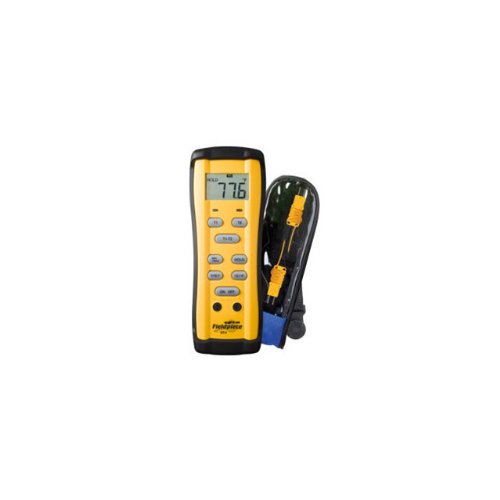
The Fieldpiece ST4 reads two thermocouples at once, displaying both channels and the difference between them. That Delta-T (the temperature difference between two points) calculation is exactly what refrigerant diagnostics calls for, so you can check superheat and subcool without swapping leads mid-service.
It covers -58 to 2000°F (-50 to 1300°C), which comfortably handles everything from a frozen coil to a furnace heat exchanger. Inside, it compensates for rapid ambient swings, the kind that happen when you walk from a cool basement into a hot attic and crack open an air handler.
What Works In Its Favor
- True dual-channel input for live Delta-T calculations
- Wide -58 to 2000°F range covers HVAC and combustion work
- Rapid ambient compensation during field swings
- Includes wrap-tab beaded K-type thermocouples (the standard plug-in temperature probes) ready to use
Honest Caveats
- Contact-only design, no infrared for quick scans from a distance
- Priced above casual DIY territory
- K-type wire connectors can wear with daily plugging and unplugging
Feature Snapshot
Right Fit For
Field service techs doing refrigerant diagnostics who need real Delta-T readings rather than back-of-the-napkin math.
Where Another Pick Suits Better
The Milwaukee 2278-20 is a better fit for techs who primarily want non-contact scans across breaker panels and registers.
Temirup’s color-LCD model splits the difference between household troubleshooting and light HVAC checks. The screen shows ambient temperature, humidity, dew point, and spoilage thresholds side by side, which helps when you’re sizing up a damp basement or a musty supply run.
Adjustable emissivity (a surface’s ability to emit infrared energy; shiny metal reads low, matte paint reads high) from 0.1 to 1.0 lets you dial in readings for copper pipe, painted ductwork, or a greasy stove pipe. For homeowners juggling cooking checks and home repairs, the breadth is more useful than the depth you’d get from a single-purpose tool.
Everyday Perks
- Color LCD displays humidity, dew point, and temperature together
- Wide emissivity adjustment handles shiny and matte surfaces
- 13-point laser guidance for targeting small spots
- French HTU20 sensor is a sensible humidity component for damp-space work
Points To Note
- Upper range of 1472°F is fine for residential tasks but limits industrial forging
- Color LCD drains batteries faster than a basic monochrome screen
- Plasticky housing feels light compared to pro-grade options
Built With In Mind
Homeowners and renters who want one thermometer for cooking, moisture checks, and light HVAC troubleshooting.
Not Your Match When
The Fieldpiece ST4 is a stronger choice when Delta-T refrigerant work is the priority.
Pizza-oven owners and serious grillers tend to want both: scan the stone from across the deck, then push a probe into the dough’s center to confirm internal temp. This Temirup does both without forcing you to buy two separate tools. The 13-point laser grid gives you a clear idea of where you’re aiming on a 900°F deck.
Humidity and dew-point readouts come courtesy of the same HTU20 sensor seen in the sibling model above, which helps when a cold stone fogs up on a damp morning. For most home cooks, the ergonomics matter more than the spec sheet: the grip lands comfortably even with greasy hands.
Notable Gains
- IR plus K-probe contact reading in one device
- 13-point laser pattern clarifies the exact target zone
- Adjustable emissivity for steel decks and stone hearths
- Compact enough for a kitchen drawer
Small Caveats
- K-probe wire can scorch if it rests on a hot deck surface
- 1472°F ceiling won’t reach true industrial forging temps
- Probe accuracy claim of 1.5% sounds good but isn’t independently verified, so cross-check with a known reference
Perfect Match For
Home chefs running pizza ovens, wood-fired grills, or smokers who need both surface scans and internal probe checks.
Look Elsewhere When
The Temirup 50:1 High Temp Industrial Pyrometer is a better match when your work involves true forging temperatures above 2000°F.
This is the pyrometer (a non-contact thermometer built for high-temperature industrial use) that handles forge and smelting work. The -40 to 3632°F range reaches well beyond any residential HVAC scenario and covers most blacksmithing and foundry applications. The 50:1 distance-to-spot ratio, meaning at 50 inches you read a 1-inch target, lets you step back from a glowing crucible and still get a reliable reading.
Dual laser pointers frame the measurement area, which matters when you’re aiming at a small crucible mouth from across the shop. For hobbyist metalworkers, this is the kind of tool that lets you keep your hands and face away from radiant heat.
Good Reasons To Consider
- 3632°F upper limit covers most forge and foundry work
- 50:1 optics let you read from a safe distance
- Dual laser pointers frame the target zone clearly
- Adjustable emissivity handles oxidized and shiny metal
Worth Bearing In Mind
- Overkill for any residential HVAC task
- Accuracy tolerance of around 2% can drift at extreme temps, so verify against a known reference for critical pours
- Color LCD and dual laser draw battery faster than basic units
Best Suited To
Small-shop metalworkers, bladesmiths, and foundry hobbyists who need to read crucible and forge temperatures from a safe distance.
Reach For A Different Pick When
The Temirup 30:1 Pyrometer with Thermocouple Probe is a more measured choice when you mostly work in the 1000°F range and want a contact probe included.
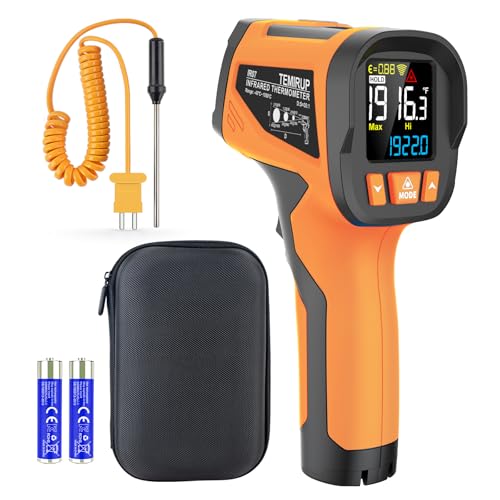
Stepping down from the 50:1 flagship, this 30:1 model trades a bit of distance for a faster sub-half-second response time. For kiln and forging work where you’re watching temperature climb, that quick read matters more than reaching further across the shop.
The K-type probe handles liquid and internal readings, so you can confirm kiln interior temps by inserting the probe through a peephole. IR mode covers 1922°F (-40 to 1922°F range), and probe mode runs 14 to 932°F at the tighter 1.5% tolerance.
Benefits That Matter
- Sub-half-second response for watching temperature climbs
- K-probe covers liquid and interior readings
- 30:1 ratio balances distance with targeting accuracy
- Adjustable emissivity from 0.1 to 1.0
Where It May Fall Short
- 30:1 optics can’t match the 50:1 flagship for distant targets
- Plastic probe handle can soften in very hot environments
- 1922°F ceiling rules out higher-end foundry work
Quick Facts
Who Should Grab It
Pottery and ceramics kiln operators who need both rapid surface scans and contact probe readings during firings.
Consider Something Else When
The Temirup 50:1 High Temp Industrial Pyrometer is a smarter upgrade when you need to read glowing metal from across the shop floor.
The Klein IR07 is built to ride in a back pocket or clipped to a tool bag without weighing you down. The 8:1 distance-to-spot ratio is modest, but that’s the trade-off you accept for the pocketable size: at 8 inches, you’re reading a 1-inch target, which suits panel work and outlet checks.
It covers -40 to 572°F (-40 to 400°C) on both IR and probe modes, which aligns with the temperatures electricians and HVAC techs actually touch. The probe folds into the body, which is a small detail that matters when you’re grabbing it alongside a wire stripper.
What It Does Well
- Pocket-size form factor with a folding probe
- Klein Tools build quality for daily field abuse
- IR plus probe in one compact unit
- Laser doubles as a target pointer for panel work
A Few Limitations
- 572°F ceiling is restrictive for any forging or kiln work
- 8:1 optics can’t read distant overhead duct targets
- Smaller LCD harder to read in bright sunlight on a rooftop
Who Will Love This
Electricians and HVAC techs who want a thermometer that disappears into a pocket until they need it on a service call.
A Better Fit Elsewhere
The Fluke 62 Max is a sturdier alternative when durability and a higher temperature ceiling matter more than pocket size.
For overhead duct inspections where you’re reading a 16-inch supply trunk from the floor below, the 50:1 distance-to-spot ratio does the heavy lifting. The IR range runs -40 to 2912°F and the K-type probe covers 14 to 932°F, so the same tool handles rooftop supply lines and combustion checks.
It’s built for industrial HVAC rather than residential: think boiler rooms, large air handlers, and forge-adjacent facilities. The trade-off is bulk and weight, but you get readings you can trust from a position that’s actually safe to stand in.
What Makes Sense
- 50:1 ratio for distant industrial readings
- Wide 2912°F ceiling for high-temp industrial work
- Contact probe included for spot-checking line interiors
- Adjustable emissivity suits varied surface conditions
Practical Considerations
- Larger and heavier than handheld consumer models
- Probe accuracy of 1.5% should still be cross-checked for calibration work
- Industrial feature set adds cost that homeowners won’t recoup
Made For
Commercial HVAC techs and industrial maintenance crews working on large air handlers, boilers, and high-temperature duct runs.
Skip It When
The Temirup 30:1 Pyrometer with Thermocouple Probe is a leaner fit when you don’t need 50:1 distance and want faster response.
Same 50:1 optics and 2912°F ceiling as the sibling above, but the dual-laser targeting changes how it feels in use. Two beams converge at the measurement point, so you can see exactly where you’re aiming without guessing at the spot size.
For engine bay diagnostics, the dual laser helps confirm you’re reading the exhaust manifold surface rather than the heat shield next to it. The K-type probe handles intake air and coolant checks from 14 to 932°F.
The Good Stuff
- Dual laser beams converge to mark the exact target spot
- 50:1 ratio for engine bay and overhead work
- Wide -40 to 2912°F IR range
- Contact probe for liquid and air temperature checks
Possible Compromises
- 2% IR accuracy tolerance widens at the extremes of the range
- Not intended for human body temperature readings
- Dual laser and high-temp specs add cost for casual home users
Feature Card
Who It Suits Best
Auto enthusiasts and small-engine mechanics who need to read manifold temps from a safe distance and confirm coolant behavior with a probe.
Another Choice May Suit
The Temirup 50:1 Industrial Pyrometer with Probe is the right call when HVAC ducts are the primary target rather than engine bays.
The Fluke 62 Max is the survivor of the roundup. Rated IP54 against dust and water splashes and tested to withstand a 9.8-foot drop, it shrugs off the kind of abuse that ends other thermometers after one bad ladder day. The 10:1 distance-to-spot ratio suits the kind of close-quarter reading a field tech typically takes.
It covers -22 to 932°F, runs on a single AA battery, and weighs just over half a pound. Adjustable emissivity and high/low alarms round out a feature set designed for daily commercial service rather than weekend tinkering.
Features That Help
- IP54-rated dust and water resistance
- Drop-tested to 9.8 feet onto hard surfaces
- High and low temperature alarms for unattended monitoring
- Compact 6.8 x 3.3 x 2.9-inch form factor
Some Limits To Know
- 932°F ceiling rules out forging and most foundry work
- 10:1 optics can’t match the 50:1 Temirup models for distant targets
- Industrial use only, not intended for human body temperature
Key Product Details
Perfect Match For
Field service techs who drop tools, work in dusty mechanical rooms, and need a thermometer that keeps working year after year.
Where A Sibling Pick Shines
The Klein Tools IR07 is a smaller, lighter alternative when pocket carry matters more than drop-tested durability.
What Matters Most Before Choosing Hvac Thermometers
The first decision is contact versus non-contact. Infrared (IR) thermometers read surface temperature from a distance using emitted heat, while contact thermometers use a probe pressed against the target. For HVAC diagnostics, IR is the workhorse for ducts, registers, and breaker panels, but Delta-T refrigerant work almost always needs a thermocouple.
Distance-to-spot ratio determines how far back you can stand. A 10:1 ratio reads a 1-inch target at 10 inches; a 50:1 ratio reads the same 1-inch target at 50 inches. Overhead duct inspections, boiler fronts, and tall mechanical rooms reward higher ratios.
Emissivity adjustment matters more than most specs suggest. Bare copper, shiny aluminum, and matte paint all emit infrared differently, and a fixed-emissivity unit will read low on shiny metals. If you work across varied surfaces, look for 0.1 to 1.0 adjustable emissivity.
Temperature range is another filter. Residential HVAC rarely exceeds 200°F, so a 932°F ceiling covers almost every home scenario. Forge, kiln, and foundry work pushes past 2000°F and demands a higher ceiling.
Sensor And Probe Quality
A K-type thermocouple is the standard plug-in probe format. Tighter accuracy tolerance (1.5% versus 2%) reduces guesswork when verifying calibration or diagnosing stubborn complaints. Replacement probes should be inexpensive and widely available, since probe wires get cut, scorched, or simply walked away from.
Durability And Daily Use
IP ratings indicate how well a unit shrugs off dust and water. IP54 handles splashes and dust, which is enough for most rooftop and mechanical-room work. Drop ratings matter on jobsites, and a 9.8-foot drop rating (like the Fluke 62 Max) is genuinely field-proven rather than marketing copy.
Reading The Display
Color LCDs add features like humidity and dew point readouts, but they drain batteries faster. A high-contrast monochrome screen reads well in direct sunlight on a rooftop and runs longer on a single set of cells. For techs who can’t stop to swap batteries mid-call, monochrome is often the practical pick.
Key Considerations Across These Picks
Pitfalls Shoppers Hit
The most common mistake is choosing the highest range available without thinking about accuracy at the temperatures you actually measure. A 3632°F pyrometer sounds impressive, but if its tolerance widens at extreme heat, your kiln readings drift at the temperatures that matter. Match the range to your real workload, not the most extreme spec on the sheet.
Another trap is ignoring emissivity. Fixed-emissivity units read low on shiny copper pipe and polished aluminum ductwork, which are exactly the surfaces HVAC work involves. Adjustable emissivity costs little but solves a recurring diagnostic headache.
Where The Extra Money Goes
The jump from budget to premium mostly buys better distance-to-spot ratios, tighter accuracy tolerance, and tougher housings. The Fluke 62 Max’s drop and IP ratings cost real money to design and certify. Higher-ratio Temirup models use better optics to focus infrared energy cleanly at distance. If you read from ladders and rooftops, the upgrade pays off in fewer bad readings and longer service life. For kitchen-counter use, the budget tier usually suffices.