Older homes and rentals rarely have the dedicated common wire modern smart thermostats demand. Running new cable through finished drywall is messy, expensive, and often off the table for homeowners. The thermostats gathered here sidestep that wiring issue by drawing power straight from the existing heat-only or shared circuit, or by using batteries, so you can upgrade without opening up the walls.
The Leading Options At A Glance

PRO1 T725 Programmable Heat Pump Thermostat
PRO1 T771 Single Stage Non-Programmable Thermostat
Honeywell TH1100DV1000 Pro 1000 Heat-Only Thermostat

PRO1 T701 Single Stage Non-Programmable Thermostat
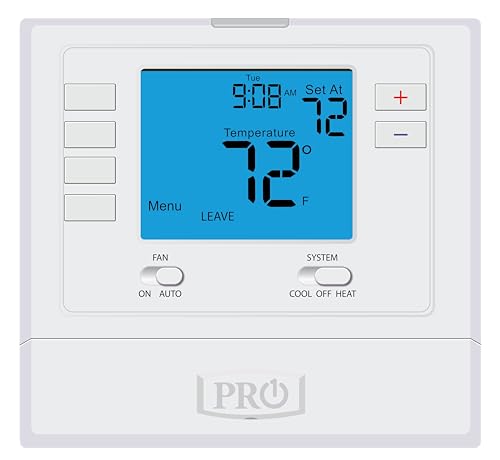
PRO1 T715 Multi-Stage Programmable Gas Thermostat

Heagstat 1 Heat/1 Cool Non-Programmable Thermostat

PRO1 T721 Heat Pump/Conventional Thermostat
PRO1 T805 Single Stage Programmable Thermostat

Google Nest Learning Thermostat 4th Gen with Sensor (Obsidian)

Google Nest Learning Thermostat 4th Gen with Sensor (Polished Gold)
Why These Options Stand Out
The PRO1 T725 is the rare wall unit that genuinely speaks both languages of home HVAC (heating, ventilation, and air conditioning): a heat pump with auxiliary heat, or a plain conventional furnace. That flexibility matters for households that don’t know exactly which system lives behind their drywall, and it lets you keep the same thermostat if the equipment ever gets swapped out.
Schedules live on the unit itself with 7-day or 5/1/1 programming, which is the standard rhythm of “same routine weekdays, different Saturday, different Sunday.” Power is drawn from the system or from AA batteries, so a missing common wire is a non-issue. The 4 sq. in. blue backlit screen stays legible in dim hallways at night.
Everyday Advantages
- Compatible with both 2H/1C heat pump and 1H/1C conventional setups, removing guesswork at install time
- 7-day or 5/1/1 schedule options handle standard work-week patterns without app dependency
- Battery or hardwired power means no common wire required, ideal for older homes and rentals
- Blue backlit display remains readable in low light and during nighttime checks
Things To Consider
- Program setup is button-driven, so the first configuration takes a few minutes of patience
- Lacks Wi-Fi or app control, which keeps the price approachable but rules out remote adjustments
Built With In Mind
Homeowners with a heat pump or a conventional system who want a dependable weekly schedule and no learning curve.
Look Elsewhere When
The PRO1 T805 Single Stage Programmable Thermostat is a better fit if you prefer a noticeably larger display with the same scheduling depth.
The PRO1 T771 leans hard into a no-nonsense approach, and that’s the point. There’s no schedule to set, no app, and no learning curve. You bump the temperature up or down, and the system responds. The wide 25°F to 90°F setpoint range opens the door to spaces that don’t behave like a living room.
Garages, sheds, basements, and workshops often need colder winter settings to keep pipes from freezing without wasting fuel. The blue backlit screen and swing adjustment help you dial in tighter control without constant manual tweaking. Like the T725, this one runs on batteries or system power, so the common-wire question doesn’t apply.
Real Benefits
- Wide 25°F–90°F range handles cold-storage spaces and garages that need frost protection
- Blue backlit display reads clearly even in dim basements or unheated utility rooms
- Battery-powered operation sidesteps the common-wire problem entirely
- Single-button interface means less time spent navigating menus during setup
Honest Caveats
- No scheduling means you’ll tweak the temperature manually as seasons change
- Better suited to single-stage conventional systems than to heat-pump configurations
Best Suited To
Garage, shed, and workshop owners who want reliable single-stage control without programming overhead.
Consider Something Else When
The PRO1 T701 Single Stage Non-Programmable Thermostat is a better match for whole-home living spaces that prefer a slightly larger platform footprint.
The Honeywell TH1100DV1000 is the wall thermostat equivalent of a tape measure: small, vertical, and built for one job. Heating-only systems are still common in older homes with boiler-fed radiators, baseboards, or single-purpose furnaces, and this unit talks to those systems without asking for anything extra.
Its vertical layout fits narrow switch-box cutouts where wider rectangular thermostats simply won’t sit. Premier white blends into most trim, and the 4 11/16 in. tall footprint keeps it visually unobtrusive. There’s no programming, no Wi-Fi, and no batteries to monitor, which keeps long-term ownership low-touch.
What Helps Most
- Vertical form factor fits tight wall spaces and replacement cutouts in older homes
- Heat-only focus avoids features that complicate a simple boiler or baseboard system
- Premier white finish blends into standard trim without drawing attention
- Hardwired heat-only operation requires no common wire and no battery swaps
Points To Note
- Limited strictly to heat-only systems with no cooling control whatsoever
- No scheduling or smart features, which rules out remote or automated adjustments
Right Fit For
Owners of radiator, baseboard, or boiler-only homes seeking an unobtrusive, no-fuss upgrade.
Skip It When
The PRO1 T725 Programmable Heat Pump Thermostat is the smarter choice if your system provides both heating and cooling and you want weekly scheduling built in.
If you’ve never swapped a thermostat before, the PRO1 T701 is the kind of unit that walks you through it with as little fuss as possible. The 4 sq. in. blue backlit display sits on the larger T700 platform, and a glow-in-the-dark light button makes it findable at 2 a.m. when the house feels off.
Gas or electric compatibility covers the bulk of single-stage conventional setups, and you choose between hardwired power or AA batteries. Compared to the simpler T771, the T701 lives on a slightly larger display platform, which gives more room for status readouts without changing the operating logic.
Everyday Wins
- Larger T700 platform displays temperature and status more clearly than the T771
- Glow-in-the-dark button helps locate controls during nighttime adjustments
- Gas and electric compatibility covers the most common single-stage configurations
- AA battery or hardwired power keeps installation simple in homes without a common wire
Points To Keep In Mind
- No weekly scheduling means you’ll adjust manually for comfort changes across seasons
- No remote or app access, which may frustrate households accustomed to smart controls
Who Should Grab It
First-time installers and homeowners replacing an aging manual thermostat with something cleaner and more readable.
Reach For A Different Pick When
The PRO1 T805 Single Stage Programmable Thermostat is a better fit once you’re comfortable with manual operation and want a 7-day schedule with a bigger display.
Two-stage gas systems deserve a thermostat that can tell them apart. The PRO1 T715 controls 2 heat and 2 cool stages, which matters when your furnace throttles between a low and high burn rather than slamming on at full power. That kind of staged control typically delivers more even temperatures and quieter operation.
You get 7-day, 5/1/1, or no-program modes, depending on how structured your week is. Power options run from AA batteries to a hardwire connection, and the blue backlit 4 sq. in. display keeps things readable in hallways and bedrooms. The T715 is essentially the multi-stage sibling of the T725, with a deeper feature set for more complex HVAC equipment.
The Helpful Details
- 2H/2C staging reduces temperature swings and short-cycles in two-stage furnaces
- Three operating modes (7-day, 5/1/1, or none) cover everything from strict schedules to fully manual
- Glow-in-the-dark light button aids quick adjustments without flipping on overhead lights
- Battery or hardwired power removes the common-wire requirement at install
Potential Drawbacks
- Setup requires more wiring know-how than single-stage units like the T701
- No Wi-Fi connectivity, so any schedule changes need to happen on the wall
Who It Suits Best
Owners of two-stage gas furnaces who want finer temperature control and weekly scheduling without app dependency.
A Better Fit Elsewhere
The PRO1 T725 Programmable Heat Pump Thermostat is a simpler swap if your system is single-stage or runs a heat pump rather than staged gas.
The Heagstat sits firmly in the budget tier, and it knows exactly what it’s for: 24VAC conventional single-stage heating and cooling systems, gas, oil, or electric, paired with an outdoor AC condenser. That covers the majority of homes that just need the temperature set and left alone.
There’s a clear compatibility boundary, and the documentation is unusually honest about it. The base accepts 2 to 5 wires only, so 6- to 8-wire configurations are out. For older rental properties and apartments where you’re just replacing a wall thermostat with the same wiring footprint, this shortlist fits without a problem.
Positive Takeaways
- Works with common gas, oil, and electric furnace setups paired with a separate AC condenser
- Low wiring count (2-5 wires) matches older homes and rental properties
- White backlight keeps the temperature readable in dim hallways and bedrooms
- Straightforward non-programmable operation reduces tenant confusion in rentals
Less Ideal Details
- Not compatible with heat pump systems, which limits it to conventional-only homes
- No scheduling or remote control, so comfort adjustments happen manually at the wall
Feature Snapshot
Whose Shelf It Belongs On
Rental property owners and tenants who need a no-fuss conventional-system thermostat that doesn’t rely on a common wire.
Swap It Out When
The PRO1 T725 Programmable Heat Pump Thermostat is the smarter pick if you want scheduling flexibility and broader system compatibility.
Think of the PRO1 T721 as a stripped-down sibling of the T725: same dual-system support (2H/1C heat pump or 1H/1C conventional), but without the weekly scheduling layer. For households that prefer to set the temperature once and forget it, that simplicity is actually a feature.
The T700 platform carries the same 4 sq. in. blue backlit display and glow-in-the-dark light button, so navigation stays consistent across this PRO1 family. AA batteries or hardwired power handle the common-wire absence cleanly. It’s the middle ground for someone torn between the no-frills T701 and the full-schedule T725.
Benefits That Matter
- Heat pump and conventional dual support keeps it flexible across equipment swaps
- Non-programmable operation simplifies daily life for set-it-and-forget households
- AA battery or hardwired power removes the common-wire constraint entirely
- Same backlit T700 display found on the T725 and T701 for consistent readability
Possible Compromises
- Lacks a weekly schedule, so any routine changes happen at the wall
- No remote or smart-home connectivity for app-driven adjustments
At A Glance
Perfect Match For
Set-it-and-forget households with a heat pump or conventional system who want broad compatibility without programming menus.
Not Your Match When
The PRO1 T725 Programmable Heat Pump Thermostat is a stronger choice if you want 7-day scheduling along with the same dual-system flexibility.
The PRO1 T805 lives on the T800 platform, which is the company’s bigger-display play. The 7 sq. in. blue backlit screen is roughly 75% larger than the T700’s 4 sq. in. panel, so temperature, mode, and schedule readouts are visible from across a living room rather than up close.
You get 7-day, 5/1/1, or non-programmable modes, plus a glow-in-the-dark light button for nighttime adjustments. Conventional 1H/1C support covers the standard residential setup, and battery or hardwired power avoids the common-wire conversation. Compared to the T701, this is essentially the same logic with a much friendlier face.
Where It Delivers
- Extra-large 7 sq. in. display improves readability from across the room
- Three operating modes (7-day, 5/1/1, or none) suit both strict and casual schedules
- T800 platform offers a noticeably cleaner button layout than the T700 series
- Battery or hardwired installation avoids the common-wire requirement entirely
Where It Is Less Suited
- Larger wall footprint requires a bit more clearance than smaller PRO1 models
- Limited to single-stage conventional systems, so heat pumps and multi-stage setups need other picks
Key Specs
Made For
Schedulers, shift workers, and anyone who wants a wall thermostat you can actually read from the couch.
Another Choice May Suit
The PRO1 T701 Single Stage Non-Programmable Thermostat is a tidier wall option if you don’t need the larger display or weekly scheduling.
The Nest Learning Thermostat (4th gen) flips the script from a button-driven wall unit to a thermostat that pays attention. It builds a schedule based on the temperatures you actually select and the times you make those changes, so manual fiddling gradually turns into automation.
The included Nest Temperature Sensor (2nd gen) lets you measure temperature in a specific room, useful when a hallway thermostat doesn’t reflect how the nursery or home office actually feels. The Obsidian finish gives the dial a deep, polished look that reads more like a piece of hardware than a wall gadget.
The Good Stuff
- Learning algorithm adapts the schedule as your routine shifts across weeks and seasons
- Included temperature sensor reads conditions in the room you care about most
- Obsidian finish delivers a polished, premium look on the wall
- Designed to operate without a common wire in many common HVAC setups
What To Weigh
- Learning behavior requires a couple of weeks of consistent manual temperature changes before automation kicks in
- Smart-home integration depends on stable Wi-Fi, so network hiccups affect remote features
Quick Facts
Right Fit
Smart-home households that want a thermostat that adapts on its own and includes a remote temperature sensor out of the box.
Where A Sibling Pick Shines
The Google Nest Learning Thermostat 4th Gen with Sensor (Polished Gold) is a better match if your smart-home ecosystem leans more on Alexa or HomeKit rather than Google Home.
The Polished Gold version of the Nest Learning Thermostat (4th gen) keeps the same learning engine and bundled temperature sensor as its Obsidian sibling, with a brighter metallic dial that catches light differently against pale or neutral walls.
Where this model pulls ahead on compatibility is the ecosystem: it plays nicely with Alexa, Apple HomeKit, and Google Home. That wider umbrella matters if your smart-home setup isn’t locked to a single voice assistant. Many homeowners can run it without a common wire using the included adapter and existing thermostat cabling.
What Stands Out
- Broader ecosystem support across Alexa, Apple HomeKit, and Google Home
- Polished Gold finish offers a brighter, more decorative look on the wall
- Same bundled temperature sensor found on the Obsidian model for room-level readings
- Learning engine refines itself as your habits change across the year
Factors To Consider
- Polished finish shows fingerprints more easily than darker thermostat dials
- Smart-home ecosystem setup takes more initial configuration than non-connected units like the T805
Feature Snapshot
Who Will Love This
Alexa and HomeKit households who want a learning thermostat with the broadest possible ecosystem support.
Look Elsewhere When
The PRO1 T805 Single Stage Programmable Thermostat is a calmer fit if you don’t want Wi-Fi, voice assistants, or app-driven scheduling on the wall.
What To Know Before Swapping Your Thermostat
A “C wire” or common wire delivers continuous 24VAC power from the HVAC transformer back to the thermostat. Without it, smart thermostats struggle to stay powered because Wi-Fi radios and bright displays draw more current than older units needed. The models here solve that problem differently: some draw from the heating or cooling circuit itself, some run on AA batteries, and some include adapters that repurpose an existing wire as a common.
Match the thermostat to your system first. Count the wires coming out of the wall and check the labels. A 2-wire heat-only system, a 4-wire conventional system with cooling, and a 5-wire heat pump each call for a different match. The PRO1 T700 and T800 series covers most residential cases, while the Honeywell TH1100DV1000 is built strictly for heat-only homes.
Decide how much scheduling you actually want. A learning thermostat like the Nest 4th gen builds a routine automatically but needs consistent Wi-Fi and a couple of weeks of your input first. A 7-day programmable unit like the PRO1 T725 or T805 gives you direct control over every block, which matters for shift workers or households with unusual routines. Non-programmable models like the T701 and T771 are essentially set-and-forget.
Think about the wall location and lighting. Hallways with no natural light benefit from a glow-in-the-dark light button, found on several PRO1 models. Living rooms with longer viewing distances are friendlier with the larger 7 sq. in. T805 display. Garages and sheds often need a wider setpoint range, which is where the PRO1 T771 shines.
Verify HVAC compatibility before you buy. Multi-stage gas furnaces need a 2H/2C thermostat like the PRO1 T715. Heat pumps typically need 2H/1C support, which the T725 and T721 provide. The Heagstat explicitly excludes heat pumps and 6- to 8-wire configurations, so renters with simpler 2- to 5-wire systems are the natural fit.
Picking Between Budget and Premium Tiers
Common Shopping Slip Ups
The most common mistake is assuming any wall thermostat works with any system. A 2H/2C gas furnace paired with a single-stage thermostat will simply ignore the second stage, and a heat pump wired to a conventional-only thermostat can behave unpredictably. Match the system type on the box to the wires in your wall before anything else.
Another slip is overlooking the wire count. Six- to eight-wire systems with many accessories may not seat properly on simpler thermostats like the Heagstat, which only accepts 2 to 5 wires. Pull the existing thermostat off the wall and count before ordering.
Where The Extra Money Goes
Higher tiers like the Google Nest 4th gen and PRO1 T805 spend the difference on display size, learning behavior, and ecosystem support. The Nest models add remote sensors, app control, and broader voice-assistant compatibility. The PRO1 T805 pays for a noticeably larger 7 sq. in. screen and a more refined T800 platform.
The upgrade is worth it for households with unusual routines, multi-room comfort complaints, or existing smart-home hubs. For a single-zone home with predictable occupancy, a budget PRO1 T701 or T771 delivers reliable comfort without the additional cost of features that go unused.
Frequently Asked Questions
Do thermostats without a C wire need batteries? Some do, some don’t. Battery-powered models like several PRO1 units run on AA cells, while others draw “power-stealing” current from the heating or cooling circuit itself. The Nest 4th gen typically uses an included adapter that repurposes an existing wire to provide continuous power without a dedicated common wire.
Will these work with a heat pump system? Specific models will. The PRO1 T725 and T721 support 2H/1C heat pump configurations. The Honeywell TH1100DV1000 is heat-only and not designed for heat pumps, and the Heagstat explicitly excludes them. Always match the thermostat’s supported system type to your equipment.
Are non-programmable models really simpler to live with? For most households, yes. You set the temperature and the thermostat holds it until you change it. The trade-off shows up when your routine shifts between seasons, since you’ll adjust the wall unit manually rather than letting a schedule handle it automatically.
Can I install any of these myself? Most homeowners can handle a like-for-like swap with the power turned off at the breaker, but always photograph the existing wiring before disconnecting anything. Multi-stage or heat-pump systems benefit from a quick professional check, especially when the wire count and labels don’t obviously line up.
How do I know if my system has a C wire? Pull the existing thermostat off its base and look at the wire terminals. A wire labeled “C” means a common wire is already present. If you only see R, W, Y, and G, you likely don’t have one, and the models listed here are designed to handle that situation.
Closing Remarks
The right thermostat without a C wire is the one that matches your system, your routine, and your appetite for technology. Battery-powered PRO1 units and the Honeywell heat-only model keep things simple for older homes and rentals, while the Nest 4th gen models add learning behavior for households that want automation. Match the wiring first, choose your feature depth second, and the comfort trade-offs tend to fall into place on their own.