A two-stage furnace runs smoother than a single-stage unit, but only when the thermostat knows what to do with the extra stage. Match the wall control to the equipment underneath, and the furnace ramps gently instead of blasting full-blast. Mismatch it, and the second stage never kicks in, or the system shorts cycles, which costs comfort and efficiency. The list below mixes true multi-stage picks alongside single-stage and heat-pump options that come up when you’re scoping the category, so you can see how the field compares side by side and pick the right fit for the wires already in your wall.
The Essentials At A Glance

PRO1 T725 Heat Pump/Conventional Programmable Thermostat
PRO1 T771 Single Stage Non-Programmable Wall Thermostat

White-Rodgers 80 Series Heat Pump Thermostat 1F83H-21NP

PRO1 T701 Single Stage Non-Programmable Wall Thermostat
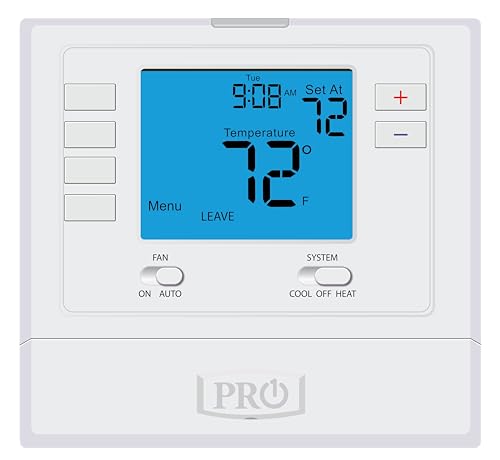
PRO1 T715 Multi-Stage Programmable Gas Thermostat

Heagstat Non-Programmable Thermostat 1 Heat/1 Cool

PRO1 T721 Non-Programmable Heat Pump Thermostat

Reliance 9000507-045 Lower Electric Thermostat

White-Rodgers Single Stage Non-Programmable Thermostat 1E78-144
PRO1 T805 Single Stage Programmable Wall Thermostat
Why These Options Stand Out
The PRO1 T725 is the rare wall control that actually speaks two-stage heat pump language. It’s rated for 2 heat/1 cool heat pump systems (meaning two heating stages plus one cooling stage) and falls back to 1 heat/1 cool conventional if your equipment isn’t a heat pump, which covers a lot of basements and additions with hybrid setups.
The 4-square-inch blue backlit screen reads clearly at a glance, and 7-day or 5/1/1 programmability (a weekly schedule you set once) gives a working family the kind of granular control that pays back in a milder gas bill without needing an app. For homeowners with a real two-stage heat pump who want a wired wall unit instead of a smart gadget, this lands in the sweet spot.
Notable Gains
- Genuine 2H/1C heat pump staging, so the second stage actually triggers when the weather drops.
- Dual-mode compatibility: heat pump today, conventional furnace tomorrow, no swap-out needed.
- Programmable scheduling with a backlit screen, useful for households with predictable weekday routines.
- Hardwired reliability with battery backup, avoiding the wifi-dropout headaches that plague cloud-dependent units.
Trade Offs Worth Knowing
- Programming takes patience the first weekend; the menus aren’t as forgiving as a touchscreen.
- No app or voice control, which may frustrate households that want remote setpoint tweaks.
- You’ll want to confirm the C-wire (the common wire that delivers continuous power) is present, or plan on a quick adapter install.
Key Specs
Who Should Grab It
Owners of true two-stage heat pump systems who want dependable staging without committing to a smart-home ecosystem.
A Better Fit Elsewhere
For straight two-stage gas furnaces without a heat pump outside, the PRO1 T715 covers that profile with cleaner 2H/2C gas staging.
The PRO1 T771 trades features for simplicity. Non-programmable means no schedule, no menus, and almost nothing to misconfigure. You set the temperature and walk away, which is exactly what most people want in a garage or workshop wall.
The wide setpoint range (25°F to 90°F) handles the unusual demands of unconditioned spaces where you might want frost protection at night and a comfortable work temperature during the day. The 4-square-inch blue backlit display keeps the read clear, and the swing adjustment (a setting that controls how far past the target the room drifts before the system kicks back on) lets you tune how aggressively the heater cycles.
Good Reasons To Consider
- No programming required, which means no learning curve for anyone in the household.
- Wide 25°F to 90°F setpoint range handles garages, sheds, and basements that need freeze protection.
- Compact T700-platform build feels solid on the wall without dominating the space.
Points To Keep In Mind
- Single-stage only, so it’s a poor match for actual two-stage furnaces that need stage control.
- Lacks scheduling, so efficiency gains from set-back temperatures are out of reach.
- Backlight is functional but not fancy, which may bother anyone wanting a modern touchscreen look.
Right Fit For
Garage, shed, or workshop owners with single-stage equipment who want a dial-and-done control.
Skip It When
Two-stage furnace owners should look at the PRO1 T715 instead, which is built for genuine 2H/2C staging.
The White-Rodgers 1F83H-21NP is a heat pump-specific non-programmable that earns its keep through installation friendliness. The built-in level on the base helps DIYers get the unit plumb on the wall without the usual second-trip-to-the-hardware-store moment.
The backlit display keeps things readable from across a room, and the heat pump compatibility covers most standard setups you’ll find in milder climates. Compared to the PRO1 T725 above, this one skips programmability entirely, which is the trade-off you make for the lower learning curve.
Everyday Wins
- Built-in mounting level makes first-time installs much more forgiving.
- Heat pump compatibility with simple backlit digital readouts, no menu diving required.
- White-Rodgers has decades of HVAC history, so replacement parts and support tend to stay available.
- Lower menu complexity than programmable alternatives, which suits anyone who just wants set-and-forget.
Honest Caveats
- Heat pump only, so it won’t suit households running a conventional furnace.
- No scheduling means no automatic set-backs when the house is empty.
- Display design is functional rather than modern, which may bother design-conscious renovators.
Feature Snapshot
Made For
DIY-minded heat pump owners who want a no-fuss replacement that installs cleanly without an electrician.
Look Elsewhere When
Two-stage furnace households should pivot to the PRO1 T715 for proper 2H/2C gas staging.
The PRO1 T701 sits comfortably in the same non-programmable family as the T771 above, but tilts toward conventional gas or electric systems. The wider T700-platform chassis gives it a slightly more substantial feel on the wall, and the glow-in-the-dark light button is a small but thoughtful touch for anyone fumbling in a dark hallway at 2 a.m.
It covers 1 heat/1 cool conventional systems with gas or electric configuration, which describes a huge slice of homes in North America. Single-stage owners who want a no-surprises control will find this hits the mark.
Bright Spots
- 4 sq. in. blue backlit display plus a glow-in-the-dark light button, handy for overnight adjustments.
- Gas or electric conventional compatibility covers the most common household setups.
- Larger T700 chassis feels sturdy and looks less toy-like than budget alternatives.
Possible Compromises
- No scheduling, so set-and-forget routines aren’t an option here.
- Single-stage only, which leaves two-stage furnace owners out of luck on staging control.
- No connectivity, so remote access requires a separate smart-home upgrade.
Whose Shelf It Belongs On
Owners of straightforward single-stage conventional systems who value a backlit, easy-to-read wall control.
Another Choice May Suit
Two-stage gas furnace owners get a better match with the PRO1 T715 multi-stage programmable unit.
The PRO1 T715 is the gas-furnace counterpart to the T725 above. It’s rated for 2 heat/2 cool gas systems, which means it actually knows how to stage a two-stage furnace through both heating and cooling without guessing. For homeowners who paid for the efficiency of a two-stage gas furnace, this control is what unlocks it.
The 7-day, 5/1/1, or non-programmable modes let you start simple and grow into automation, and the glow-in-the-dark light button is a small usability touch. Battery or hardwire power keeps installation flexible when there’s no C-wire behind the old thermostat.
A Few Strong Suits
- Genuine 2H/2C staging for gas systems, the headline feature this list is built around.
- Three programmable modes plus non-programmable fallback, useful for households that want flexibility.
- Glow-in-the-dark light button plus a 4 sq. in. blue backlit display for low-light visibility.
- Battery or hardwire power options ease installation in older homes without a C-wire.
Trade-Offs To Consider
- Not heat pump compatible, so hybrid homes with an outdoor compressor need the T725 instead.
- Programming depth rewards a weekend investment rather than a five-minute setup.
- No app or voice control, which may disappoint smart-home enthusiasts.
Feature Overview
Best Suited To
Two-stage gas furnace owners who want real staging behavior with optional scheduling, no smart-home required.
Reach For A Different Pick When
Heat pump households should grab the PRO1 T725, which is built for 2H/1C heat pump systems instead.
The Heagstat is a budget-tier non-programmable built exclusively for 24VAC conventional single-stage systems (the standard low-voltage wiring used in most forced-air homes). That’s a real constraint: it won’t talk to heat pumps, millivolt systems, or anything more elaborate than a single-stage furnace and a single-stage air conditioner.
Within that lane, it’s a straightforward replacement with a white backlight and a 2-to-5 wire requirement. Landlords and homeowners doing a quick swap-out will find the price tag easier to swallow than the multi-stage options above.
What Pays Off
- Lower price point than multi-stage units, useful for rental properties or quick replacements.
- 24VAC conventional compatibility covers gas, oil, and electric forced-air setups.
- White backlight stays readable without being harsh on the eyes at night.
- Non-programmable design means nothing to configure for tenants or infrequent users.
Where It Is Less Suited
- Strict 2-to-5 wire limit rules out homes with thicker wire bundles, which is a common retrofit gotcha.
- Not compatible with heat pumps at all, so hybrid homes need a different pick entirely.
- Build quality feels lighter than the PRO1 units, which matters over a decade of daily use.
Who Will Love This
Landlords and homeowners with simple 1H/1C conventional systems who want the cheapest sensible replacement.
Not Your Match When
Two-stage furnace owners should skip ahead to the PRO1 T715 for actual staging support.
The PRO1 T721 lives in the middle ground: a non-programmable unit that handles both 2 heat/1 cool heat pumps and 1 heat/1 cool conventional systems. That dual-mode flexibility makes it a useful choice for households that might switch fuel types during a renovation, or for contractors stocking a single SKU (stock keeping unit) for varied jobs.
The 4 sq. in. blue backlit display and glow-in-the-dark light button match the rest of the T700 family, so switching between PRO1 models feels familiar. AA battery power is the simpler install path when there’s no common wire on the wall.
Key Advantages
- Heat pump or conventional dual compatibility, rare in a non-programmable price tier.
- Glow-in-the-dark light button for dark hallways, a small but consistent PRO1 touch.
- AA battery option avoids the C-wire retrofit when the wall only has two wires.
- T700 platform consistency, so PRO1 installers know exactly what they’re handling.
Some Limits To Know
- No scheduling means no set-back temperatures during the workday.
- Non-programmable keeps things simple but limits efficiency gains in occupied homes.
- Only 2H/1C on the heat pump side, so three-stage heat pumps aren’t supported here.
Perfect Match For
Heat pump owners who want a non-programmable control with the option to fall back to conventional configuration.
Swap It Out When
Two-stage gas furnace owners get cleaner staging with the PRO1 T715 instead.
This Reliance part looks out of place on a thermostat roundup, and that’s the point. The 9000507-045 is a lower-element thermostat for electric water heaters, the kind of replacement part that brings a dead heater back to life when the lower element thermostat fails.
You include it on a list like this because shoppers often arrive here searching for any thermostat they can find, and a quick reality check helps. This unit is not a wall thermostat. It’s a screw-in water-heater part with a specific role.
Practical Advantages
- Direct OEM-style replacement (original equipment manufacturer, meaning a part built by the same maker) for many Reliance, Rheem, and compatible water heaters.
- Lower-element positioning matches the typical water-heater failure point.
- Modest price for a part that often brings an entire water heater back online.
What To Weigh
- Not a wall thermostat, despite appearing in thermostat search results.
- Requires draining the tank and basic electrical comfort to install.
- Only works with electric water heaters that use this lower-element style.
Who It Suits Best
Homeowners troubleshooting a lukewarm or fully cold electric water heater caused by a failed lower thermostat.
Where Another Pick Suits Better
Anyone needing a wall thermostat for a furnace should jump back to the PRO1 T715 or the White-Rodgers 1F83H-21NP earlier in the list.
The White-Rodgers 1E78-144 is the long-running classic of the category. It’s been on the market for years, which is exactly the kind of staying power that signals reliability. The 24-volt and millivolt compatibility (millivolt being a low-voltage signal used by some older pilot-light systems) covers older furnaces that newer smart thermostats sometimes refuse to play with.
The backlit digital display is simple but clear, and the non-programmable layout means even a first-time user can swap it in without consulting the manual. For older furnace retrofits where you’re just trying to bring the wall control into the modern era, this is a workhorse choice.
What It Does Well
- Millivolt compatibility, a genuine rarity that lets you upgrade thermostats on older pilot-light furnaces.
- Backlit digital display keeps the read clear in dim basements and utility rooms.
- White-Rodgers brand longevity means support documentation and replacement parts stay easy to find.
Smaller Limitations
- Single-stage only, so two-stage furnace owners won’t see the second stage activate.
- Not for electric baseboard heat, which is a common retrofit trap.
- Plain styling may look dated next to modern touchscreen alternatives.
Built With In Mind
Older furnace owners, including those with millivolt pilot-light setups, who want a reliable modern wall control.
A Better Fit Elsewhere
Two-stage gas furnace households will find more relevant staging in the PRO1 T715 covered earlier.
The PRO1 T805 closes the list with the brand’s largest display. The 7-square-inch blue backlit screen is roughly 75% bigger than the T700 family, which makes it easier to read from across a large living room or for anyone who struggles with smaller text.
It’s a single-stage conventional programmable with 7-day, 5/1/1, or non-programmable modes, so you can start hands-off and grow into scheduling. Single-stage means it’s not the staging match for two-stage furnaces, but for households running basic 1H/1C systems, the bigger display alone is a meaningful upgrade.
Noteworthy Benefits
- Extra-large 7 sq. in. blue backlit display, the most readable unit on the list.
- Three schedule modes including 7-day, ideal for predictable weekly routines.
- Glow-in-the-dark light button for nighttime navigation without flooding the room.
- T800 platform builds on the T700 with a larger footprint and slightly more refined interface.
Honest Trade-Offs
- Single-stage only, so two-stage furnace owners won’t see the second stage engage.
- Larger footprint may not suit narrow wall plates between windows or doors.
- Programming takes a longer setup pass than non-programmable alternatives.
Feature Rundown
Right Fit For
Single-stage conventional homeowners who want scheduling plus a generously sized display for easy reading.
Consider Something Else When
Two-stage furnace owners should move up to the PRO1 T715 for genuine 2H/2C staging support.
What To Match Before You Pick A Thermostat For A Two-Stage Furnace
Stage Count And Equipment Type
The single most important attribute is whether the thermostat actually supports two heating stages. A two-stage furnace will technically run on a single-stage thermostat, but the second stage never activates, which defeats the efficiency gains that justified buying the furnace in the first place. Look for explicit “2H/1C” or “2H/2C” labels on the spec sheet, and match the equipment: heat pumps need heat pump thermostats, while conventional gas or electric furnaces need conventional thermostats. The PRO1 T715 handles two-stage gas, while the T725 handles two-stage heat pumps, which is why both made the list.
Wiring And C-Wire Reality
Before any other consideration, count the wires behind your current thermostat and confirm whether a common wire is present. The C-wire (common wire) delivers continuous 24VAC power to the thermostat and is what most modern units need for stable operation. Households without a C-wire often lean toward battery-powered models like the PRO1 T721 or non-programmable units that draw less current. Skipping this step is the single most common reason a “compatible” thermostat mysteriously loses power or has a dead display six months in.
Scheduling Versus Set-And-Forget
Programmable thermostats reward households with predictable routines, where weekday set-backs can shave real money off heating bills. Non-programmable models fit the way most people actually live: set it once and forget it. The honest read is that schedules only pay off if you actually program them, so a complicated programmable unit sitting in manual mode does the same job as a cheap non-programmable. Pick the level of automation that matches how you’ll use it.
Climate And Use-Case Fit
Garages, workshops, and basements often need wider setpoint ranges than living spaces, which is where units like the PRO1 T771 shine. Living areas with two-stage furnaces want full staging control to avoid cold drafts during mild weather. Climates with shoulder seasons (the milder weeks between deep winter and hot summer) benefit most from two-stage modulation, because the first stage handles most days and the second stage only fires on the coldest mornings.
Key Considerations Across These Picks
Common Buying Traps
The biggest pitfall in this category is buying a thermostat that doesn’t actually stage the equipment. A two-stage furnace on a single-stage control runs as a single-stage furnace, full stop. Wiring mismatches are the second-most-common trap: assuming a C-wire exists when it doesn’t, or buying a millivolt-incompatible unit for an older pilot-light furnace. Always confirm the wire count, the presence of a common wire, and the system voltage before choosing.
Why The Premium Tier Costs More
Higher-tier multi-stage thermostats earn their higher price through genuine staging control, larger displays, and programmable scheduling. The PRO1 T715 versus the PRO1 T701 comparison illustrates this: both have similar physical footprints, but the T715 actually orchestrates two heating stages and two cooling stages, which is where the comfort and efficiency gains come from. For households running actual two-stage equipment, the upgrade typically pays back through smoother temperature swings and lower cycling wear on the furnace itself.
Frequently Asked Questions
Can a two-stage furnace run on a single-stage thermostat?
Yes, it will physically operate, but only the first stage will engage. The second stage never activates, so you lose the efficiency and comfort benefits that justified the two-stage furnace in the first place.
Do I need a C-wire for these thermostats?
Most modern programmable units do require a C-wire (common wire) for continuous power. Some PRO1 models accept AA battery power as an alternative, and dedicated battery-powered units like the PRO1 T721 are worth considering when no common wire is present.
What is the difference between a heat pump thermostat and a conventional thermostat?
Heat pump thermostats handle the reversing valve and auxiliary heat logic that heat pumps need, while conventional thermostats are built for gas, oil, or electric forced-air systems. Using the wrong type typically means the system either won’t run or won’t switch modes correctly between heating and cooling.
How many wires do I need for a typical two-stage install?
Most two-stage conventional setups use five to eight wires, including separate leads for each heating stage and the cooling stage. Heat pump installs often run similar counts but include additional terminals for the reversing valve and any auxiliary heat strip.
Is a programmable thermostat worth it for a two-stage furnace?
For households with predictable schedules, yes, because set-backs during work hours compound with the staging gains to deliver noticeable savings. For set-and-forget households, a simpler non-programmable unit accomplishes the same comfort with less setup effort.
Wrap Up
The right thermostat for a two-stage furnace is the one that matches the equipment under the floor and the routine of the people under the roof. Pick a true multi-stage unit like the PRO1 T715 for two-stage gas, the T725 for two-stage heat pumps, or a simpler non-programmable for the spaces that just need a reliable dial. Get the wiring and equipment type right, and the rest is personal preference.