Running a home office, garage workshop, or entertainment setup usually means more gear than available wall outlets. A solid smart surge protector solves that quietly, taming cable spaghetti while guarding laptops, TVs, and power tools from voltage spikes. The list below rounds up ten thoughtful options built for real daily use, from short desktop strips to long outdoor-grade cords, each picked to match a specific kind of household.
A Fast Comparison Of The Options

CCCEI 12 Gauge Extension Cord with Multiple Outlets 50FT Yellow

CCCEI 12 Gauge Extension Cord with Multiple Outlets 100FT Yellow

CCCEI Heavy Duty Surge Protector 12 Gauge USB Ports 6FT Black

NANOLAKE Surge Protector 4800J 18 Outlets 4 USB Ports 10ft

TAGZILO Tower Power Strip PD 30W 12 Outlets 1800J 10FT White
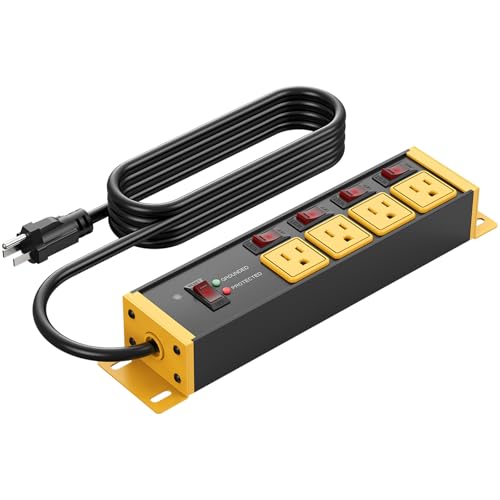
CCCEI 12 Gauge Heavy Duty Surge Protector 6FT Yellow

CCCEI Magnetic Heavy Duty Surge Protector 12 Gauge 6FT Orange

CCCEI 12 Gauge Heavy Duty Power Strip GFCI 8 Ports 6FT Grey

Anker Power Strip 900J Surge Protector 35W Max

CCCEI Heavy Duty Surge Protector 20A Individual Switches 12 Gauge 6FT
Why These Options Stand Out
Reach matters in any garage or backyard setup, and this CCCEI cord delivers a full 50 feet of working length without skimping on conductor thickness. The 12 gauge wire (a thicker conductor that handles more current over distance with less voltage drop) keeps heavy tools running at full strength, while eight grounded outlets let a woodshop, lawn crew, or tailgate setup share a single circuit.
A built-in circuit breaker cuts power if the load climbs too high, and the bright yellow jacket stays visible on busy job sites. For anyone tired of chaining cheap strips together, this is the upgrade that ends the daisy-chain habit for good.
A Few Highlights
- 50 foot reach handles large garages and outdoor setups
- 12 gauge wiring preserves tool performance over distance
- Eight grounded outlets replace a tangle of smaller strips
- Dedicated on/off switch for fast load control
- Hi-vis yellow jacket reduces trip hazards on busy sites
Things To Consider
- Long cord can snag in tight indoor layouts
- No USB ports for charging phones directly
Who It Suits Best
Garage hobbyists, small contractors, and homeowners running mowers, pressure washers, or shop vacs away from the nearest wall outlet.
Consider Something Else When
Reach beyond 50 feet calls for the CCCEI 12 Gauge Extension Cord with Multiple Outlets 100FT Yellow, which gives yards and long driveways the extra runway they need.
Stretching a full 100 feet, this CCCEI strip handles the kind of runs that defeat ordinary indoor cables. Outdoor event planners, RV owners, and homeowners powering string lights across a patio all benefit from the same heavy 12 gauge conductor that keeps tools honest at the far end of the line.
Eight outlets and an inline breaker give it the feel of a portable distribution box, and the rugged yellow jacket handles scuffs from concrete or gravel. The honest read is that 100 feet is overkill for a desk, but it’s liberating anywhere the nearest outlet is far away.
The Case For It
- 100 foot reach covers full yards and event spaces
- Twelve gauge build prevents tool slowdown across long runs
- Eight grounded outlets handle grouped equipment
- Inline breaker protects against overload
Worth Noting
- Bulky to coil and store in smaller homes
- Higher weight makes ceiling or wall routing harder
- Premium price for the extra cord length
Feature Snapshot
Made For
Backyard entertainers, lighting crews, and contractors managing jobs that demand serious reach from a single feed.
Skip It When
A shorter workspace inside a home office calls for the Anker Power Strip 900J Surge Protector 35W Max, which keeps things compact on the desk.
Modern desks rarely run on AC alone. This CCCEI unit folds two USB-C ports and one USB-A alongside four grounded outlets, turning a single wall socket into a true charging hub for laptops, tablets, and accessories. Each outlet carries its own switch, so one device can sleep without cutting power to the rest.
Compared with the long yellow cords from CCCEI earlier in the list, this model trades reach for desk-friendly density. It feels like a logical step for anyone whose power needs have shifted from power tools to pixel-heavy gear.
Benefits That Matter
- USB-C and USB-A ports eliminate bulky wall adapters
- Individual outlet switches give granular control
- Twelve gauge cord stays cool under load
- Master switch cuts everything during long absences
Trade Offs
- Only four AC outlets limit bigger workstation setups
- Short six foot cord may not reach distant wall jacks
Best Suited To
Hybrid workers, students, and creators who charge a laptop and several small devices from the same spot every day.
A Better Fit Elsewhere
High-current workshops are better served by the CCCEI 12 Gauge Heavy Duty Surge Protector 6FT Yellow, which trades USB ports for 20A capability.
Eighteen wide-spaced outlets sound excessive until you actually count what a real workstation demands: monitors, dock, speakers, printers, lamps, and the occasional laptop charger. NANOLAKE delivers that scale with a flat plug (a low-profile wall connector that tucks behind furniture) that disappears behind desks and entertainment centers.
The 4800 joule rating (a measure of how much energy a surge protector can absorb before its components wear out) is among the highest on this list, which matters if you protect expensive TVs, PCs, or audio gear. Adding four USB ports, including two USB-C with PD 20W, makes this a one-stop power solution.
The Upside
- Eighteen outlets cover whole workstation setups
- 4800 joule rating shields high-value electronics
- Wide spacing fits chunky adapters side by side
- USB-C PD 20W charges phones fast
- Mountable design supports under-desk or wall installs
Minor Gripes
- Long body takes up real estate on shallow shelves
- Ten foot cord can be tricky to hide cleanly
Who Will Love This
Power users with gaming setups, home recording studios, or multi-monitor workstations that pull real wattage from the wall.
Look Elsewhere When
A compact dorm desk makes better use of the Anker Power Strip 900J Surge Protector 35W Max, which delivers charging power without the bulk.
Tower-format power strips shine in shared spaces, and TAGZILO leans into that with twelve outlets arranged around a slim vertical column. The dedicated 30W USB-C PD port (Power Delivery, a fast-charging standard that negotiates higher wattage for compatible phones and laptops) hits charging speeds that most strips in this category can’t match.
A family kitchen counter, a conference table, or a craft room all make good homes for this shape. It cleans up cable clutter because every plug faces a different direction, reducing the wall-of-bricks look that flat strips often create.
Notable Gains
- 30W USB-C PD fast-charges phones and small laptops
- Tower shape saves counter space
- Twelve outlets serve multi-user households
- 1800 joule protection covers daily electronics
- Ten foot cord reaches distant outlets
Points To Note
- Tower can tip if all cables pull from one side
- Higher price than flat strip equivalents
Perfect Match For
Busy families and remote-work households where multiple people charge devices at the same kitchen counter or shared table.
Another Choice May Suit
Single-user desks with tighter space constraints fit better with the CCCEI Heavy Duty Surge Protector 12 Gauge USB Ports 6FT Black, which lies flat.
Industrial-grade outlets (5-20R and 6-20R, the heavier NEMA receptacle types used for 20-amp circuits rather than standard 15-amp household plugs) set this CCCEI strip apart from anything on the residential side of the catalog. Each outlet gets its own 20A breaker, so a tripped circuit never shuts down the whole bench.
That makes the strip a natural fit for metalworking tools, air compressors, and other gear that draws serious current. The wall-mountable design also clears floor space in tight workshops where cables love to tangle.
What Helps Most
- Per-outlet 20A breakers isolate trips
- Wall-mountable hardware saves floor space
- Twelve gauge cord stays cool under heavy load
- Industrial-grade receptacles accept 20A plugs
Room For Improvement
- Only four outlets limit simultaneous tool count
- Yellow jacket looks utilitarian in finished rooms
Who Should Grab It
Woodworkers, fabricators, and serious DIYers running table saws, planers, or compressors from a single bench feed.
Reach For A Different Pick When
Anyone needing magnetic mounting for a steel cabinet should look at the CCCEI Magnetic Heavy Duty Surge Protector 12 Gauge 6FT Orange instead.
Built-in magnets change how a power strip lives in a workshop. Snap this CCCEI strip to a steel cabinet, tool chest, or saw leg, and it stays exactly where you need it without screws or shelves. Four outlets with individual switches and a master control keep the layout tidy.
The bright orange jacket keeps it visible on cluttered benches. Compared with the wall-mount option earlier in the list, this one trades permanent installation for grab-and-go flexibility.
Where It Excels
- Magnetic mount attaches to any ferrous metal surface
- Individual switches control each outlet independently
- Master switch handles full power-down
- Twelve gauge cord runs cool under heavy loads
Honest Caveats
- Magnet useless on aluminum or wood surfaces
- Orange color stands out in styled interiors
- Four outlets may feel tight for big tool fleets
Built With In Mind
Garage tinkerers and small-shop pros who reconfigure their bench layout often and want power that follows the work.
Where A Sibling Pick Shines
Anyone needing GFCI protection for damp basements should choose the CCCEI 12 Gauge Heavy Duty Power Strip GFCI 8 Ports 6FT Grey instead.
Moisture changes the electrical safety math, and GFCI (Ground Fault Circuit Interrupter, a built-in breaker that cuts power in milliseconds when current leaks through water or a person) is the standard defense in damp spaces. CCCEI folds that protection into a strip with eight grounded outlets, making it a strong fit for basements, outdoor kitchens, and detached garages.
The 20A switch and 12 gauge cord stay ready for real load. Owners commonly install it on surfaces where a standard strip would be a code violation, and that alone justifies the slightly heavier build.
Everyday Advantages
- Built-in GFCI protects against ground faults in damp areas
- Eight outlets handle grouped equipment
- Twelve gauge cord runs cool under full load
- Neutral grey jacket blends into utility spaces
A Few Limitations
- GFCI test button adds a small learning curve for first-time owners
- Six foot cord limits placement in larger rooms
- No USB ports for direct device charging
Key Product Details
The Right Fit
Homeowners finishing basements, building outdoor kitchens, or wiring detached workshops where moisture makes code-grade protection essential.
Swap It Out When
A clean indoor office doesn’t need GFCI, and the TAGZILO Tower Power Strip PD 30W 12 Outlets 1800J 10FT White covers that case with faster charging.
Anker built its reputation on compact charging gear, and this strip channels that expertise into a slim desktop format. Eight AC outlets, two USB-C, and two USB-A share a body thin enough to slip behind a monitor or mount under a standing desk. The 35W USB-C port is the standout, fast-charging a MacBook Air without a separate brick.
Where the heavy-duty CCCEI models earlier on this list speak to workshops, this one speaks to design-conscious home offices. It feels like a category shift, and for many readers, that’s exactly the point.
Useful Touches
- 35W USB-C fast-charges laptops without a brick
- Slim profile tucks behind monitors and furniture
- Twelve total ports cover modern device loads
- 900 joule protection handles everyday surges
Some Limits To Know
- Lower joule rating than industrial-grade options
- Not designed for high-draw shop tools
- Premium price for a desktop form factor
Feature Rundown
Whose Shelf It Belongs On
Minimalist home office owners and remote workers who value clean lines and fast laptop charging over raw outlet count.
Where Another Pick Suits Better
Industrial workshops pulling real amperage need the CCCEI 12 Gauge Heavy Duty Surge Protector 6FT Yellow and its 20A outlets instead.
This CCCEI strip closes the list by combining what the previous models split apart: GFCI protection, individual 20A switches, and a heavy 12 gauge cord in one yellow-jacketed body. Garage benches, commercial kitchens, and shop floors all benefit from per-outlet control without tripping the whole strip.
The design keeps the cord cool even at full draw, which matters when air fryers, mixers, and vacuums cycle through a kitchen outlet. For anyone whose space mixes food prep with power tools, this strip handles both honestly.
Positive Takeaways
- GFCI plus per-outlet switches give layered safety and control
- Twelve gauge cord stays cool under continuous load
- Four independently switched plugs allow selective use
- Industrial-grade plug suits shop and kitchen use
Points To Keep In Mind
- Four outlets may be limiting for larger tool fleets
- Yellow jacket stands out in styled kitchens
- Heavier than typical residential strips
Feature Card
Built With In Mind
Pros running hybrid garage-and-kitchen setups, food trucks, and home workshops that cycle between tools and appliances all day.
Not Your Match When
A clean desk environment is better served by the Anker Power Strip 900J Surge Protector 35W Max, which fits the office aesthetic.
What To Weigh Before Picking a Smart Surge Protector
Match Capacity To Real Load
The first honest question is how many amps your tools or devices actually draw. Most home electronics sit comfortably on a 15-amp circuit, but air compressors, space heaters, and table saws climb higher. Industrial receptacles (5-20R, 6-20R) earn their place when you regularly cross that threshold. Mismatched capacity is the most common cause of nuisance trips, so sizing matters more than outlet count.
Consider The Environment
Dry indoor spaces give you the broadest choice, while basements, garages, and outdoor kitchens demand GFCI protection. Moisture turns a cheap strip into a hazard, and code inspectors increasingly flag residential installs that ignore the rule. If the strip lives anywhere damp, GFCI is non-negotiable.
Balance Cord Length Against Clutter
Long cords reach farther, but they also tangle, snag, and store poorly. A six foot cord covers most desks and benches; a 50 or 100 foot cord belongs outside, where it earns its bulk. Measure first, then buy, since oversize cords become permanent trip hazards in tight rooms.
Look For Real Surge Ratings
Joule ratings describe how much energy a strip absorbs before its protection wears out. Higher numbers last longer under repeated small surges and shield expensive gear during big spikes. A 900-joule strip is fine for lamps and laptops, while 4800 joules earns its place around high-value TVs or workstations.
Key Considerations Across These Picks
Common Shopping Slip Ups
The biggest trap is counting outlets instead of checking spacing. Wide brick-style adapters can swallow two or three adjacent slots on a standard strip, leaving the count misleading. Always check the spacing between receptacles if your cables include chunky wall warts.
What The Higher Tier Buys
Premium strips in this category add per-outlet switches, GFCI protection, USB-C PD charging, and thicker 12 gauge cords. Those upgrades matter most in shared kitchens, busy desks, and shops where one weak link can ruin an expensive tool. For a single lamp and laptop, a basic 15-amp strip is plenty.
Frequently Asked Questions
How many joules do I really need?
A 900-joule strip covers most everyday electronics, while 1800 to 4800 joules makes sense for home theaters, gaming PCs, and workstations with expensive monitors. Heavy shop tools benefit less from joule ratings and more from higher amp ratings and GFCI protection.
Do I need a smart surge protector or a regular one?
Smart features like app control and energy monitoring add convenience but cost more. Most households get full protection from a well-rated standard strip, while smart models make sense for energy tracking or remote rebooting of network gear.
What does GFCI actually protect against?
GFCI cuts power in milliseconds when current leaks through water, a person, or a damaged wire. It’s required by code in kitchens, bathrooms, garages, basements, and outdoor outlets. Using a GFCI strip lets you add protected outlets without rewiring the wall.
How long do surge protectors last?
The protection components degrade with each surge they absorb. A good rule is to replace strips every few years, sooner if a major storm or power event recently hit. LED indicators help signal when internal protection has worn out.
Can I daisy-chain power strips?
Daisy-chaining strips is a fire code violation in most jurisdictions. It overloads the wall outlet and bypasses the safety features of each strip. When you run out of outlets, add a single higher-capacity strip instead of stacking.
Closing Remarks
The best smart surge protector for you depends less on spec sheets and more on where you actually use it. Workshops reward thick cords and high amp ratings. Desks want USB-C and slim builds. Damp spaces need GFCI. Start with the room, then pick the strip that fits how you already work.