Countertop cooking has changed a lot in the last few years, and air-fryer toaster ovens are the reason. You get toast, bakes, roasts, and crisp wings from a single appliance, often in less time than a full-size oven. The picks below cover compact singles, family-sized cavities, and a few handy add-ons that make the daily routine smoother.
A Closer Look At The Lineup

Runeaoys Heat Resistant Mat for Air Fryer 4-Pack 16 x 12 In

SMIRLY Digital Air Fryer Toaster Oven Combo 25L Stainless Steel
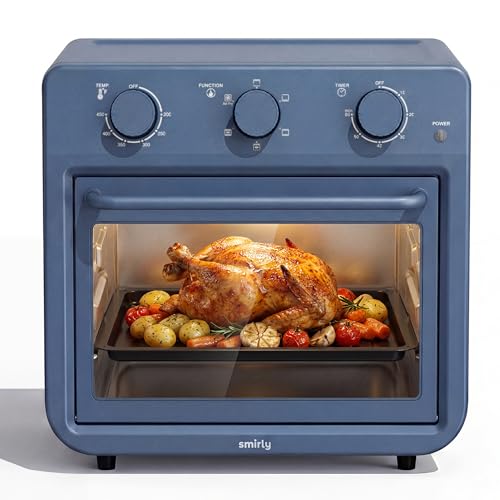
SMIRLY 6-in-1 Air Fryer Toaster Oven Combo 27QT Blue

INFRAOVENS Wooden Oven Rack Puller Stick Long Handle

Nuwave Bravo Pro Smart Air Fryer Toaster Oven Countertop Combo

Nuwave Bravo Air Fryer Toaster Countertop Convection Oven Combo

Midea Neo Air Fryer Toaster Oven Combo 12.7 Quarts Stainless Steel

Midea Flexify Slim 8-in-1 French Door Toaster Oven Air Fryer 25QT
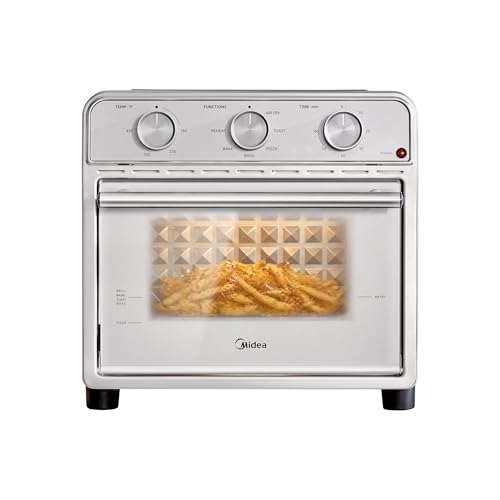
Midea Neo Air Fryer Toaster Oven Combo 21.1 Quarts Stainless Steel
What Each Pick Brings To The Table
Countertop air-fryer ovens run hot on the bottom, and a bare stone surface takes the brunt of it. This Runeaoys mat set is built to sit between your appliance and the counter, catching heat, drips, and the slow grind of vibration. Each pad is 16 by 12 inches, large enough for most mid-size air fryers and basket-style toaster ovens.
Owners who treat granite or butcher block as a long-term investment get the most out of these. The silicone-and-felt blend grips well, so the appliance tends to stay put during the door-slam that comes with retrieving a hot tray.
Positive Points
- Heat-resistant layer reduces risk of discoloration on stone counters
- Non-slip base keeps the appliance from creeping during heavy use
- Four-pack covers the air fryer, coffee maker, blender, and toaster at once
- Slim profile slides under most appliances without a visible bump
Worth Noting
- Felt underside can trap crumbs, so a quick vacuum every couple of weeks is wise
- Mat thickness may raise shorter appliances enough to affect door clearance
Right Fit For
Renters and homeowners with stone or laminate counters who run their air fryer several times a week.
Swap It Out When
You’d rather focus on the oven itself, in which case the SMIRLY Digital Air Fryer Toaster Oven Combo brings actual cooking capability to the counter.
The first proper cooking pick on the list is the SMIRLY 25L. The cavity is roomy enough for a small chicken, a 12-inch pizza, or two sheet pans side by side, and the stainless housing gives it a slightly more grown-up look than the usual plastic shells. A digital panel handles time, temperature, and mode selection, which removes a lot of the guesswork that dial-style ovens carry.
Weeknight cooks feeding three or four people tend to be the right fit. Compared with the Runeaoys mat above, this is where the appliance category really begins: a single counter unit that handles toast in the morning and a full air-fry dinner at night.
Features That Help
- 25L cavity handles family-sized portions in one pass
- Digital display removes the dial-and-guess routine
- Stainless housing wipes clean with a damp cloth after greasy cooks
- Multi-mode cooking covers bake, broil, toast, and air fry
Points To Note
- Stainless finish shows fingerprints, so plan on quick wipe-downs
- Larger cavity means a longer preheat than compact picks
Key Specs
Who It Suits Best
Home cooks batching meals for three or four people most evenings.
Consider Something Else When
You cook in tight quarters, where the Midea Neo 12.7-Quarts is the more compact alternative.
The sibling to the SMIRLY 25L, this 27QT model adds a six-mode heating system (top, bottom, dual, and each paired with convection) on top of the larger cavity. Convection is the bit that circulates hot air with a fan, so it tends to crisp food faster than a static heating element. If you’ve ever been disappointed by soggy oven fries, convection is the usual fix.
Compared to the 25L, this unit gives up a touch of counter real estate for noticeably more headroom and more cooking flexibility. Households that split cooking duties between two people will appreciate the multiple heater pairings.
Where It Excels
- Six heating combinations cover most everyday recipes
- Convection mode crisps wings and fries faster than static heat
- 27QT capacity suits casseroles and a small roast
- Analog knob controls feel intuitive for non-tech-oriented cooks
Trade Offs
- Takes up more counter depth than the 25L model
- Knob controls lack the precise digital readouts of higher-tier picks
Built With In Mind
Cooks who rotate between baking, roasting, and air-frying throughout the week and want flexibility without learning a touchscreen.
Not Your Match When
You want digital precision for pizza-style adjustments, where the Nuwave Bravo Pro offers finer heater ratios.
Countertop ovens sit low, and their openings are narrower than full-size ovens, which means standard mitts often bump the door frame before reaching the tray. INFRAOVENS solved that with a wooden puller stick that slides under the rack edge so you can hook and slide without getting close to the heat source. The longer handle keeps knuckles well away from the heating elements.
This isn’t an oven, but for anyone who owns a compact air-fryer toaster oven, it earns its place in the same drawer. Smaller-batch cooks and apartment dwellers tend to find it useful, since these appliances heat up fast and the rack gets hot quicker than a full-size oven rack.
Real Benefits
- Long handle keeps hands away from heating elements
- Wooden hook shape slides under narrow rack edges
- Compact size stores in a utensil drawer
- Works with toaster ovens, air fryers, and convection units
Some Limits To Know
- Wood handle should not be left near active heating elements
- Hook angle works best on standard wire racks, not solid trays
Feature Snapshot
Made For
Anyone with a compact countertop oven who pulls trays out several times a week.
Look Elsewhere When
You mostly cook one-pan meals and rarely pull the rack mid-cook, where you’d save the counter space entirely.
The Bravo Pro is where the category shifts from “toaster oven that air-fries” to “air-fry oven with serious controls.” A high-speed fan paired with top and bottom heater ratios (adjustable from zero to one hundred percent) lets you build zones for thick pizza, bread bake, or open-faced roasting. The 2025 fan upgrade is reported to push faster airflow than earlier Bravo models.
Compared with the SMIRLY 27QT’s six fixed modes, this gives you continuous sliders instead of presets. That suits recipe tinkerers who adjust mid-cook, but it can feel like overkill for anyone who mainly wants toast and reheats.
Why It Works Well
- Independent top and bottom heater ratios enable pizza-style zoning
- High-speed fan crisps wings and fries quickly
- On-the-fly digital adjustments without restarting the cycle
- Convection control complements the heater balance
Things To Weigh
- Steeper learning curve than knob-controlled picks
- Larger footprint than the SMIRLY 25L
At A Glance
Best Suited To
Home cooks who treat weeknight dinners like small experiments and want fine-grained control over heat zones.
A Better Fit Elsewhere
You mostly toast and reheat, where the Midea Flexify Slim offers a more straightforward preset experience.
The original Bravo sits a step below the Pro but keeps the same DNA: digital controls, top-and-bottom heater ratios, and a convection fan that handles the air-fry side of cooking. This is the everyday workhorse of the Bravo line, and for many households it’s the more comfortable entry point than the Pro.
Where the Pro pushes fan speed higher, this model leans on its intuitive controls and easier mid-cook adjustments. If you’ve been eyeing the SMIRLY 27QT but want more precise digital readouts, the Bravo is the natural step up.
The Practical Payoff
- Digital controls adjust time and temperature mid-cook
- Top and bottom heater balance handles pizza and toast alike
- Convection fan crisps without preheating the full oven
- Refined interface suits recipe-driven cooking
Small Caveats
- Digital panel collects splatter and needs occasional wiping
- Older Bravo generation than the Pro
Who Should Grab It
Cooks who want digital control and convection without the Pro’s higher fan speeds.
Reach For A Different Pick When
Crispy wings are a weekly staple, where the Nuwave Bravo Pro’s upgraded fan pulls ahead.
The Midea Neo 12.7QT is the smallest of the Mideas in this roundup, and it earns its slot by fitting where the others won’t. Dorm counters, galley kitchens, and one- or two-person households are its natural habitat. The 12-liter cavity handles a couple of chicken thighs or a personal pizza without dominating the workspace.
Compared with the SMIRLY 25L, you’re trading roughly half the cavity for a noticeably slimmer footprint. If counter space is the constraint and not party-size cooking, this is often the smarter buy.
Reasons It Performs
- Slim 12.7QT footprint fits on narrow counters
- Multi-function presets cover air fry, toast, pizza, broil, bake, and reheat
- Stainless housing fits in with most modern kitchens
- Quick preheat suits single-portion meals
Honest Caveats
- Smaller cavity means cooking for more than two requires batch rounds
- Lacks the infrared heating element of the Flexify Slim
Feature Card
Perfect Match For
Dorm rooms, studio apartments, and singles who want air-fry capability without surrendering the counter.
Where Another Pick Suits Better
Family-style cooking is the priority, where the Midea Neo 21.1-Quarts offers nearly twice the cavity.
The Flexify Slim looks like a piece of small furniture, with twin French doors that swing down instead of a single drop-down panel. Inside, infrared heating (a technology that uses radiant energy to cook food faster than conventional hot air) drives the SpeedHeat element, which gets the cavity up to temperature notably faster than a standard coil oven. The 25QT capacity splits the difference between the SMIRLY 25L and the Midea Neo 21.1QT.
Style-driven kitchens benefit most. If you’ve ever wanted an appliance that earns its place visually rather than hiding behind a toaster, this is the one. Compared with the SMIRLY 25L, you trade a single-door layout for a wider, more furniture-like footprint.
Good Reasons To Consider
- Infrared SpeedHeat cuts preheat time noticeably
- Eight-in-one function list covers daily cooking needs
- French doors open flat for easy tray access
- Stainless exterior fits modern kitchen aesthetics
Things To Consider
- Wider counter footprint than a single-door compact
- Infrared element tends to brown food quickly, so recipes may need a few minutes less
Quick Facts
Whose Shelf It Belongs On
Style-conscious cooks who want an appliance that earns its visual real estate and delivers faster preheats.
Skip It When
Counter depth is tight, where the Midea Neo 12.7QT keeps a slimmer profile.
The 21.1QT Midea Neo sits between the compact 12.7QT and the Flexify Slim’s 25QT, and for many households it’s the sweet spot. The 20-liter cavity fits a 12-inch pizza, full sheet-pan dinners, or a small roast with vegetables around it. EvenHeat Technology helps distribute that heat evenly, which is the usual complaint with cheaper toaster ovens.
Compared with the smaller Neo, this adds meaningful capacity for families without jumping to the wider Flexify footprint. If you’re feeding four to five on a regular basis, it’s the more comfortable daily driver.
Strengths Worth Knowing
- 21.1QT cavity handles full family meals
- EvenHeat Technology reduces hot-spot browning
- Stainless housing matches most kitchen finishes
- Multi-mode presets cover daily cooking routines
Worth Bearing In Mind
- Heavier to reposition on the counter than smaller picks
- Lacks the infrared SpeedHeat of the Flexify Slim
Best Suited To
Families or households hosting friends a few times a week who want one oven to cover it all.
Not Your Match When
You mostly cook for one and want a smaller, lighter appliance, where the Midea Neo 12.7QT makes more sense.
Picking The Right Size And Features For Your Kitchen
Cavity size is the single biggest decision, and most people either under-buy or over-buy. A 12 to 13-quart cavity handles one or two portions and a slice of toast without breaking a sweat, but it struggles with a full pizza stone or a family-size casserole. Anything in the 21 to 27-quart range handles a 12-inch pizza and most everyday roasts. Anything above that starts eating counter space you might need for prep.
Convection versus infrared is the second decision. Convection uses a fan to move hot air around, which is the standard approach in picks like the SMIRLY 27QT and the Nuwave Bravo. Infrared, as in the Midea Flexify Slim, uses radiant heating that browns faster but can over-crisp if you’re not paying attention.
Digital controls versus analog knobs come down to how often you plan to tinker. The Nuwave Bravo Pro and SMIRLY Digital lean into precise adjustments, while the SMIRLY 27QT’s analog dial is friendlier for anyone who doesn’t want to learn a new interface. Stainless versus plastic housing affects long-term durability more than cooking performance, but stainless tends to clean up better after a greasy cook.
Key Considerations Across These Picks
Where Shoppers Go Wrong
The most common mistake is buying by capacity alone. A 27-quart oven that you only use for toast and reheats wastes counter space and preheats slowly compared to a smaller unit. The opposite happens too: a 12-quart oven that sounds appealing can frustrate anyone who tries to cook for four on Sunday night.
Another trap is ignoring door clearance. French-door models like the Midea Flexify Slim open wide and forward, which matters if the oven sits under a cabinet. Single-door drops need vertical clearance above, which matters if the unit is parked under a shelf.
What The Higher Tier Buys
Stepping up to a digital, multi-zone oven buys you mid-cook adjustability and finer heat ratios. For most households, that’s the difference between following a recipe and tweaking one. If you rotate between pizza, roast, and air-fry without thinking about it, a Bravo Pro or Midea Flexify is the upgrade that pays off.
Frequently Asked Questions
Are air fryer toaster ovens worth it compared to a regular toaster oven?
For most households, yes. The air-fry function crisps food faster and uses less oil than oven baking, and you still get toast, bake, and broil in the same unit. The trade-off is a higher price and slightly larger footprint.
How big should the cavity be for a family of four?
A 21 to 27-quart cavity usually handles a 12-inch pizza, a small roast, or two trays of vegetables at once. Anything smaller tends to require batch cooking for that family size.
Do these ovens need special cleaning?
Most use a removable crumb tray and dishwasher-safe rack. Stainless exteriors wipe clean with a damp cloth. Avoid abrasive pads, since they tend to scratch the finish over time.
Can a countertop air fryer oven replace a full-size oven?
For daily weeknight cooking, often. For large holiday roasts or multiple sheet pans at once, a full-size oven still wins on capacity. Most people end up using the countertop unit for 80% of cooks and the full-size oven for the rest.
Is infrared heating better than convection?
Infrared, as in the Midea Flexify Slim, preheats faster and browns more aggressively. Convection, used in picks like the SMIRLY 27QT and Nuwave Bravo, cooks more evenly and is more forgiving on timing. The right answer depends on how often you watch the cook versus set it and walk away.
Bottom Line
Air-fryer toaster ovens have grown into genuine everyday appliances rather than specialty gadgets, and the picks above cover the main profiles: compact singles, mid-size family ovens, and high-control picks for tinkerers. Match the cavity to your household size, decide how much mid-cook adjustment you actually want, and the right pick usually reveals itself. Whichever one you choose, the counter becomes a more useful place to cook.