Walk into a small woodworking shop and the first thing you hear is the roar of a dust collector. The second thing you notice is the owner crossing the room every few minutes to flip it on and off. An automatic vacuum switch solves that small but constant annoyance, syncing your shop vac or dust collector to whatever tool you’re running so extraction happens only when it needs to. The eight options below cover the common setups: wireless remotes for solo work, plug-in autoswitches with adjustable thresholds, and a few specialty picks for unusual power configurations.
The Lineup, Simplified

CHAOSEND 120V Wireless Remote Vacuum Switch (Battery Included)
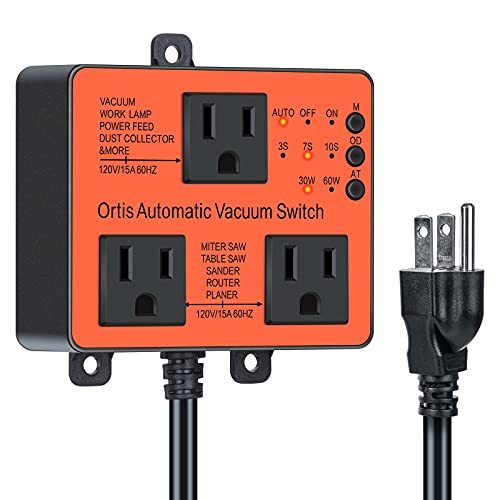
Ortis Dust Control Autoswitch with Delay On/Off

TAICHODEER Shop Vac & Dust Collector Switch

MIAOLINK 120V/15A Autoswitch with 30W/60W/90W Threshold

Palawell 30W/60W Tool-Activated Vacuum Switch
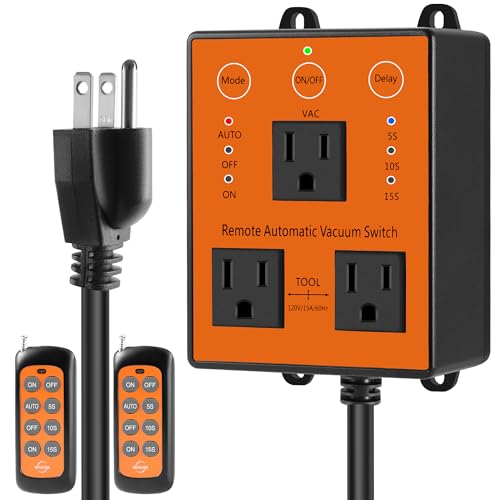
MIAOLINK 120V/15A Power Tool Dust Control Switch

MIAOLINK 120V Wireless Dust Collector Switch with 2 Remotes
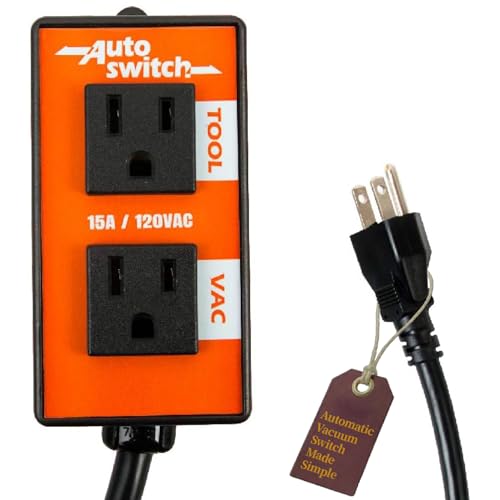
O’SKOOL Shop Vac Delay-Off Switch
Why These Options Stand Out
The CHAOSEND takes a different angle from most switches on this list: it skips the autoswitch sensor entirely and leans on a 120V wireless remote instead. RF (radio frequency) signals travel through walls and across open shop floors, so you can stand at the miter saw and click the collector on without crossing the room.
That setup works nicely in detached garages or shops with concrete-block walls where Bluetooth would struggle. Owners of long, single-floor layouts benefit most, since the listed range covers far more ground than a typical line-of-sight remote. The trade-off is that there’s no automatic tool-trigger, so you’ll still press the button by hand.
The Case For It
- Wireless on/off control from across a large shop
- Signal passes through walls and workbench clutter
- Battery is included, so the unit works out of the box
- Plug-and-play design needs no tool-side setup
Points To Keep In Mind
- No automatic tool activation; you’ll press the button every time
- Battery replacement is occasionally needed, depending on use frequency
- Remote is small and easy to misplace in a busy shop
Feature Snapshot
Whose Shelf It Belongs On
Workshop owners with large or spread-out floor plans who prefer remote control over sensor-based automation.
A Better Fit Elsewhere
If you want hands-free activation that fires up the collector the moment a saw starts, the MIAOLINK 120V/15A Autoswitch suits that workflow better.
Ortis has been on this list’s category for a while, and the current generation adds two tool outlets so you don’t need a separate power strip. Three modes (Auto, Off, On) let you choose between sensor-driven use, manual override, or a constant-on state for awkward jobs.
The adjustable actuation threshold matters more than it sounds. A 30W trigger works for sensitive small tools; 60W suits heavier saws. The delay on/off feature prevents circuit trips by spacing out the inrush current (the brief power spike when motors first spin up) when multiple tools wake up at once, which is common in a tight shop circuit.
Everyday Perks
- Two tool outlets reduce cord clutter at the bench
- Three-mode switch covers most workshop routines
- Adjustable threshold stops false triggers from standby current (the small phantom draw electronics pull even when “off”)
- LED indicators show current mode at a glance
Trade-Offs To Consider
- Single vacuum outlet limits dust collector placement
- Threshold steps are limited to two presets
- Plastic housing feels lighter than metal-cased competitors
Perfect Match For
Garage woodworkers running two adjacent power tools who want proven auto-detection without overthinking settings.
Skip It When
You need three or more outlets at once; the MIAOLINK 120V/15A Power Tool Dust Control Switch offers an extra outlet for larger setups.
TAICHODEER keeps the feature list short and the daily use case clear. Two tool outlets, a configurable delay (3, 7, or 10 seconds), and broad tool compatibility from table saws down to routers and planers. For hobbyists who don’t want to read a manual, that’s about the right amount of complexity.
The custom delay is the quiet highlight. A 10-second run-on after the tool stops gives the hose time to pull loose dust into the canister, which matters when you’re cutting MDF or plywood that sheds fine particles. Compared to the CHAOSEND pick above, you trade wireless control for hands-free automation.
A Strong Showing
- Three delay settings match common cutting durations
- Works with routers, planers, and joiners, not just saws
- Two tool outlets handle adjacent bench tools
- Compact housing fits tight outlet boxes
Worth Bearing In Mind
- No adjustable actuation threshold in the published specs
- Single vacuum outlet may require an extension for distant collectors
Right Fit For
Hobby woodworkers using two benchtop tools who want a “set it and forget it” delay without extra configuration.
Reach For A Different Pick When
You frequently switch between heavy and light tools; the MIAOLINK 30W/60W/90W model offers finer threshold tuning.
Where most autoswitches offer two threshold choices, the MIAOLINK B0FXKTKTF2 adds a third: 30W, 60W, or 90W. That extra step matters in mixed shops where a 1/4-inch router might pull 200W but a small trim saw sits closer to 800W. The 90W setting prevents small tool standby current from waking the collector.
The 15A tool outlets handle heavier draw tools, so this fits shops where a miter saw and planer share a circuit. Three modes (Auto/On/Off) match the standard pattern. Compared to the Ortis above, you get finer threshold tuning in exchange for a very similar feature set elsewhere.
Bright Spots
- Three threshold presets handle a wider tool range
- 15A outlets support heavier shop tools
- Adjustable delay shutoff clears the hose after the cut
- Compatible with most woodworking setups out of the box
Factors To Consider
- More settings can confuse first-time installers
- No wireless remote included, unlike the CHAOSEND pick
Quick Facts
Best Suited To
Shops running tools across a wide wattage range, from light sanders to mid-size miter saws, who want fine trigger control.
Not Your Match When
You’d rather press a remote button than configure thresholds; the CHAOSEND wireless remote is the simpler path.
Palawell leans into the low end of the threshold range. The 30W setting catches small rotary tools and detail sanders that other switches miss entirely. Most autoswitches default to 60W or higher, which is fine for saws but leaves palm sanders and engravers out in the cold.
The 60W mode handles the heavier workshop tools when needed, so the unit isn’t limited to fine work. Two-mode toggling keeps the controls simple. For a craftsperson doing mostly detail sanding and small cuts, this catches the low-wattage tools that bulkier competitors overlook.
Positive Points
- 30W threshold catches small detail tools
- Two-mode toggle is straightforward to set
- Tool-activated design means no remote to lose
- Compact body fits small benchtop spaces
Small Caveats
- 30W mode can false-trigger on devices with phantom loads, like a smart plug
- Not ideal as the only switch for a miter saw
Product Snapshot
Made For
Model makers and detail sanders who run low-wattage tools that standard autoswitches tend to ignore.
Where Another Pick Suits Better
If your shop runs mostly full-size saws, the MIAOLINK B0FXKTKTF2 with its 90W threshold handles those loads more reliably.
This MIAOLINK sibling to the B0FXKTKTF2 swaps one tool outlet for an extra one, giving you three AC outlets total: one vacuum-dedicated and two for tools. That layout suits benchtop clusters where a sander, router, and dust collector all share a single wall socket.
The 35W activation floor sits between the Palawell’s 30W and the MIAOLINK B0FXKTKTF2’s 30W. The 5/10/15-second delay options run longer than most competitors, which is genuinely useful for long hose runs where dust needs extra time to clear. Compared to the Ortis, you get an extra outlet at the cost of a slightly higher threshold floor.
Practical Advantages
- Three outlets handle busier benchtop setups
- 15-second delay option suits long hose runs
- 120V/15A rating covers full-size shop tools
- Three-mode operation matches the standard pattern
Some Limits To Know
- 35W floor may miss very small tools
- Larger housing takes more outlet-box room
Feature Rundown
Who Should Grab It
Shops running three-tool benchtop setups where outlet count matters more than fine threshold tuning.
Look Elsewhere When
You mostly use compact detail tools; the Palawell 30W/60W model triggers more reliably for low-wattage work.
This MIAOLINK unit takes the wireless approach one step further by bundling two remotes in the box. Shared garages, two-person shops, or anyone prone to losing small electronics benefits from a spare clicker already in the package.
The 5s/10s delay-off options are shorter than the B0FCXYB8PP above, which keeps the focus on quick clearing rather than long hose runs. Owners commonly mount the receiver near the collector inlet and stick a remote on each major workbench. Compared to the CHAOSEND, you get two clickers instead of one at a similar feature level.
Why It Works Well
- Two remotes included for multi-user shops
- Wireless control from across the room
- Delay-off clears remaining dust from the line
- Battery included for immediate use
A Few Limitations
- No tool-activated sensor mode
- Delay options top out at 10 seconds
Key Product Details
Who Will Love This
Two-person workshops or anyone who has misplaced a single remote and wished for a backup already on hand.
Consider Something Else When
Hands-free tool-triggered automation is the priority; the Ortis autoswitch fires the collector without any button press.
O’SKOOL narrows the scope to a single problem: clearing the hose after a cut. The delay-off runs long enough that fine dust keeps moving toward the canister instead of settling back into the hose. For long hose runs to a remote dust collector, that detail alone can save hours of clearing time per year.
The setup is intentionally straightforward. Plug the tool into one side, the vacuum into the other, and the switch handles the rest. Compared to the MIAOLINK B0FCXYB8PP, you trade multiple outlets for a purpose-built focus on hose clearing. For shop owners fighting chronic dust buildup, that focus is the selling point.
A Favorable Mix
- Delay-off optimized for hose clearing
- Compatible with table saws, miter saws, and routers
- Simple install needs no extra configuration
- Reliable auto-trigger for common woodworking tools
Honest Caveats
- Single tool outlet limits adjacent tool setups
- No wireless remote for far-away triggering
Built With In Mind
Shops running long hose runs to a distant collector where dust settling in the line is a recurring frustration.
Swap It Out When
You need multiple outlets at one station; the MIAOLINK 120V/15A Power Tool Dust Control Switch offers an extra tool outlet for clustered benches.
Picking The Right Automatic Vacuum Switch For Your Shop
Tool Wattage And Threshold Sensitivity
The activation threshold, measured in watts, decides how much current must flow before the switch wakes the vacuum. Set it too low and small phantom loads (the standby draw electronics pull even when “off”) from smart plugs or battery chargers can false-trigger the collector. Set it too high and a 200W palm sander might never fire it up. Matching threshold to your smallest commonly used tool is the single biggest factor in everyday satisfaction.
Outlet Count And Tool Cluster Layout
Count the tools you actually run at one station. Two outlets cover a saw-plus-router bench. Three outlets suit a sander, router, and vacuum sharing a wall socket. Going short means adding a power strip, which adds clutter; going long means paying for capacity you won’t use.
Delay-Off Duration For Hose Clearing
The delay timer keeps the vacuum running after the tool stops. Short delays (3-7 seconds) suit short hose runs where dust moves quickly. Long delays (10-15 seconds) help when the collector sits 20+ feet away or the hose diameter is small. Fine dust from MDF or plywood settles fastest, so longer delays help most there.
Remote Control Versus Sensor Automation
Wireless remotes (like the CHAOSEND or MIAOLINK B0CSCKZQ3L) put you in charge of when the collector runs. Sensor-based autoswitches react to whatever tool you turn on. Solo workers who like the predictability of a button often prefer remotes; multitaskers who forget to flip switches usually want sensors.
Key Considerations Across These Picks
Pitfalls Shoppers Hit
Choosing by outlet count alone is a common trap. A three-outlet switch with a 35W activation floor will miss your 200W sander if you assumed all switches trigger at the same threshold. Always cross-check the activation floor against your smallest tool. Another misstep: ignoring the difference between radio-frequency remotes and Bluetooth, where the former punches through walls and the latter rarely does.
What The Higher Tier Buys
Premium switches in this category add finer threshold tuning, longer delay-off options, and more tool outlets. The upgrade makes sense for shops running a wide mix of tools, where a single fixed threshold causes either false triggers or missed activations. For a one-tool, one-collector setup, a basic switch handles the job without the extra cost.
Frequently Asked Questions
How does an automatic vacuum switch know when to turn on?
It senses current flowing through the tool outlet. Once that current crosses the threshold you’ve set (often 30W to 90W), the switch powers the vacuum outlet. When the tool stops drawing, the vacuum runs through its delay-off period and shuts down.
Will an automatic vacuum switch work with any shop vac?
Most work with standard 120V shop vacs and dust collectors up to 15A. Some heavy-duty 240V collectors need a switch rated for that voltage, which isn’t covered by the picks in this roundup.
Can I plug more than one tool into the switch at once?
It depends on the outlet count. Two-outlet switches handle one tool alongside the vacuum, while three-outlet units like the MIAOLINK B0FCXYB8PP allow two tools plus the collector. Running tools simultaneously triggers the vacuum whenever any one of them draws current.
Why does my vacuum switch false-trigger when nothing is running?
Phantom loads (the small current devices pull even when off) from things like smart plugs, battery chargers, or LED indicators on other equipment can cross the threshold. Raising the activation floor or removing those phantom-load devices from the same circuit usually solves it.
Do wireless remote switches need Wi-Fi or Bluetooth?
No. The wireless options here use radio frequency (RF) signals, which pass through walls and work without a network connection. The remote and receiver are paired at the factory.
The Takeaway
An automatic vacuum switch is a small accessory that pays back in saved steps and cleaner air, especially when matched to your actual tool wattage and bench layout. The eight options above cover most shop configurations, from large wireless setups to tight benchtop clusters. Pick the threshold and outlet count that match your smallest tool and busiest station, and the rest falls into place.