A thermostat that lets you dial in a heating and cooling schedule that actually fits your week can quietly reshape how a home feels. Mornings warm up before anyone drags themselves out of bed, the house cools while you’re at work, and bedtime drifts into a slightly cooler room without anyone touching a dial. The catch is that not every wall thermostat plays nicely with every HVAC system, and the term “programmable” means different things depending on who’s selling it.
This list focuses on programmable wall thermostats built for common residential setups, with a few commercial-grade options that work for light commercial or accessory spaces. Each pick earns its spot by handling a specific job cleanly, from single-stage forced-air systems to heat pumps and specialty line-voltage heating. If you’ve been guessing whether your system is “1H/1C” or “2H/2Cool,” the buying guide below sorts that out before you commit.
A Fast Comparison Of The Options

PRO1 T725 Heat Pump/Conventional Programmable Thermostat
PRO1 T771 Single Stage Non-Programmable Thermostat
Honeywell TH1100DV1000 PRO 1000 Vertical Thermostat

PRO1 T701 Single Stage Non-Programmable Thermostat
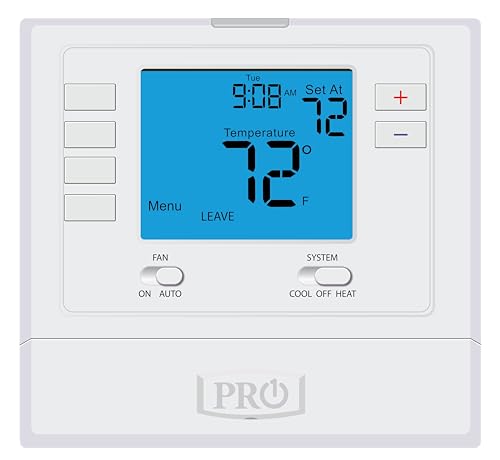
PRO1 T715 Multi-Stage Programmable Gas Thermostat

Heagstat NonProgrammable Thermostat 1 Heat/1 Cool

Honeywell TL7235A1003 Line Volt Pro 240-Volt Thermostat

PRO1 T721 Non-Programmable Thermostat 2H/1C Heat Pump

Venstar T2800 Commercial Platinum Slimline Thermostat
PRO1 T805 Single Stage Programmable Thermostat
A Closer Look At Each Pick
Heat pump households sit in a strange middle ground: their system is more efficient than a furnace, but the thermostat has to speak the right language or the compressor never cycles the way it should. The PRO1 T725 handles both 2 heat/1 cool heat pump configurations and 1 heat/1 cool conventional setups, so swapping it in during a system upgrade is straightforward. Its 7-day scheduling (or 5/1/1 split) lets weekdays follow one routine and weekends drift into a looser schedule without manual resets.
The 4 sq. in. blue backlit display is readable from a couch, and the wake/leave/return/sleep schedule blocks cover the typical day patterns most households actually live. Compare that to the simpler PRO1 T701 reviewed below, and the difference is clear: this model adds the programmable logic without forcing you into a learning curve. Heat pump owners who want real energy savings from setpoint setbacks will appreciate having full weekday and weekend control.
A Few Highlights
- Dual-system compatibility covers heat pump and conventional HVAC in one unit
- Full 7-day or 5/1/1 scheduling suits shifting weekday and weekend routines
- 4 sq. in. blue backlit display stays readable in low light
- Four daily schedule blocks (wake, leave, return, sleep) match common household patterns
- Part of the consistent T700 platform, making future swaps less disruptive
Things To Consider
- Heat pump systems require correct wiring at the terminal block, so mismatched C-wire setups can complicate install
- Lacks the larger 7 sq. in. screen found on the PRO1 T805 for users who prefer oversized numbers
- Schedule programming takes a few minutes to map out the first time you set it
Who Will Love This
Heat pump homeowners who want weekday-and-weekend differentiation without stepping up to a multi-stage system will find the right balance here.
Skip It When
Runners with single-stage conventional furnaces and no programming interest are better matched by the simpler PRO1 T701.
Most thermostats refuse to set the temperature low enough for unheated spaces. The PRO1 T771 breaks that mold with a setpoint range that drops down to roughly 25°F, which matters more than you’d think for garages, workshops, sheds, and hunting cabins where you only need freeze protection, not comfort conditioning. It’s also a non-programmable unit, which fits the way these spaces are usually heated: turn it up when you arrive, turn it down when you leave.
The T700 platform shows up again with its familiar 4 sq. in. blue backlit display, so the visual language matches other PRO1 units in the same home. Swing adjustment and calibration controls give you fine-tuning that pure-programmable units often skip. For anyone whose main system already runs a full schedule, this little wall thermostat covers the outbuilding without complicating things.
The Upside
- Wide setpoint range extends below typical residential thermostats for true cold-space control
- 4 sq. in. backlit display offers the same legibility as larger PRO1 units
- Swing adjustment and calibration help fine-tune performance in drafty spaces
- Simple non-programmable operation matches how most garage or shop heaters are used
Honest Caveats
- Limited to 1 heat/1 cool conventional systems, so heat pump owners can’t use it
- No scheduling means manual setpoint changes whenever conditions shift
Built With In Mind
Garage, shed, and workshop owners running simple 1 heat/1 cool systems and wanting low-temp freeze protection will get exactly what they need.
A Better Fit Elsewhere
Heat-only homeowners wanting vertical mounting should look at the Honeywell TH1100DV1000 PRO 1000 instead.
Sometimes the simplest job is the one that matters: turning a furnace on and off without any schedule drama. The Honeywell TH1100DV1000 PRO 1000 sits in that lane as a heat-only vertical thermostat in a premier white finish. Its roughly 4.7-inch tall, 2.9-inch wide footprint fits narrow wall sections where a horizontal layout would crowd existing trim or paint lines, and at just over an inch deep, it sits nearly flush against drywall.
This is a no-frills replacement for older mercury-switch heat-only thermostats, particularly in older homes with two-wire heat systems that won’t accept fancier controls. It will not run a schedule, won’t talk to a heat pump, and won’t try to do anything except respond to a temperature dial. That focus is the point, and for the right household, it removes more friction than it creates.
What Stands Out
- Vertical orientation saves wall space in tight hallway or stair landings
- Premier white finish blends with most residential trim palettes
- Heat-only design simplifies wiring on legacy two-wire systems
- Compact depth keeps the unit close to the wall for a clean look
Points To Note
- Limited strictly to heat-only single-stage systems; no cooling control at all
- Non-programmable, so any setback has to happen by hand
- No backlight is listed, so dim hallways can make adjustments harder at night
Right Fit For
Homeowners with heat-only systems who want a clean, no-schedule replacement that simply turns the furnace on and off.
Consider Something Else When
Anyone wanting programmable scheduling should choose the PRO1 T725 or PRO1 T805 reviewed here.
Replacing an old thermostat can feel like defusing a bomb, especially when the new one comes with programming menus nobody wants to learn. The PRO1 T701 sidesteps that problem by sticking to the basics: a 1 heat/1 cool conventional control with manual setpoint adjustment and nothing more. The glow-in-the-dark light button is a small touch, but it’s the kind of detail that matters when you’re fumbling for the wall control at 2 a.m.
Built on the T700 platform with the same 4 sq. in. blue backlit display as its programmable siblings, this model gives first-time installers a familiar look and the same physical wiring layout. That’s helpful if you ever decide to step up to a programmable unit later, since the swap usually requires only a feature change rather than a full rewire. For renters, vacation homes, or anyone who genuinely wants to set a temperature and forget about schedules, the T701 delivers exactly that.
Positive Points
- Glow-in-the-dark button makes nighttime adjustments easier without a flashlight
- Same 4 sq. in. backlit display as more advanced PRO1 models for visual consistency
- Non-programmable operation removes any setup confusion for new users
- Compatible with both gas and electric conventional HVAC systems
Trade Offs
- No scheduling means no automated setbacks for energy savings
- Single-stage only, so homes with multi-stage equipment will need a different model
Made For
First-time installers and renters with 1 heat/1 cool conventional systems who want a no-schedule, no-fuss wall control.
Look Elsewhere When
Anyone running a heat pump should consider the PRO1 T725 instead for proper system compatibility.
Bigger homes with multi-stage gas furnaces lose efficiency when the thermostat can’t ask for low-fire versus high-fire operation. The PRO1 T715 solves that by supporting 2 heat/2 cool conventional systems, letting your equipment modulate the way it was designed to. Scheduling options include full 7-day, 5/1/1, or a non-programmable mode if you’d rather keep things manual from day one.
Like its T700 siblings, it carries the 4 sq. in. blue backlit display and a glow-in-the-dark light button for nighttime visibility. Battery or hardwired common-wire options ease installation in older homes where the wiring tray wasn’t designed for modern thermostats. Compared to the single-stage PRO1 T701, this is the step-up model for anyone whose HVAC runs in stages and wants the schedule flexibility to match.
Useful Highlights
- 2 heat/2 cool support matches multi-stage gas furnace and AC systems
- Three operating modes (7-day, 5/1/1, non-programmable) suit different comfort preferences
- Battery or hardwired power options help in older homes lacking a common wire
- Glow-in-the-dark button keeps nighttime use practical
A Few Limitations
- More wiring terminals means installation takes longer for homeowners new to multi-stage systems
- Larger stage count isn’t useful for single-stage homes, so it’s overkill for simpler setups
Best Suited To
Owners of larger homes with multi-stage gas furnaces who want programmable scheduling without going to a smart thermostat.
Not Your Match When
Heat pump households running 2 heat/1 cool configurations are better served by the PRO1 T725 above.
Apartment dwellers and condo owners often have a forced-air gas, oil, or electric furnace matched with a separate air conditioner, and that’s exactly the 24VAC single-stage setup this Heagstat controls. The white backlight keeps the screen readable without flooding the room with light, which matters in smaller spaces where the thermostat might be right next to a bed.
Compatibility is locked to 2 to 5 wire configurations, which covers most single-stage residential installs but excludes systems with 6 to 8 wires. Heat pump systems are explicitly off the list, so confirm your system type before installing. For renters who want a clean, manual-only replacement, the form factor and simple button layout make day-to-day use straightforward.
What Earns Its Place
- White backlight provides visibility without harsh ambient glow in bedrooms
- Works with gas, oil, and electric conventional furnaces paired with AC
- Manual-only operation suits renters who can’t reprogram a thermostat anyway
- 24VAC single-stage compatibility matches most apartment HVAC configurations
Softer Spots
- Not compatible with heat pump systems at all
- 2 to 5 wire limitation means older homes with 6+ wire configurations can’t use it
Perfect Match For
Apartment or condo dwellers with single-stage conventional HVAC who want a quiet, manual thermostat with a soft white backlight.
Where Another Pick Suits Better
Heat pump owners running a 2 heat/1 cool configuration should look at the PRO1 T725 instead for system support.
Electric baseboard heating is a different animal from forced-air systems, and slapping a 24VAC thermostat on a 240V circuit is both wrong and dangerous. The Honeywell TL7235A1003 is built for line-voltage use, meaning it switches the actual heating power rather than signaling a furnace control board. An on-demand backlight makes the screen readable in dark hallways without keeping the display lit all night.
The soundproof operation reduces the audible “click” typical of mechanical line-voltage thermostats, which is a real quality-of-life improvement in quiet bedrooms. A heating indicator light confirms at a glance that the baseboard is actually drawing power, useful for troubleshooting whether a cold room is a thermostat issue or a heater issue. This unit is purpose-built, so it doesn’t belong in a forced-air home, but for the right application, nothing else on this list does what it does.
What Pays Off
- 240V line-voltage compatibility covers electric baseboard and convection heaters
- On-demand backlight activates only when needed, reducing ambient light
- Soundproof operation quiets the typical mechanical click of line-voltage switches
- Heating indicator confirms at a glance whether the system is drawing power
Factors To Consider
- Not interchangeable with low-voltage thermostats, so forced-air homes cannot use it
- Non-programmable operation requires manual adjustments for setpoint changes
- 240V wiring work may require a licensed electrician depending on local codes
The Right Fit
Homeowners with electric baseboard or 240V convection heaters who want quiet switching and a clear heating indicator.
Swap It Out When
Forced-air households should use the PRO1 T805 or another low-voltage model from this list instead.
Heat pump homes that also have a conventional backup strip or furnace often run a hybrid system that confuses single-mode thermostats. The PRO1 T721 supports either a 2 heat/1 cool heat pump setup or a 1 heat/1 cool conventional setup, with internal switching to match the equipment it’s actually wired to. It’s non-programmable, so there’s no schedule learning curve, but it gets the system compatibility right where many entry-level units fail.
The T700 platform shows up again: 4 sq. in. blue backlit display, glow-in-the-dark light button, and the option to run on AA batteries or a hardwired common wire. Compared to the programmable PRO1 T725 above, the T721 trades scheduling flexibility for simpler day-to-day operation. For mixed-system homes or households that simply want to set a temperature and leave it, that tradeoff makes sense.
Good Reasons To Consider
- Supports either 2 heat/1 cool heat pump or 1 heat/1 cool conventional configurations
- Glow-in-the-dark button supports quick nighttime adjustments
- Battery or hardwired power eases retrofit installs
- Same T700 platform look as more advanced PRO1 units
Room For Improvement
- Non-programmable means no automatic setbacks for energy savings
- Limited to single-stage conventional, so multi-stage systems aren’t covered
Whose Shelf It Belongs On
Heat pump homeowners who want system compatibility without dealing with weekly schedule programming will appreciate the simplicity.
Reach For A Different Pick When
Anyone wanting weekday and weekend differentiation should step up to the PRO1 T725 reviewed earlier.
Light commercial spaces, in-law units, and accessory dwelling spaces usually need more than a residential thermostat can offer. The Venstar T2800 steps into that role with 7-day programmability plus smart fan control, 3 heat/2 cool support, and three configurable outputs that adapt to a wider range of HVAC equipment. It also includes service filter and UV light indicators, the kind of maintenance reminders that commercial properties need to track.
The slimline form factor keeps the wall plate from looking bulky, and the color-coded keys with backlit legends reduce operator confusion in spaces where multiple people adjust the temperature. Non-volatile memory preserves the schedule through power outages, which matters more in commercial settings than in homes. Heat pump compatibility rounds out a feature set that goes well beyond what the PRO1 T805 provides, though the extra capacity only earns its keep if your equipment actually uses it.
Where It Excels
- 3 heat/2 cool capacity covers a broader range of HVAC equipment than residential units
- Three configurable outputs adapt to different system layouts
- Service filter and UV light reminders support proactive maintenance
- Non-volatile memory preserves schedules through power outages
Practical Considerations
- Feature depth may exceed what a typical single-family home actually needs
- More wiring terminals can complicate the install for non-professionals
Feature Snapshot
Who Should Grab It
Light commercial property managers or homeowners running accessory dwelling units with multi-stage HVAC equipment will get the most out of this unit.
Where A Sibling Pick Shines
Standard single-family homes are usually better served by the more approachable PRO1 T805 covered below.
Anyone who’s squinted at a tiny thermostat screen across a living room will appreciate the PRO1 T805’s 7 sq. in. display. That’s nearly double the reading area of most T700-platform siblings, with the same blue backlit styling and a glow-in-the-dark light button for low-light use. Programming covers full 7-day, 5/1/1, or non-programmable modes, so the schedule complexity can match your comfort preferences.
Designed for 1 heat/1 cool conventional systems, the T805 fits single-stage homes where bigger numbers and clear menus matter more than multi-stage capacity. The T800 platform gives it a slightly different visual identity from the T725 reviewed earlier, while keeping the same scheduling philosophy. For aging homeowners or anyone with vision concerns, the oversized display alone justifies the choice.
Strong Points
- Extra-large 7 sq. in. display improves readability from across the room
- Three operating modes (7-day, 5/1/1, non-programmable) match varied routines
- Glow-in-the-dark button supports nighttime adjustments without strain
- T800 platform design distinguishes it visually from the T700 series
Less-Strong Areas
- Single-stage only, so multi-stage HVAC homes need the PRO1 T715 instead
- Larger display adds slightly more wall footprint than smaller T700 units
Perfect Match For
Single-stage conventional homeowners who prioritize a large, easy-to-read screen over multi-stage capacity will appreciate this model.
Consider Something Else When
Multi-stage gas furnace households should step up to the PRO1 T715 reviewed above for proper system support.
What Matters Most Before Choosing 7 Day Programmable Thermostats
Match The Thermostat To Your HVAC System
The single biggest mistake when shopping is picking a thermostat before confirming what your system actually needs. Count the wires at your existing thermostat: a 1 heat/1 cool conventional system typically uses 2 to 5 wires, while multi-stage systems need more. Heat pump setups require thermostats specifically designed for them, since the compressor behaves differently than a gas furnace valve. The PRO1 T725 and T721 both speak heat pump language; the PRO1 T701 and T805 cover conventional systems only.
Decide Whether Programming Actually Helps You
Programmable thermostats save energy only when you use the schedule. Households with predictable weekday and weekend routines benefit most from 7-day or 5/1/1 programming. Households where someone is home most days, or where setpoints change based on weather more than schedule, often do fine with a non-programmable unit like the PRO1 T701 or the Honeywell TH1100DV1000 PRO 1000. Honest self-assessment here saves both money and frustration.
Look Beyond The Screen
Display size, backlight behavior, and button visibility matter more than marketing brochures suggest. A 7 sq. in. screen like the PRO1 T805 is genuinely easier to read at a distance than a 4 sq. in. screen. Glow-in-the-dark buttons help in dim hallways. Compatibility with battery-only or hardwired common-wire setups determines whether installation goes smoothly or requires an electrician. None of these details are flashy, but they’re the ones that shape daily ownership.
Key Considerations Across These Picks
Pitfalls Worth Dodging
The most common buying mistake is assuming any thermostat will work with any system. A 24VAC low-voltage thermostat cannot replace a 240V line-voltage model like the Honeywell TL7235A1003 without creating a wiring hazard. Heat pump owners sometimes grab a conventional thermostat without realizing the compressor needs specific signaling. Count your wires, confirm your system type, and verify compatibility before purchase. C-wire presence matters too: many modern programmable thermostats expect a common wire, and older homes without one may need a different model or a wiring adapter.
Where The Extra Money Goes
Higher-tier thermostats earn their keep through scheduling flexibility, larger displays, multi-stage HVAC support, and maintenance reminders that basic units skip. The Venstar T2800 adds service filter indicators and configurable outputs that matter in commercial settings. The PRO1 T805 delivers an oversized display that some homeowners genuinely need. These features aren’t universal upgrades, but for the right household or building, they turn a thermostat from a temperature dial into a small piece of climate management that quietly handles itself week after week.
Frequently Asked Questions
What does “7 day programmable” actually mean?
It means the thermostat can store a separate heating and cooling schedule for each of the seven days of the week, rather than repeating the same routine every day.
Can I install one of these myself?
Many homeowners can swap a like-for-like thermostat themselves, but wiring a new system type (like adding a heat pump thermostat where there was none) often requires an electrician or HVAC technician.
Do programmable thermostats really save energy?
They can, especially when schedules include meaningful setbacks during hours when no one is home or everyone is asleep. Savings depend on how consistently the schedule is used.
Will a 7 day programmable thermostat work with a heat pump?
Only models designed for heat pump systems will, including the PRO1 T725 and PRO1 T721 in this list. Conventional-only thermostats should not be connected to heat pump equipment.
Is a larger display worth choosing?
For anyone who reads the thermostat from across the room, has vision concerns, or simply prefers oversized numbers, yes. For close-range use, a smaller display is usually fine.
Wrap Up
A 7 day programmable thermostat that actually matches your HVAC system will fade into the background and quietly manage comfort week after week. The right pick depends less on brand loyalty and more on whether your system is conventional or heat pump, single-stage or multi-stage, and whether programming fits how your household actually lives. Start with system compatibility, then choose the schedule complexity and screen size that match your routine, and the rest falls into place.