A smart thermostat quietly reshapes how a home feels from morning to night. Picking the right one means matching features to your climate, your wiring, and the way you actually live, not just grabbing the flashiest dial on the shelf.
A Quick View Of The Lineup

Google Nest Thermostat with Trim Kit (Snow)

Google Nest Thermostat (Fog)

Google Nest Thermostat (Sand)

Google Nest Learning Thermostat (Polished Steel)

Nest T3007ES Learning Thermostat with WiFi Smart Plug Bundle

Google Nest Thermostat (Snow)

Nest Learning Thermostat 4th Gen (Polished Gold)

Nest Learning Thermostat 4th Gen with Sensor (Obsidian)

Nest Learning Thermostat 4th Gen with Sensor (Silver)
Taking A Closer Look At The Options
Older homes with paint scars, larger holes, or even a leftover electrical box behind the wall often get the cold shoulder from slim new thermostats. This Snow variant solves that gap by shipping the same smart thermostat as the standard Nest, bundled with a trim plate and a steel plate that covers an electrical box. For most retrofit projects, that means a single trip to the hardware store vanishes.
Once powered, the thermostat learns your comings and goings, easing into an energy saving temperature when no one is home, and warming or cooling again before you return. Scheduling lives inside the Google Home app, so you set it once and let the routine take over.
A Favorable Mix
- ENERGY STAR certified, so it meets recognized efficiency benchmarks for your utility paperwork.
- Trim plate hides wall imperfections left by older thermostats.
- Steel plate lets you mount cleanly over an existing electrical box.
- Automatic away mode cuts conditioning in an empty house, which adds up over a winter.
- Programmable through the Google Home app on Android or iPhone.
Things To Consider
- The trim plate adds bulk to the wall footprint, which may look oversized in a tight hallway.
- Commonly reported wiring hassles arise on older systems without a C-wire, so an adapter or professional install may be needed.
Feature Snapshot
Who It Suits Best
Homeowners replacing an older thermostat in a house with visible wall damage or a leftover electrical box will find this kit removes the most common retrofit headaches.
Where Another Pick Suits Better
For a clean, modern install on an undamaged wall, the standard Google Nest Thermostat (Snow) is a lighter buy without the extra mounting plates.
Charcoal suits the homeowner who wants a thermostat that disappears into a darker wall or a moody media room rather than competing with the art beside it. The mirror-style face and side dial feel like jewelry on the wall, while the matte Charcoal finish keeps it understated.
You handle everything from the Google Home app, including schedules, remote temperature nudges, and away routines. The learning curve is gentle because setup walks you through wiring checks before power ever flows.
A Strong Showing
- Charcoal finish hides fingerprints and pairs with darker switch plates.
- Remote control through the Google Home app on phone or tablet.
- Auto-away behavior trims conditioning when the house sits empty.
- Compact footprint that fits in tight wall space between light switches.
Worth Noting
- Without the trim plate, any prior paint ring shows around the base.
- Reports of needing a C-wire adapter on older HVAC systems are common, which adds a small install step.
Quick Facts
Made For
Renters and owners with darker wall palettes who want a low-profile smart thermostat without buying a separate trim kit.
Skip It When
Heads of household with a damaged wall or an old electrical box should step up to the Google Nest Thermostat with Trim Kit (Snow) for a cleaner retrofit.
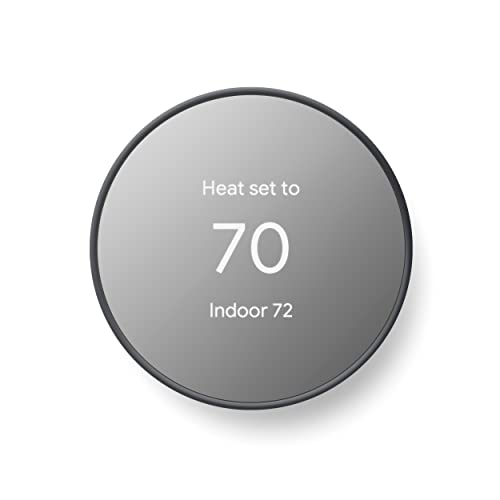
Fog is the gentlest colorway in the line, a muted gray-green that slips into soft, earthy interiors without shouting. People with muted linen walls, sage cabinetry, or Scandinavian palettes tend to love how it blends rather than contrasts.
Functionally, it shares the same smart platform as the Charcoal and Snow siblings, so the differences stop at the pigment on the dial. If you have already committed to a calm, low-saturation room, this finish pulls the whole wall together.
Well-Handled Touches
- Fog finish complements soft, muted interiors without visual weight.
- Same remote control and scheduling as other Nest Thermostat models through Google Home.
- Self-lowering temperature when the home is empty, then warming back up before you arrive.
- DIY-friendly install aimed at roughly 30 minutes for most homeowners with a C-wire.
Trade Offs
- The pale color shows dust more visibly than the darker Charcoal option.
- Some users with heat-only or cool-only older systems may need an extra adapter.
Feature Card
Right Fit For
Design-focused homeowners who want a thermostat that complements muted, natural interiors instead of standing out like a piece of tech.
Swap It Out When
Anyone with visible paint rings or a wider hole in the wall should consider the Google Nest Thermostat with Trim Kit (Snow), which covers the same kind of retrofit mess.
Sand speaks to warm-toned interiors, terracotta tile, cream walls, or any room where cool gray would feel clinical. Compared to the Fog sibling, this finish carries more yellow undertone, so it sits comfortably next to wood trim.
The smart features stay consistent with the Nest Thermostat family, from Google Home scheduling to the auto-away behavior. The difference is purely aesthetic, which is the right reason to choose it for some spaces.
What Stands Out
- Sand finish warms up earth-toned interiors that white or gray would clash with.
- Same Wi-Fi scheduling, remote control, and away routines as other Nest Thermostat colors.
- Mirrored dial that shows the temperature only when you approach.
- Compatible with the Google Home app for both Android and iPhone users.
Minor Gripes
- The warm tone can read as dated against very modern, cool-toned design schemes.
- Older HVAC wiring without a C-wire may still call for an external adapter.
Technical Sheet
Best Suited To
Householders with terracotta, ochre, cream, or wood-forward interiors who want the dial to feel like part of the wall art instead of a tech gadget.
Consider Something Else When
Those decorating with very cool gray or stark minimalist palettes will find the Charcoal Nest Thermostat a more natural fit on the wall.
This is the model that earned the Nest name. Instead of a fixed schedule you write once, it watches the temperatures you choose over a week or two and quietly builds a routine around your life. The first month feels a little uncanny, then suddenly the house is warm before you wake up and cool before you get home.
Home/Away Assist flips into a savings Eco Temperature when the last person leaves, so it does not keep heating an empty house. The polished steel ring rotates for manual changes and doubles as a satisfying mechanical click when you nudge the temperature.
Real Benefits
- Self-learning schedule removes the need to handcraft routines.
- Home/Away Assist drops to an Eco Temperature automatically when no one is home.
- Energy History in the app shows how much power you used and why.
- HVAC monitoring alerts you if the heating or cooling system behaves unusually.
- Remote control from phone, laptop, or tablet through the Nest app.
Honest Caveats
- Learning takes a couple of weeks, so early temperature choices may feel off until the pattern solidifies.
- Polished steel shows smudges from handling more than darker finishes.
- Commonly reported need for a C-wire or adapter on older heating systems.
The Numbers That Matter
Who Will Love This
Busy households with predictable weekdays who want the thermostat to handle the schedule without micromanaging it through the app.
Reach For A Different Pick When
Shoppers with a tighter budget and a more hands-on approach may prefer the Google Nest Thermostat (Snow) and craft their own schedule inside the Google Home app.
Starting a smart home from scratch usually means buying a thermostat and then circling back for outlets and lamps. This bundle ships the third-generation T3007ES stainless steel Learning Thermostat alongside two Deco Gear Wi-Fi smart plugs, so the climate and a pair of small appliances come under one roof on day one.
The thermostat carries the same self-learning platform as the rest of the Nest Learning line, while the plugs open the door to scheduling a coffee maker or fan alongside the heating schedule. Useful, depending on your priorities.
The Case For It
- Self-learning scheduling that adapts to your daily routine over a week or two.
- Two Wi-Fi smart plugs expand control to lamps, fans, or small heaters.
- Stainless steel finish that suits kitchen and hallway walls.
- Energy History in the app tracks usage trends.
Points To Note
- Third-generation hardware sits a step behind the 4th-gen Learning Thermostat lineup.
- Smart plugs add another app to manage alongside the Nest ecosystem.
- Stainless steel can show fingerprints, similar to other polished finishes in this lineup.
Perfect Match For
First-time smart home adopters who want climate control plus two controllable outlets from a single purchase.
A Better Fit Elsewhere
Anyone who already owns smart plugs or just wants the newest hardware should consider the Nest Learning Thermostat 4th Gen (Silver), which ships without extras.
Snow is the quiet finish that blends into white walls, ceilings, and trim without drawing attention. Many homeowners reach for it first because it disappears into the most common interior palettes in North America.
Like the Charcoal and Fog versions, it relies on the Google Home app for setup, scheduling, and remote nudges. The mirrored display wakes up when you approach and shows the temperature only then, which keeps the hallway feeling calm.
Key Advantages
- Snow finish suits bright, neutral walls in most homes.
- Remote scheduling through the Google Home app on Android or iPhone.
- Auto-away mode conserves energy when the house is empty.
- Mirrored display that shows temperature only when needed.
Soft Spots
- White finish may show scuffs from mounting more than darker siblings.
- Some older HVAC setups require a C-wire adapter for stable power.
Spec Overview
Built With In Mind
Owners with classic white walls and minimalist decor who want the smartest part of their HVAC system to blend rather than stand out.
Look Elsewhere When
Anyone needing a fresh wall patch covered at the same time should consider the Google Nest Thermostat with Trim Kit (Snow) instead.
The 4th generation Nest Learning Thermostat pulls double duty for households where one thermostat just is not enough. The included second-gen Nest Temperature Sensor lets you read the temperature in another room, so the upstairs bedroom can finally stay cooler than the hallway where the thermostat lives.
Compatibility with Alexa, Apple HomeKit, and the Google Home app means the device plays well across ecosystems, which is the upgrade most users feel right away. Polished Gold is the standout finish, designed for warm-toned interiors that the standard stainless steel would clash with.
Useful Touches
- Bundled Temperature Sensor enables multi-room averaging or priority rooms.
- Works across Alexa, Apple HomeKit, and Google Home for broad smart home fit.
- Self-learning schedule refines itself as your routine shifts.
- Polished Gold finish pairs with brass hardware and warm wood tones.
Points To Keep In Mind
- Sensor placement matters, so homeowners may need to experiment with positioning.
- Gold finish is statement-making and may not blend into minimalist white walls.
Feature Rundown
Whose Shelf It Belongs On
Multi-room homes where one thermostat cannot capture real comfort, paired with homeowners invested in cross-platform smart home ecosystems.
Reach For A Different Pick When
Single-room dwellers and apartment residents may find the Nest Learning Thermostat 4th Gen (Silver) a more understated finish without the gold commitment.
Obsidian is the moody sibling in the 4th-gen lineup, a near-black finish that disappears into dark feature walls and looks intentional next to matte black hardware. The same learning platform and 2nd-gen Temperature Sensor ride along, so functionality tracks with the Polished Gold version.
Where Obsidian really shines is in media rooms and modern lofts where a bright dial would feel out of place. The dark ring blends into the wall, and the mirrored face wakes up only when you walk near it.
What It Does Well
- Obsidian finish suits dark feature walls and modern interiors.
- Includes the Nest Temperature Sensor for multi-room comfort.
- Self-learning schedule refines itself over the first weeks of use.
- Compatible with Alexa, Apple HomeKit, and Google Home apps.
A Few Limitations
- Obsidian can vanish against dark walls, which makes the mirrored display harder to spot at a glance.
- The Sensor requires a spot to mount and battery changes every year or two.
Who Should Grab It
Owners with dark feature walls and a taste for modern interiors who want the latest learning thermostat in a finish that blends into the room.
Not Your Match When
Anyone decorating with light, neutral walls should step to the Nest Learning Thermostat 4th Gen (Polished Gold) or (Silver) for better contrast.
Silver is the safe, versatile finish for homeowners who want the latest learning hardware without committing to a strong color statement. It carries the same 4th-gen internals and the 2nd-gen Temperature Sensor, so the upgrade story tracks with the Polished Gold and Obsidian siblings.
For most households, Silver reads as the default, which is also why it transplants cleanly between rooms if you renovate later. Pair it with a neutral wall and the dial looks like part of the design rather than a gadget.
Everyday Wins
- Silver finish fits the widest range of interior palettes.
- Bundled Temperature Sensor adds multi-room temperature awareness.
- Cross-platform support across Alexa, Apple HomeKit, and Google Home.
- Self-learning schedule fine-tunes itself over the first weeks.
Worth Bearing In Mind
- Silver finish shows fingerprints more readily than darker Obsidian.
- The Temperature Sensor needs occasional battery swaps and a good mounting spot.
The Right Fit
Neutral-decor homeowners who want the most flexible 4th-gen finish and the bonus of multi-room temperature sensing in a single package.
Consider Something Else When
Anyone who wants a strong design statement alongside the sensor should weigh the Nest Learning Thermostat 4th Gen (Polished Gold) for warm interiors.
What To Weigh Before Choosing A Nest Thermostat
The right pick depends on three honest questions. First, what does your wall actually look like behind the current thermostat? Scars, oversized holes, or an exposed electrical box push the answer toward the trim kit variant. A clean wall opens the field to the standard finishes.
Second, how predictable is your routine? Households that follow a near-identical weekday rhythm benefit from the self-learning Nest Learning Thermostat models, because the device builds the schedule for you. People with chaotic or shift-based schedules may prefer the standard Nest Thermostat, since manual schedules in the Google Home app give finer control.
Third, do you need more than one room to feel right? If the upstairs bedroom stays stuffy while the hallway thermostat reads comfortable, the 4th-gen Learning Thermostat with Temperature Sensor solves a problem the standard models cannot. Otherwise, the standard Nest Thermostat is plenty for single-zone homes.
Wire compatibility is the silent gatekeeper. Many older HVAC systems lack a C-wire (common wire), which delivers continuous power to a smart thermostat. If your current setup is heat-only or has only two wires, plan on a C-wire adapter or a professional check before installing any model in this list.
Things Worth Knowing Across This Lineup
Pitfalls Shoppers Hit
The most common misstep is choosing a finish that looks great in photos but clashes with the actual wall color. Order a paint chip from the manufacturer if the listing does not show enough wall context. The second trap is assuming any smart thermostat will work on any HVAC system. Heat pumps, multi-stage systems, and older furnaces each have specific wiring needs that affect compatibility. A quick photo of the current thermostat’s wire labels sent to a licensed installer saves a return trip later.
When Paying More Pays Off
The price gap between the standard Nest Thermostat and the Learning Thermostat 4th Gen reflects two real upgrades. The Learning models build a schedule around your habits rather than waiting on you to program one, and the 4th-gen versions include a Temperature Sensor that solves real multi-room comfort problems. For households with predictable routines and uneven heating across rooms, the upgrade pays back in comfort and energy savings within a season or two. For a single-zone apartment with a regular schedule, the standard Nest Thermostat is plenty.
Frequently Asked Questions
Do Google Nest Thermostats need a C-wire?
Most models work best with a C-wire, which delivers continuous power from the HVAC system. Homes without one can use a compatible adapter or have a technician pull a new wire through the wall.
Will a Nest Thermostat work with Apple HomeKit?
The 4th-gen Nest Learning Thermostat models in this list support Apple HomeKit alongside Alexa and Google Home. The standard Nest Thermostat works within the Google Home ecosystem.
How long does installation usually take?
A typical swap takes around 30 minutes for homeowners comfortable with low-voltage wiring. The trim kit variant may add a few extra minutes because of the mounting plate alignment.
Can I control the thermostat when I am away from home?
Yes. The Google Home app lets you change temperatures, check the schedule, and review energy history from anywhere with a phone signal.
Do these thermostats help lower energy bills?
They help by trimming conditioning when the home is empty and letting you fine-tune schedules from your phone. Actual savings depend on your local climate, utility rates, and how often you adjust the temperature.
Wrap Up
The smartest pick is the one that fits your wall, your wiring, and the way your household actually moves through the day. Match the finish to the room, the platform to your routine, and the sensor bundle to your home’s layout, and the rest is comfort that quietly takes care of itself.