Most air conditioners still rely on the same chunky remote you keep losing between couch cushions. Smart AC controls change that equation, putting your cooling on your phone, your voice, and your schedule. This roundup covers the add-on controllers, smart breakers, and IR hubs that turn a regular AC into a connected one, so you can stop fighting the thermostat and start living with it.
The Main Contenders

Smart Switch AC 90-300V Adjustable WiFi Breaker (2PCS)

Cielo Breez Eco Smart AC Controller

AC Infinity Controller AI+ for Grow Tents

DIGITEN WTC100 Pro Wireless Thermostat
MHCOZY 2CH WiFi RF Wireless Switch Relay

Sensibo Air Smart AC Controller

Sensibo Air PRO Smart Controller & Air Sensor
ORIKLON 2.4G WiFi Universal Smart IR Hub

Sensibo Sky Smart Wireless AC Controller
A Breakdown Of The Leading Choices
This is not a typical AC remote replacement; it’s a smart breaker that sits between your mains supply and a heavy load. Where most items on this list target your mini-split, this one aims at whole-circuit protection, making it a fit for workshops, garage ACs, or anywhere a high-draw cooling appliance lives.
The 90-300V input window and 1-63A adjustable current range cover most residential AC circuits and a lot of light commercial gear. You get a two-pack, so protecting two circuits in one panel is realistic. Compared to the Cielo Breez Eco and Sensibo Air further down, this is a far more invasive installation, but it solves a problem those units can’t: tripping before an over-current event damages a compressor.
What Pays Off
- Adjustable current ceiling up to 63A handles most residential AC loads without swap-out.
- Wide 90-300V input range works with diverse mains standards, useful in older homes.
- Two-pack format covers both legs of a typical AC wiring setup on the same panel.
- App-driven monitoring means you spot energy waste before the utility bill arrives.
Things To Weigh Up
- Installation typically requires working inside a live breaker panel, which is not a beginner-friendly task.
- You may find the WiFi setup finicky if your router sits far from the electrical panel.
- Limited brand-ecosystem support compared with mainstream smart home platforms.
Key Specs
Whose Shelf It Belongs On
Homeowners with high-draw AC circuits who want monitoring and overload protection layered on top of cooling control.
Reach For A Different Pick When
Casual renters or anyone wanting plug-and-play control will get more out of the Cielo Breez Eco or Sensibo Sky.
The Cielo Breez Eco is the kind of device that quietly solves the “I lost the remote again” problem. It clips in front of your mini-split or window unit’s IR receiver, pairs over WiFi, and hands you back control through a free app, with no monthly fees layered on top.
For renters or anyone unwilling to touch the breaker panel, this is a much easier install than the aeliussine smart switch above. Geofencing, schedules, and voice hooks through Alexa, Google, Siri Shortcuts, SmartThings, and IFTTT make it unusually flexible for its size. Owners commonly report that compatibility with obscure AC brands sometimes takes a bit of trial in the app setup, but most mainstream units work out of the gate.
The Practical Payoff
- No subscription fees keep ongoing costs at zero.
- Works with mini-splits, window units, and portable ACs that already have an IR remote.
- Geofencing automatically adjusts cooling as you leave or arrive home.
- Comfy mode balances temperature and humidity to avoid overcooling.
Trade Offs
- Depends on a clear line of sight to the AC’s IR sensor for reliable control.
- Setup occasionally requires a firmware update before the unit behaves smoothly.
Made For
Renters and homeowners with a single ductless or window AC who want scheduling and voice control without rewiring.
Swap It Out When
You run a grow tent or want air quality data baked in, in which case the AC Infinity Controller AI+ or Sensibo Air PRO is a stronger match.
The AC Infinity Controller AI+ is built for a very specific reader: the indoor gardener who treats climate like a second job. Rather than competing with the Cielo Breez Eco or Sensibo Air in the living room, it sits inside a grow tent running fans, ducting, and AC equipment on learned schedules.
The “AI+” angle isn’t a buzzword here; the controller observes patterns in your tent’s environment and ramps fans up before humidity spikes hit. That anticipatory behavior is what separates it from the static timers most growers rely on. Compared to the MHCOZY relay earlier, this is purpose-built software rather than a generic on/off switch.
The Case For It
- Learns environmental patterns and pre-emptively adjusts output rather than reacting late.
- Native AC Infinity fan support means no third-party adapters for the brand’s equipment.
- WiFi access lets you tweak tent conditions from anywhere, useful on travel days.
- Real-time climate insights show which factor is drifting first, temperature or humidity.
Honest Caveats
- Best results depend on staying inside the AC Infinity ecosystem of fans and accessories.
- The interface can feel dense for casual users with a single AC and no other gear.
Who Should Grab It
Growers running tents or dedicated climate rooms who want predictive automation more than basic scheduling.
Look Elsewhere When
You only need to control a household mini-split, where the Sensibo Sky delivers a more streamlined path.
The DIGITEN WTC100 Pro leans hard into simplicity. Three buttons, a plug-and-play setup, and a built-in temp sensor deliver the basics without dragging in apps, voice assistants, or cloud accounts. That’s a deliberate trade-off that some shoppers actually prefer.
Unlike the Sensibo Air or ORIKLON hub, the WTC100 Pro doesn’t try to be the brain of a smart home. It just runs a temperature target on a schedule you dial in manually, which is plenty for a reptile room, a greenhouse cabinet, or a workshop AC. Owners commonly report the wireless remote is a useful touch, since you can read the room temperature without walking across the space.
Useful Strengths
- Non-programmable design keeps the learning curve to under five minutes.
- Celsius and Fahrenheit switch on the fly without re-flashing firmware.
- Built-in sensor cuts out the need for extra probe purchases.
Points To Keep In Mind
- Lacks WiFi, so there’s no app-based scheduling or remote control.
- Best suited to spot cooling rather than whole-home coordination.
- The plastic housing feels lighter-duty than higher-priced competitors.
The Right Fit
Workshop owners, greenhouse tinkerers, and anyone who wants a thermostat they can hand to a parent without a setup walkthrough.
Where Another Pick Suits Better
If voice and app control matter, the Cielo Breez Eco is the closer match for the same kind of room-based use.
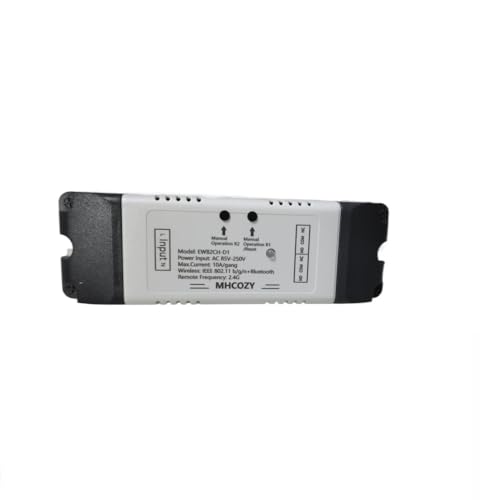
The MHCOZY 2CH relay is a tinkerer’s tool. Two channels, three operating modes (inching, self-locking, interlock), and a power input range that covers both 5V USB and 85-250V AC. It’s less of an appliance and more of a building block for DIY projects.
Pair it with the eWelink app and you can wire it into motorized blinds, garage doors, or older AC units that lack any native smarts. Where the aeliussine smart switch protects an entire circuit, this one switches specific loads on command. The dry-contact, passive output means you supply your own load voltage, which is flexible but adds wiring complexity for first-time installers.
The Helpful Details
- Two channels let you run two separate loads from one module.
- Mode selection handles pulse, toggle, and interlock control patterns.
- Dual power input options (USB 5V or 85-250V AC) fit varied installations.
- eWelink integration supports Alexa and Google Home routines.
Practical Considerations
- Dry-contact output requires the installer to supply load-side voltage separately.
- No dedicated climate scheduling, so it’s a switch, not a thermostat.
Best Suited To
Hobbyists comfortable with low-voltage wiring who want to retro-fit smarts into older equipment.
A Better Fit Elsewhere
Most homeowners chasing climate control will be happier with the Sensibo Air than with a bare relay module.
Sensibo has been in the smart AC game long enough to refine the experience, and the Air is the polished expression of that work. Plug it in, link it to your WiFi, and the app walks you through pairing with virtually any IR-controlled AC you own.
Geofencing, climate-react scheduling, and energy reports all live inside the Sensibo app. Compared to the Cielo Breez Eco, the Air leans more into data and reporting, which can be a draw for energy-conscious households. Setup is genuinely tool-free, which is a meaningful upgrade from the wired options earlier in this list.
Strengths Worth Knowing
- Bluetooth fallback makes the WiFi handoff faster during initial setup.
- Energy-saving features reduce run time without sacrificing comfort.
- Compatibility covers mini-splits, window units, and portable ACs.
- Climate React triggers routines based on temperature and humidity thresholds.
A Few Limitations
- No built-in air quality sensor, which the Air PRO below addresses.
- Requires line-of-sight to the AC’s IR receiver for full feature use.
Key Specs
Who It Suits Best
Connected-home beginners who want a friendly app, broad AC compatibility, and useful energy reporting out of the box.
Not Your Match When
You need air quality monitoring alongside climate, which is where the Sensibo Air PRO earns its premium.
The Air PRO takes everything the standard Sensibo Air does well and bolts on an air quality sensor. Now your living room has a continuous read on particulates and VOCs alongside temperature and humidity, with the AC reacting when air quality slips.
It’s a sensible upgrade for households with allergies, asthma, or wildfire-season concerns. Compared to the Air, the PRO is a more compelling buy when the air quality data actually changes how you run your AC, say, by pausing recirculation when particulate levels climb. Owners commonly report the additional sensor adds genuine value during pollen-heavy weeks.
What Earns Its Place
- Built-in air quality sensor keeps watch on particulates, VOCs, and CO2.
- Same polished Sensibo app experience as the standard Air.
- Allergy-aware routines adjust cooling based on real-time air data.
- Energy tracking layered on top of climate data gives a fuller picture.
Less Ideal Details
- Premium price over the standard Air may not pencil out for mild-climate homes.
- Air quality readouts depend on placement away from direct vents.
Perfect Match For
Allergy sufferers and households in wildfire or smog-prone regions who want cooling tied to air quality.
Skip It When
Your main concern is energy savings alone; the Sensibo Air delivers that without the sensor premium.
The MoesGo hub is the multi-tool of this list. Rather than specializing in one AC, it learns the IR codes of any 38KHz device you point at it: TVs, fans, set-top boxes, and air conditioners all fall under the same umbrella.
That breadth is most useful in homes already running on the Smart Life or Tuya app, where the hub slots in without adding a third-party ecosystem. Compared to the ORIKLON hub below, the MoesGo leans harder into the Tuya/Smart Life pipeline, which simplifies setup if you’re already committed to that platform. You may find the AC-specific scheduling less refined than what Cielo or Sensibo offers, but the consolidation is hard to beat.
Well-Handled Touches
- Single hub handles AC, TV, fan, and media devices from one app.
- Smart Life and Tuya compatibility make it friendly to existing Tuya households.
- Voice integration through Alexa and Google covers the major assistants.
- Device sharing lets multiple household members control the same gear.
Possible Compromises
- IR-only support means it can’t replace RF-only appliances.
- Line-of-sight constraints apply to every device it controls.
Built With In Mind
Tuya ecosystem users with a mix of ACs, TVs, and fans who want one hub running them all.
Consider Something Else When
You run a single ductless AC and care more about deep climate scheduling than cross-device consolidation; Cielo Breez Eco fits that.
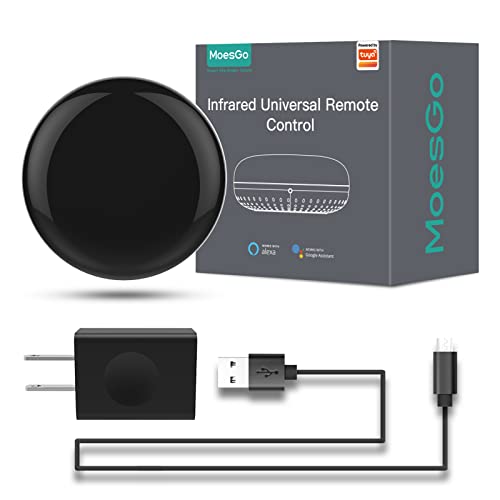
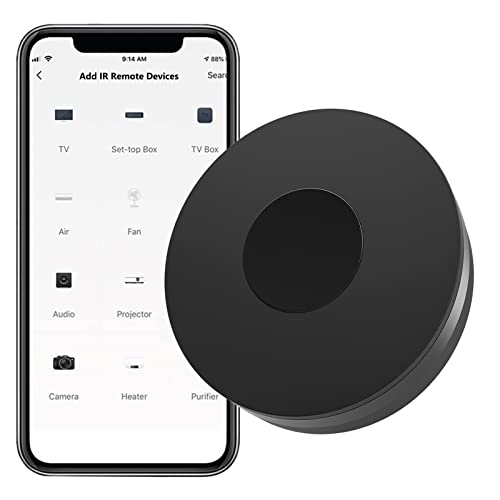
The ORIKLON hub advertises compatibility with over 50,000 IR devices, which sounds like marketing fluff until you realize that’s roughly the size of every mainstream TV, AC, and fan made in the last decade. For homes with a Frankenstein mix of brands, that’s genuinely useful.
The 2.4G WiFi focus keeps it compatible with the older but more reliable router band. Setup is straightforward: plug in the USB cable, press pair, and you’re in business. Compared to the MoesGo hub, the ORIKLON trades some Tuya-specific polish for a broader device library, which works if your household spans multiple smart home platforms.
Notable Gains
- Massive IR code library covers TVs, ACs, fans, soundbars, and set-top boxes.
- 2.4G WiFi focus means broader compatibility with older routers.
- Alexa and Google Assistant support across all linked devices.
- DIY-friendly pairing via a single button press on the unit.
Where It Is Less Suited
- Lacks RF support, so ceiling fans with RF remotes stay manual.
- No dedicated air quality sensor, unlike the Sensibo Air PRO.
Who Will Love This
Households juggling vintage AV gear alongside a modern AC who want one hub for both.
Another Choice May Suit
If you only need to control the AC and want deeper climate scheduling, the Sensibo Air is the better fit.
The Sensibo Sky is the original Sensibo, refined into a tiny wall-mounted brick that disappears in a room. At roughly 3.2 by 2.2 inches, it’s small enough to mount near the AC and forget about, which is the highest compliment for a controller.
DIY installation is genuinely quick: stick it on the wall, pair it in the app, and you’re running your AC from anywhere. Compared to the Sensibo Air, the Sky skips Bluetooth fallback and the polished modern housing, but covers the same core climate control. Renters especially appreciate that nothing requires opening a panel or modifying wiring.
Useful Highlights
- Compact wall-mounted footprint keeps it visually out of the way.
- Quick DIY install with no tools beyond a mounting surface.
- Works with Alexa, Google, and Siri shortcuts for voice control.
- Energy-saving modes cut AC run time in empty rooms.
Factors To Consider
- No Bluetooth fallback, so WiFi hiccups can interrupt pairing.
- No air quality sensor, which the newer Air PRO addresses.
Quick Technical Notes
Right Fit For
Renters and small-space dwellers who want smart AC control without permanent installation.
Where A Sibling Pick Shines
If you need air quality data, the Sensibo Air PRO carries the same brand DNA with a built-in sensor.
What To Weigh Before Buying Smart Ac Controls
Compatibility decides more than any other spec. An IR-based controller only works with air conditioners that already respond to a handheld remote; if your unit is old enough to lack one, you need a relay or smart breaker solution instead. Voice integration also shapes daily use. Alexa and Google coverage is common, but Siri Shortcuts and SmartThings support varies, so pick the controller that matches the assistant already running your speakers.
Connectivity matters for placement. A hub that depends on a clean line of sight to your AC’s IR receiver can struggle in L-shaped living rooms or behind TV cabinets. Bluetooth fallback, like on the Sensibo Air, makes first-time pairing smoother when WiFi is slow. For multi-device homes, look for hubs that consolidate TVs, fans, and ACs under one app, since juggling three different platforms gets old fast.
Finally, weigh installation depth. Plug-and-play controllers like the Sensibo Sky and Cielo Breez Eco clip onto a wall and pair in minutes. The aeliussine smart switch and MHCOZY relay demand real electrical work and belong with homeowners comfortable working inside a panel. Match the install to your comfort level, not just the feature sheet.
Mistakes Worth Dodging And Where The Premium Pays
Wrong Turns To Avoid
Skipping the compatibility check is the fastest way to end up with a paperweight. An IR hub cannot control a unit that never had a remote, and a smart breaker does nothing for a mini-split that already runs fine. Buying by feature count alone, rather than matching the controller type to your AC’s hardware, leads to returns and frustration.
Another slip-up: assuming “smart” means “scheduled.” Several entry-level controllers only stream commands; they do not store routines locally. If your WiFi drops for a few hours, the AC may stay stuck at whatever setting the hub last sent. Controllers with local schedule storage handle outages more gracefully.
When Paying More Pays Off
Higher-tier controllers earn their cost through sensors and software. The Sensibo Air PRO adds air quality data that genuinely changes how you run cooling during wildfire season or pollen peaks. The AC Infinity Controller AI+ uses pattern learning that static timers cannot match for indoor gardens. In both cases, the upgrade is not cosmetic; it changes behavior in ways that matter to the user.
Paying more also buys platform depth. A controller with mature Alexa, Google, SmartThings, and IFTTT support slots into a multi-vendor smart home without manual workarounds. The cheaper units often cover one or two assistants, leaving you to set up parallel ecosystems for different rooms.
Frequently Asked Questions
Do smart AC controls work with any air conditioner?
IR-based controllers work with any AC that already has a handheld IR remote. Units without a remote need a relay or smart breaker instead.
Will a smart AC controller reduce my electricity bill?
It can, by running the AC only when someone is home, trimming run time in empty rooms, and avoiding overcooling. Actual savings depend on your usage patterns and local rates.
Do I need a hub to use these controllers?
Most controllers listed are standalone, but IR hubs like the MoesGo and ORIKLON can consolidate multiple devices. Smart breakers and relays require their own apps without a separate hub.
Are subscriptions required to use these controllers?
Several options here, including the Cielo Breez Eco and Sensibo lineup, operate without subscription fees. Verify the listing before purchase if ongoing costs matter to you.
Can I install these myself?
Plug-in controllers clip on without tools. Anything involving a breaker panel, like the aeliussine smart switch or MHCOZY relay, requires electrical knowledge or a licensed installer.
The Takeaway
Smart AC controls turn a stubborn wall unit into something you can manage from the couch, the car, or the office. Match the controller type to your AC’s hardware first, then layer on the features that actually change how you live with cooling. Any of the ten options above will earn its keep, provided it fits the unit you already own.