Cutting your heating bill, protecting a fermenting batch, or just getting weekend climate control without rewiring your whole house starts with the right thermostat. Most people don’t want to dig through endless listings, so this guide pulls together ten solid options that cover common scenarios, from whole-home retrofits to grow tents and water heaters. Each pick comes with honest trade-offs, so you spend your money where it actually counts.
A Side-By-Side Look

Inkbird ITC-308 Digital Temperature Controller Thermostat

Inkbird WiFi ITC-308 Digital Temperature Controller Thermostat

Petrichor Nest Thermostat Wall Plate (Snow)

PRO1 T725 Heat Pump/Conventional Programmable Thermostat

PRO1 T701 Single Stage Non-Programmable Thermostat
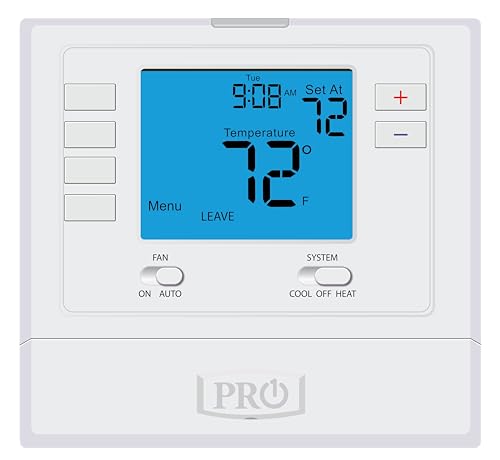
PRO1 T715 Multi-Stage Programmable Gas Thermostat

Reliance 9000507-045 Lower Electric Thermostat

PRO1 T721 Non-Programmable Wall Thermostat

Inkbird ITC-608T Temperature and Humidity Controller
PRO1 T805 Single Stage Programmable Thermostat
A Closer Look At Each Pick
The Inkbird ITC-308 sits in the Industrial & Scientific category for a reason: it’s built to control equipment, not to blend into a hallway wall. You get a dedicated dual-relay output, which means it can switch between heating and cooling gear automatically as temperatures swing past your set point.
For homebrewers running a fermentation fridge, this one earns its keep. The display shows both the measured and target readings at the same time, so you always know how far off the chamber is. A maximum output load of 1100W at 110V handles most small compressors and heat mats without breaking a sweat. Compared to the Wi-Fi ITC-308 covered next, this version keeps things local, which actually suits shop and garage setups just fine.
Practical Advantages
- Dual relay toggles between cooling and heating gear without manual swaps.
- Concurrent display of measured and target temps simplifies mid-cycle checks.
- Switchable Celsius and Fahrenheit readouts help international users.
- Audible alarm fires when temps exceed limits or the probe fails.
- 1100W output handles mid-size fridges and heat mats on a standard outlet.
Things To Consider
- No wireless monitoring, so changes require you to walk to the unit.
- The probe cable is long enough for most setups but may need a extension in larger rooms.
Who It Suits Best
Homebrewers, hobbyists, and small-shop owners who need reliable temperature control without needing a phone app.
Where Another Pick Suits Better
For remote monitoring from anywhere, the Inkbird WiFi ITC-308 is the natural step forward.
The Wi-Fi version of the ITC-308 takes everything the local Inkbird does well and adds app-based remote control. The unit talks to your 2.4 GHz network and links up with the Inkbird app on iOS and Android, so you can nudge your fermentation chamber from the couch or a hotel room.
Dual relay outputs still drive both cooling and heating loads, which keeps the original controller’s flexibility intact. High and low temperature alarms push straight to your phone, a real plus if your probe ever goes loose mid-cycle. For someone running an off-site brew setup or a greenhouse in the backyard, the peace of mind is worth the small step up in complexity.
The Good Stuff
- Remote monitoring and control over a 2.4 GHz Wi-Fi connection.
- Phone-push alarms trigger when temps cross thresholds or sensors fail.
- Dual relay design preserves the heating/cooling flexibility of the local model.
- App-based scheduling simplifies complex multi-step fermentation profiles.
Worth Noting
- 2.4 GHz only: dual-band routers need to keep that older band enabled.
- Setup is straightforward but assumes basic comfort with network settings.
Made For
Off-site brew operators, greenhouse hobbyists, and anyone running unattended cycles who wants phone alerts when things drift.
Consider Something Else When
If you never need remote access, the standard Inkbird ITC-308 keeps things simpler and is plenty for a garage setup.
Not every thermostat upgrade is about the device itself. The Petrichor wall plate targets the visual gap that often appears when you swap an old rectangular thermostat for the round Nest 2020. It covers old screw holes, paint mismatches, and exposed drywall in one clean install.
Compatibility is locked to the 2020 Nest (G4CVZ) models, so double-check your generation before you order. Once mounted, the snow-white finish blends with most interior walls, and a fingerprint-resistant surface keeps the plate looking fresh through daily swipes. For homeowners who care about the finished look as much as the tech, this is a small upgrade that punches above its weight.
A Few Highlights
- Generous coverage area hides old holes and paint mismatches behind the thermostat.
- Modern, fingerprint-resistant surface keeps the plate looking clean.
- Quick installation with a flush-to-wall finish.
- Snow-tone color coordinates with most standard interior paint palettes.
Trade Offs
- Compatibility is limited to the 2020 Nest generation only.
- It’s an accessory, so it doesn’t replace any control function.
Best Suited To
Homeowners who recently upgraded to the 2020 Nest and want a clean, finished look without repainting.
Not Your Match When
If you own an older Nest Learning Thermostat, this plate won’t fit, so confirm your model number before adding it.
The PRO1 T725 lands in that useful middle ground between basic dial thermostats and full smart-home systems. It supports 2 heat/1 cool heat pump configurations plus 1 heat/1 cool conventional setups, which covers most mixed-system homes. Programming runs on a 7-day or 5/1/1 schedule, so weekdays and weekends can finally have different set points.
The 4-square-inch blue backlit screen displays schedule blocks (wake, leave, return, sleep) without forcing you to dig into menus. Sitting on the reliable T700 platform, the T725 handles the kind of wiring layouts that scare off renters. Compared to the simpler T701 covered below, this model adds programmability, which most homeowners want but don’t always need.
The Case For It
- Programmable scheduling handles weekday, weekend, and single-day patterns.
- Backlit screen stays readable in dim hallways and overnight adjustments.
- Compatible with most heat-pump and conventional HVAC layouts.
- T700 platform shares parts and reliability with sibling PRO1 models.
- Hardwired or battery-powered installation accommodates older homes.
Points To Keep In Mind
- No Wi-Fi connectivity, so remote control requires a separate smart upgrade.
- Programming interface feels dated compared to app-driven thermostats.
Quick Facts
Right Fit For
Homeowners with a mixed heat-pump and conventional system who want scheduled control without paying smart-thermostat prices.
A Better Fit Elsewhere
For a single-stage conventional setup that doesn’t need scheduling, the PRO1 T701 keeps the interface even simpler.
The PRO1 T701 is the anti-feature thermostat, and that’s exactly the point. You set a temperature, the system holds it, and nobody needs an app. Built for 1 heat/1 cool conventional systems, it sidesteps the programming menus that often go unused anyway.
The display follows the same T700 platform pattern as the T725, with a clear 4-square-inch blue backlit screen and a glow-in-the-dark light button for low-light adjustments. For rental units or guest rooms, where tenants shouldn’t be reprogramming schedules, the straightforward interface is a quiet win. Compared to the larger T805 covered later, this one stays compact and unfussy.
Useful Strengths
- Non-programmable design prevents accidental schedule changes.
- Glow-in-the-dark light button aids adjustments in dark hallways.
- Backlit 4 sq. in. screen delivers at-a-glance readability.
- Suited for 1H/1C conventional HVAC layouts common in older homes.
Honest Caveats
- No scheduling means manual tweaks when seasons shift.
- Single-stage only, so multi-speed systems lose fine-grained control.
- No remote or app control for off-site adjustments.
Who Should Grab It
Landlords, renters, and homeowners who want a reliable thermostat without scheduling complexity.
Look Elsewhere When
For 7-day scheduling on a single-stage system, the PRO1 T805 adds programmability with a similar footprint.
The PRO1 T715 steps into the territory where multi-stage HVAC actually lives. It’s built for 2 heat/2 cool gas systems, so if your furnace ramps up through low and high fire stages, this thermostat can manage both without manual intervention.
You get flexible programming with 7-day, 5/1/1, or non-programmable modes, which means you can start simple and turn scheduling on later. The familiar T700 backlit display and glow-in-the-dark light button carry over from the rest of the lineup, so swapping out an older PRO1 won’t surprise anyone in the household. Compared to the single-stage T701, this one handles the kind of HVAC equipment that needs more than on/off control.
Advantages To Know
- Multi-stage support drives both heating and cooling stages independently.
- Three operating modes, programmable, 5/1/1, or set-and-forget, let you customize complexity.
- Hardwired or battery install adapts to legacy wiring setups.
- Backlit display paired with a glow-in-the-dark light button simplifies nighttime use.
Room For Improvement
- Programming menus can feel dense for first-time users.
- No Wi-Fi, so remote adjustments require physical presence.
Perfect Match For
Homeowners with a two-stage gas furnace or heat pump who want precision staging control without app dependency.
Swap It Out When
Single-stage conventional homes will do fine with the simpler PRO1 T701 or T805 models.
This Reliance thermostat doesn’t try to be smart, and that’s the point. The 9000507-045 is a direct-fit lower element thermostat for electric water heaters, designed to slot into a specific spot on the tank’s surface.
It works with standard electric water heater models, so the replacement process stays simple for anyone comfortable with a basic screwdriver and a multimeter. Compared to the whole-home units above, this one’s role is narrower: it regulates the lower heating element to keep hot water consistent through heavy use. For homeowners managing a failing lower element on a dual-element tank, this replacement is hard to skip.
Key Advantages
- Direct-fit design for standard dual-element electric water heaters.
- Mechanical reliability means fewer points of failure than digital alternatives.
- Cost-effective replacement compared to full smart thermostats.
Possible Compromises
- Limited to electric water heater tanks, not whole-home HVAC.
- No programmability or temperature display beyond mechanical indication.
Built With In Mind
Homeowners tackling a lower-element replacement on a dual-element electric water heater.
Another Choice May Suit
For whole-home climate control rather than water heater service, any of the PRO1 wall thermostats above will fit the bill.
The PRO1 T721 fills a specific gap in the lineup: heat-pump compatibility without scheduling complexity. It supports 2 heat/1 cool heat pump systems as well as 1 heat/1 cool conventional layouts, so swapping an aging heat-pump thermostat becomes straightforward.
The T700 platform brings the same 4-square-inch backlit display and glow-in-the-dark light button found on the T701 and T715, which keeps the visual language consistent across rooms. For homeowners wary of Wi-Fi-dependent controls, the wired simplicity is reassuring. Compared to the T725 above, this one trades programmability for a cleaner user experience, which is sometimes the right call.
Useful Touches
- Heat-pump compatibility handles 2H/1C setups without extra modules.
- AA battery power accommodates installs without a common wire.
- Glow-in-the-dark button for nighttime adjustments in dim spaces.
- Consistent T700 styling blends with other PRO1 thermostats in the home.
Less Ideal Details
- No programmable schedules, so set points stay static until manually changed.
- Single conventional mode limits future system upgrades.
Whose Shelf It Belongs On
Heat-pump homeowners who want a clean wall thermostat without signing up for app ecosystems.
Reach For A Different Pick When
For programmable scheduling on a heat-pump system, the PRO1 T725 delivers more flexibility.
The Inkbird ITC-608T brings humidity into the picture, which the rest of the Inkbird lineup skips. It’s pre-wired for 120VAC operation with a maximum load of 15A and 1800W, so installation reduces to plugging in the cords and mounting the probe.
Temperature ranges stretch from -40°F to 212°F, covering everything from a winter reptile enclosure to a steamy fermentation tent. The unit is ETL listed, which signals it has been tested against recognized safety standards, useful if you’re running humidifiers near outlets or grow lights. Compared to the ITC-308 controllers above, this model adds the humidity channel that mushroom growers and greenhouse operators specifically need.
What Earns Its Place
- Combined temperature and humidity control in a single pre-wired unit.
- 1800W capacity handles most humidifiers and heat mats on a standard outlet.
- Wide -40°F to 212°F range covers reptile, ferment, and greenhouse needs.
- ETL listing signals compliance with safety testing standards.
Factors To Consider
- Pre-wired 120VAC design is less flexible for international voltages.
- Humidity probe requires careful placement away from direct misting for accurate readings.
Feature Snapshot
The Right Fit For
Mushroom growers, greenhouse operators, and homebrewers who need humidity and temperature managed side by side.
Where A Sibling Pick Shines
For temperature-only control without humidity, the Inkbird ITC-308 keeps things simpler.
The PRO1 T805 closes the lineup with what many homeowners actually want: programmability on a single-stage conventional system, plus a display big enough to read from across the room. The 7-square-inch screen is nearly twice the area of the T701 and T725, which helps anyone who hates squinting at thermostat text.
Programming covers 7-day, 5/1/1, or fully non-programmable modes, which lets you start simple and grow into scheduling as you learn the rhythm of your home. Running on the T800 platform, the T805 shares visual cues with the rest of the PRO1 family. For a daily-driver replacement on a standard 1H/1C system, the screen real estate alone often justifies the choice.
Real-World Strengths
- Oversized 7 sq. in. backlit display improves readability across rooms.
- Three operating modes accommodate both schedulers and set-and-forget users.
- Glow-in-the-dark light button helps with late-night adjustments.
- T800 platform signals a generation newer than the T700 series.
Worth Bearing In Mind
- Single-stage only, so multi-speed HVAC won’t unlock full control.
- Larger footprint may not match shallow retrofit boxes in older walls.
Quick Technical Notes
Who Will Love This
Homeowners with a standard single-stage conventional system who want a programmable thermostat with a generously sized display.
Skip It When
For a heat-pump setup or multi-stage furnace, the PRO1 T715 or T725 match the equipment better.
What Matters Most Before Choosing Wifi Thermostats For The Money
Before you commit, match the thermostat’s system compatibility to your actual HVAC setup. A single-stage conventional system has different terminal demands than a 2 heat/1 cool heat pump, and forcing the wrong match leads to jumper wires and confused contractors. Look at the wiring behind your current thermostat first: if you see labeled terminals like W, Y, G, R, and possibly O or B, you’re dealing with a heat pump. Plain W and Y usually signal a conventional system.
Display readability often gets overlooked until you’re squinting at 2 a.m. trying to nudge a set point. Larger backlit screens, like the 7-square-inch panel on the PRO1 T805, make a real difference for anyone with aging eyes. The glow-in-the-dark light button found on most T700 and T800 units is a small touch that earns its keep in dark hallways.
Power source affects installation as much as features. Many newer thermostats demand a C-wire (common wire) for steady power, while battery-only units trade constant power for simpler retrofits. If your current setup lacks a C-wire, look for hardwired-or-battery flexibility, which avoids pulling a new cable through the wall.
Finally, decide whether Wi-Fi and app control actually serve your routine. For vacation homes and remote setups, the Inkbird WiFi ITC-308 earns its place. For a primary residence where someone is usually home, the local-only models run reliably without depending on a 2.4 GHz network that might drop at inconvenient moments.
Choosing the Right Thermostat for Your Home and Budget
The biggest misstep in this category is buying a thermostat before confirming your HVAC system type. A programmable heat-pump model is wasted on a conventional gas furnace, and a single-stage thermostat will frustrate anyone with a multi-stage system. Verify your system’s stages and fuel type before browsing, ideally by checking the label on your indoor unit or the manual that came with the original install.
Another common error is overlooking accessory compatibility. Items like the Petrichor wall plate only fit specific Nest generations, and ordering the wrong trim kit returns in a wasted afternoon. If you’re replacing an older thermostat, measure the existing footprint and check the brand documentation for direct-fit claims before adding accessories to your cart.
The premium tier earns its keep in three places: bigger displays, multi-stage support, and Wi-Fi integration. For whole-home control with staging, the upgrade from a T701 to a T715 feels noticeable the first time your system ramps through low and high fire. For occasional remote checks, Wi-Fi thermostats like the Inkbird ITC-308 Wi-Fi model justify the modest step up, especially for unattended setups where a temperature drift could mean a lost batch.
Key Considerations Across These Picks
Mistakes Worth Dodging
A frequent slip in this category is buying a Wi-Fi thermostat for a system that doesn’t need one. Network connectivity adds setup steps, app dependencies, and firmware updates, none of which matter for a steady home that someone is always monitoring. For most households, a reliable wired unit with scheduling handles the job.
Another trap is assuming any wall plate fits any thermostat. Models like the Petrichor wall plate are tied to specific Nest generations, so a 2015 Nest Learning Thermostat won’t accept the same trim as a 2020 unit. Match the generation before you click.
Where The Extra Money Goes
Higher-tier thermostats tend to spend your money on three upgrades: larger backlit displays, multi-stage HVAC support, and remote access. The PRO1 T805’s 7-square-inch screen and the Inkbird WiFi ITC-308’s app integration represent the most visible differences. For households managing complex HVAC staging, those upgrades are worth a careful look, but for simpler setups, the basic T701 still does the job cleanly.
Frequently Asked Questions
Do I need Wi-Fi to get useful features from a thermostat?
No. Wired programmable models like the PRO1 T725 or T805 deliver scheduling, multi-stage support, and backlit displays without needing a network connection. Wi-Fi adds remote control and app alerts, which matter most for vacation homes or unattended equipment.
Can these thermostats work with heat pumps as well as conventional systems?
Several models in this list cover both. The PRO1 T725 handles 2 heat/1 cool heat pump plus 1 heat/1 cool conventional layouts, and the PRO1 T721 supports a similar heat-pump pairing. Single-stage conventional homes can stick with the PRO1 T701 or T805.
Are these thermostats safe to install without an electrician?
For wall-mounted units on low-voltage wiring, most homeowners comfortable with basic tools can handle the swap, though the system should be powered off at the breaker first. The Inkbird ITC-608T is pre-wired for 120VAC and should be installed with the same caution as any mains-voltage appliance.
What does an ETL listing mean on the Inkbird ITC-608T?
ETL listing indicates the product has been tested against recognized safety standards by an accredited laboratory, similar in standing to other recognized safety certifications. For humidifier and greenhouse setups near water and heat sources, that third-party testing offers useful peace of mind.
How does the Petrichor wall plate differ from a regular thermostat?
The Petrichor plate is an accessory, not a thermostat. It mounts behind a 2020 Google Nest Thermostat to cover old paint, holes, and exposed drywall, giving the installation a clean, finished appearance without repainting.
The Takeaway
Choosing among these ten picks really comes down to your HVAC system, your tolerance for app-based control, and whether you need accessories to finish the install. Match the thermostat’s compatibility to your equipment first, then weigh display size, scheduling, and Wi-Fi as bonuses. The right choice should feel almost boring once it’s mounted: just reliable climate control without thinking about it.