A thermostat that talks to your phone, your voice assistant, and your routine changes how a home feels from morning to night. Whether you run a tight schedule or just want the bedroom a little cooler at midnight, the right wall unit takes the fiddling out of staying comfortable. This list covers ten solid choices across basic, programmable, and fully connected categories, so you can match the controls to your system and your comfort goals without overspending on features you will never use.
The Main Contenders

PRO1 T725 Heat Pump/Conventional Programmable Thermostat
PRO1 T771 Single Stage Non-Programmable Thermostat

PRO1 T701 Single Stage Non-Programmable Thermostat
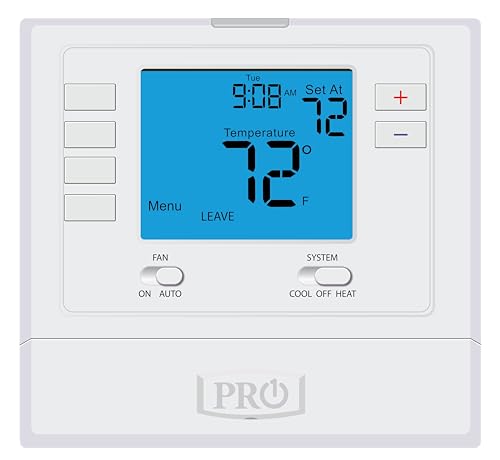
PRO1 T715 Multi-Stage Programmable Gas Thermostat

PRO1 T721 Non-Programmable Heat Pump Thermostat

Sensi Touch Smart Thermostat (ST75, Black)

ecobee3 Lite Smart Thermostat (Black)
PRO1 T805 Single Stage Programmable Thermostat

Google Nest Learning Thermostat (4th Gen, Obsidian)

Google Nest Learning Thermostat (4th Gen, Polished Gold)
Taking A Closer Look At The Options
The PRO1 T725 earns the top slot because it bridges two worlds: heat pump owners running a 2 heat/1 cool setup and conventional households on a 1 heat/1 cool system can both use the same wall hardware. That dual compatibility removes a layer of guesswork at install time, and the 7-day or 5/1/1 schedule lets you shape comfort around a real week, not just a generic weekday template.
Compared to the simpler non-programmable PRO1 units later in this list, this T725 adds a layer of control that pays off for anyone with a shifting routine. In most homes, you can wake to a warm bathroom, drop the temperature when everyone leaves for work, and have the room back at temperature by the time the kids walk in. A heat pump (a system that moves heat rather than generates it for both heating and cooling) is more efficient with steady schedules, which makes the programmable angle even more valuable here.
What It Does Well
- Dual compatibility with both heat pump and conventional HVAC, so you can match the wall unit to most existing systems.
- Flexible 7-day or 5/1/1 scheduling that handles a real work-and-family week.
- A larger backlit screen than older PRO1 models, making temperature and schedule reads easier from across a room.
- Programmable logic helps a heat pump run more efficiently by avoiding unnecessary cycling.
Things To Consider
- Requires basic wiring knowledge at install, so renters should confirm landlord approval before swapping hardware.
- Scheduling setup takes longer on a non-touch interface than on the smart units reviewed below.
Quick Facts
Best Suited To
Heat pump owners and conventional-system households who want real scheduling without paying for full smart-home connectivity.
Consider Something Else When
Anyone who wants app-based remote control should look at the Sensi Touch Smart Thermostat instead.
The PRO1 T771 looks unassuming next to its programmable siblings, but the wide setpoint range from 25°F to 90°F is the real story. That span covers spaces most living-room thermostats cannot reach, which makes the T771 a natural fit for detached garages, workshops, sheds, and other areas where you want freeze protection in winter or steady cooling in summer without managing a schedule.
Unlike the T725 above, this is a simple dial-and-display unit with no scheduling logic, so it suits anyone who would rather set a temperature once and walk away. Swing adjustment and calibration controls give installers enough flexibility to dial in accuracy for the specific space. In our view, this is one of the more practical specialty picks on the list for a workshop or outbuilding where a fancy touchscreen would be overkill.
Advantages To Know
- Setpoint range of 25°F to 90°F handles cold garages and warm workspaces alike.
- Non-programmable design means fewer buttons to learn for less tech-confident users.
- Calibration and swing adjustments help installers fine-tune accuracy for the specific room.
Worth Noting
- Limited to single-stage conventional systems, so multi-stage or heat pump setups need a different unit.
- Lacks scheduling, which matters for energy savings in a primary living space.
Made For
Garage, shed, and workshop owners running a simple 1 heat/1 cool system who want set-and-forget control.
Swap It Out When
Anyone needing full scheduling for a primary living area should pick the PRO1 T725 or the PRO1 T805 instead.
The PRO1 T701 strips the wall thermostat back to its essentials: a clear backlit screen, a glow-in-the-dark light button for nighttime adjustments, and the same T700 platform that runs through the rest of this list. For a first-time installer replacing a dated dial unit, the T701 offers enough screen space to read at a glance without piling on features you will not use.
Compared to the T771 above, the T701 targets a more conventional indoor environment where the wider setpoint range is not necessary. Gas or electric compatibility covers most standard residential setups, and the larger display compared to older PRO1 IAQ units makes daily temperature changes a one-handed job. In most homes with a basic furnace and air conditioner, this is the kind of unit that gets installed and forgotten, in the best way.
Everyday Wins
- Glow-in-the-dark light button for easy nighttime use without flipping a hallway light.
- Gas or electric compatibility covers the most common residential setups.
- Larger T700 platform display compared to older PRO1 IAQ units for better at-a-glance reading.
Trade Offs
- Single-stage conventional only, so multi-stage or heat pump households should look at the T715 or T725.
- No scheduling capability, which limits energy savings for daily commuters.
Feature Snapshot
Right Fit For
First-time installers and homeowners with a basic furnace and AC who want a simple wall swap.
Look Elsewhere When
Anyone running a heat pump system should pick the PRO1 T725 instead.
The PRO1 T715 is the most capable programmable unit in this lineup, built for 2 heat/2 cool gas systems where staging matters. Multi-stage systems (a furnace that can fire on low or high heat depending on demand) waste energy when driven by a single-stage thermostat, so matching controls to the equipment here is less about bells and whistles and more about getting the most out of an existing setup.
Unlike the single-stage T701, the T715 reads the actual demand curve and decides whether to fire the system gently or at full output. The 7-day, 5/1/1, or non-programmable modes give you a path to scale up gradually. Battery or hardwire power options also help during installation when a C-wire (a dedicated common wire that delivers continuous power to the thermostat) is not present. For two-stage gas households, this is a quiet workhorse that just keeps things steady.
A Favorable Mix
- Multi-stage control matches 2 heat/2 cool gas systems, reducing short-cycling (frequent on-off restarts) and energy waste.
- Three operating modes, including 7-day, 5/1/1, and non-programmable, give flexibility as routines evolve.
- Battery or hardwire power accommodates older homes without a C-wire.
Honest Caveats
- More complex setup than the single-stage T701, so first-time installers may want a wiring guide.
- Limited to gas systems, so heat pump households should look at the PRO1 T725.
Who It Suits Best
Owners of two-stage gas furnaces who want scheduling plus efficient staging control on the wall.
Skip It When
Single-stage households can get the same scheduling simplicity from the PRO1 T805 at a friendlier feature set.
The PRO1 T721 covers a niche that often confuses shoppers: it works with both 2 heat/1 cool heat pump setups and 1 heat/1 cool conventional systems, but without the scheduling layer of the T725. For households new to heat pumps who do not want a learning curve, that trade-off can actually feel like a relief.
The same T700 platform and backlit display that runs through the rest of the PRO1 line keep the on-wall experience consistent. A glow-in-the-dark light button makes late-night tweaks manageable, and AA battery or hardwire options cover older homes without continuous power at the wall. In our view, this unit is a sensible middle ground for a heat pump retrofit where scheduling is not yet a priority.
Useful Highlights
- Dual-system support for heat pump or conventional layouts without locking you in.
- Glow-in-the-dark light button for easy nighttime adjustment without overhead lighting.
- AA battery or hardwire power options for flexible install in older homes.
Points To Note
- No scheduling capability, which leaves efficiency gains on the table for steady routines.
- Limited to single-stage conventional control, so multi-stage systems need the T715.
Quick Facts
Whose Shelf It Belongs On
Heat pump newcomers who want dual compatibility without the commitment of a full weekly schedule.
Reach For A Different Pick When
Anyone who wants real scheduling on a heat pump should consider the PRO1 T725.
The Sensi Touch Smart Thermostat moves the conversation from wall hardware into a small color touchscreen and a phone app. Emerson’s background in HVAC manufacturing is worth noting here, since the same company that builds parts for many furnaces also builds this control. The ST75 ships with Wi-Fi connectivity, mobile app control, and voice assistant compatibility, which together make it the centerpiece of a connected HVAC setup.
Data privacy gets real attention on this model, which matters when a device knows your home schedule. Compared to the PRO1 units earlier in this list, the Sensi Touch requires a C-wire for stable power, so older homes may need a minor wiring upgrade. In our view, that wire is a fair price for the touch experience and the app control that come with it.
Practical Advantages
- Color touchscreen plus mobile app control for on-the-go adjustments.
- Data privacy focus from a brand with deep HVAC manufacturing roots.
- Voice assistant compatibility makes hands-free control a real option.
A Few Limitations
- C-wire required, so older homes without that wire may need a wiring update before install.
- Smart connectivity introduces dependency on Wi-Fi stability, which can be a real issue during router changes.
Key Specs
Perfect Match For
Smart home builders who want a privacy-focused thermostat with a real touchscreen and reliable HVAC brand backing.
A Better Fit Elsewhere
Homeowners without a C-wire should consider the ecobee3 Lite, which often ships with install helpers for that wiring gap.
The ecobee3 Lite earns its spot by offering a smart, app-controlled thermostat with broad voice assistant support at a friendlier price than most full-feature models. Siri, Alexa, and Google Assistant integration means you are not locked into one ecosystem, which is a quiet but real advantage if your household already runs mixed devices.
DIY install is the headline for first-timers here, since ecobee ships its thermostats with detailed wiring guidance that walks less experienced installers through each step. Unlike the Sensi Touch above, this model is geared toward shoppers who want smart features without paying for extras they will not use. In most homes, the on-wall app control and geofencing (automated temperature changes based on your phone’s location) handle the daily adjustments without much fuss.
Useful Strengths
- Works with Siri, Alexa, and Google Assistant, so you are not tied to one voice platform.
- DIY install guidance helps first-time thermostat installers through the wiring process.
- Energy Star certification points to solid baseline efficiency performance.
Room For Improvement
- Lacks the room sensors that ship with the full ecobee line, so whole-home averaging depends on the wall location.
- Smart features depend on a stable Wi-Fi network, which can be frustrating during outages.
Who Should Grab It
Mixed-ecosystem smart homes and DIY-first homeowners who want voice control without paying for a premium finish.
Not Your Match When
Anyone wanting a true touchscreen experience and bundled remote sensors should look at the Google Nest Learning Thermostat instead.
The PRO1 T805 takes the T800 platform approach to clarity, with an extra-large 7 sq. in. blue backlit display that is hard to miss from across a room. For households where someone needs to read the temperature from a distance, or anyone with aging eyes, that screen size is more useful than a long list of features.
Unlike the T701 above, the T805 layers in 7-day, 5/1/1, or non-programmable modes, so the unit can grow with your comfort preferences. The T800 platform keeps the controls consistent with the rest of the PRO1 line, which helps anyone already familiar with PRO1 hardware. In most homes, the large display and flexible modes handle daily comfort without forcing a learning curve.
Where It Helps
- Extra-large 7 sq. in. backlit display for easy reading at a distance.
- Three operating modes (7-day, 5/1/1, non-programmable) for routine flexibility.
- Glow-in-the-dark light button for low-light adjustments.
Soft Spots
- Larger display means a bigger wall footprint, which can feel oversized in tight hallways.
- Single-stage conventional only, so multi-stage or heat pump households should look elsewhere.
Spec Overview
Built With In Mind
Accessibility-minded households and homeowners who want a big, readable display with optional scheduling.
Another Choice May Suit
Anyone running a heat pump should pick the PRO1 T725 for proper system compatibility.
The Google Nest Learning Thermostat (4th gen) in Obsidian is the unit on this list with the most personality. It learns the temperatures you like, the times you like them, and adjusts as your routine changes, which removes the scheduling step from your to-do list after the first week. The 2nd gen Nest Temperature Sensor bundled here extends that learning into other rooms, so the hallway reading is not the only data point.
Compared to the Sensi Touch above, Nest leans more heavily into automatic learning, while Sensi stays closer to manual schedule control. The Obsidian finish is a deep, almost-black tone that suits modern interiors without looking like a piece of tech equipment. In our view, this bundle suits households whose routines shift often enough that scheduling by hand gets old.
Points In Its Favor
- Self-learning algorithm picks up routines without manual schedule edits.
- Bundled 2nd gen Nest Temperature Sensor extends comfort awareness beyond the hallway.
- Obsidian finish offers a sophisticated look for modern interiors.
Things To Weigh
- Learning thermostat depends on consistent data, so households with constantly shifting schedules may find the auto-settings frustrating.
- Smart features and sensors add complexity that a basic programmable thermostat avoids entirely.
Who Will Love This
Routine-driven households who want the thermostat to learn their habits and prefer a premium dark finish.
Where A Sibling Pick Shines
Anyone who wants manual scheduling control with a polished finish should look at the Google Nest (Polished Gold) variant instead.
The Polished Gold version of the Nest Learning Thermostat (4th gen) carries the same learning engine and sensor bundle as the Obsidian model above, but trades the dark finish for a warmer statement look. In homes with brass hardware, warm-toned tile, or intentional design choices, the gold finish can blend where the Obsidian would clash.
Compatibility with Alexa, Apple HomeKit, and the Google Home app means the Nest slots into most existing smart setups without much fuss. Unlike the PRO1 line on this list, the Nest focuses less on wall-button scheduling and more on app and voice control. For shoppers who care about the wall fixture looking intentional, this finish is the differentiator.
Key Advantages
- Polished gold finish serves as a design feature, not just a thermostat.
- Bundled Nest Temperature Sensor extends comfort awareness to other rooms.
- Compatible with Alexa, Apple HomeKit, and Google Home for broad ecosystem fit.
Possible Compromises
- Warm gold finish may clash with cooler-toned interiors where Obsidian or white would fit better.
- Learning thermostat depends on consistent data, which can frustrate users with highly variable schedules.
Perfect Match For
Style-focused smart homes with warm-toned design where the thermostat needs to look intentional on the wall.
Not Your Match When
Anyone who prefers manual scheduling control should consider the PRO1 T715 for traditional programmable comfort.
What Matters Most Before Choosing Smartthings Thermostats
Match The Thermostat To Your HVAC System
A thermostat only works as well as the equipment it controls. Knowing whether your home runs a conventional furnace and air conditioner, a heat pump, or a multi-stage system is the first decision, since the wrong match leads to either a dead display or inefficient cycling. Heat pump households in particular need a control rated for heat pump operation, while multi-stage gas owners should look for a multi-stage thermostat to avoid wasted fuel.
Decide Between Manual Schedule And Smart Connectivity
Programmable units like the PRO1 T725 or T715 give you a schedule on the wall, set once and tweaked when life shifts. Smart thermostats like the Sensi Touch, ecobee3 Lite, and Google Nest add Wi-Fi, voice assistants, and app control on top of that. The honest read is that smart features shine for variable routines and frequent travel, while a plain programmable unit is plenty for a stable weekday-to-weekend pattern.
Plan For The Wiring At Your Wall
Most smart thermostats require a C-wire for continuous power, and some programmable units offer battery power instead. Older homes without that wire may need a minor wiring update before a smart upgrade, which is worth budgeting for. Looking at the wiring first prevents the frustration of mounting a thermostat only to discover it cannot draw stable power.
Key Considerations Across These Picks
Common Buying Mistakes
A frequent trap is buying a smart thermostat for a system it cannot run, which shows up as a blank screen or constant error codes. Another slip is choosing a polished finish like the Polished Gold Nest without checking how it sits against existing hardware and paint. Always confirm HVAC compatibility first, then let the smart features follow.
Where The Extra Money Goes
Premium smart thermostats earn their price through self-learning routines, bundled room sensors, and broader voice assistant support. Higher-tier programmable units like the PRO1 T715 charge more for multi-stage compatibility and larger displays. The upgrade pays off when your HVAC system actually uses those capabilities, while a single-stage household usually gets all the comfort they need from a basic programmable model.