Controlling the temperature in your home used to mean walking to the hallway and guessing whether to nudge it up or down. Today’s remote control thermostats handle that thinking for you, whether you want a simple wall dial, a fully programmable weekly schedule, or a Wi-Fi connected unit you can adjust from the grocery store.
This roundup covers nine picks spanning basic non-programmable wall units, multi-stage programmable models for whole-home HVAC, smart thermostats with voice control, and a wireless controller built for mini-split and window ACs. Every option listed is available through Amazon, and each one fits a different kind of household.
The Choices Worth Comparing

PRO1 T725 Programmable Digital Wall Thermostat 2 Heat/1 Cool
PRO1 T771 Single Stage Non-Programmable Wall Thermostat

PRO1 T701 Single Stage Non-Programmable Wall Thermostat
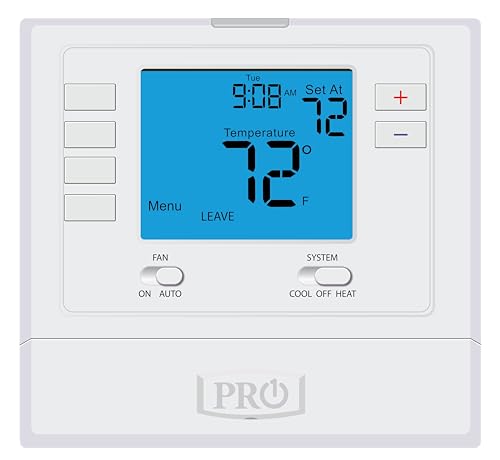
PRO1 T715 Multi-Stage Programmable Gas Thermostat 2 Heat/2 Cool

Breez Eco Smart AC Controller for Mini Split and Window Units

PRO1 T721 Non-Programmable Wall Thermostat 2H/1C Heat Pump

ecobee SmartThermostat with Voice Control

DIGITEN Wireless Thermostat WTC100 Pro Temperature Controller
PRO1 T805 Single Stage Programmable Wall Thermostat
Inside Each Recommended Option
The PRO1 T725 sits in the middle of the PRO1 IAQ lineup and handles a wider system range than the non-programmable picks below it. It supports 2 heat/1 cool heat pump setups and 1 heat/1 cool conventional systems, so it covers most homes that have moved beyond a single-stage furnace but haven’t gone fully zoned.
Programmability runs through the 7-day or 5/1/1 schedule (meaning five weekdays plus separate Saturday and Sunday blocks), letting you set four daily periods (wake, leave, return, sleep). The display measures 4 square inches with a blue backlight, which is easy to read from across a room. For anyone who wants weekday and weekend control without a smart-home app, this unit lands in the right spot.
Features That Help
- Works with both heat pump and conventional HVAC, so it survives a system upgrade without replacement.
- 7-day or 5/1/1 scheduling lets you trim runtime on days when the house is empty, which helps lower energy use.
- The 4 sq. in. blue backlit display stays readable in dim hallways.
- Sits on the established T700 platform, which gives you a familiar menu structure if you have used other PRO1 units.
Things To Consider
- Wiring complexity rises with heat pump systems, and a mismatched C-wire (the common wire that delivers continuous power) is a common installer complaint across this category.
- No Wi-Fi or app control means schedule changes happen at the wall, not from your phone.
Key Specs
Right Fit For
Homeowners with a heat pump who want reliable weekly scheduling without paying for smart-home features.
Consider Something Else When
Anyone wanting phone-based remote access will get more from the ecobee SmartThermostat with Voice Control further down this list.
Most wall thermostats are designed for living spaces where the temperature rarely drops toward freezing. The PRO1 T771 is built for the opposite case. Its setpoint range stretches down to 25°F, which matters for garages, workshops, and sheds where you want to keep pipes from freezing but don’t want to heat the space to a comfortable room temperature.
It’s a non-programmable single-stage unit for 1 heat/1 cool conventional systems, which keeps the interface to a temperature dial and a few buttons. Swing adjustment and calibration controls live behind the panel for fine-tuning. Compared to the T701, this one trades everyday polish for that wider setpoint range.
Where It Helps
- Setpoint range starting at 25°F protects unheated spaces from freezing.
- Non-programmable layout means fewer buttons and less user error in utility areas.
- Calibration and swing adjustments help match the reading to a remote thermometer when needed.
Worth Noting
- Single-stage only, so it cannot manage a two-stage furnace or heat pump system.
- No glow-in-the-dark light button on this model, which makes low-light adjustment harder in a dark garage.
Who Will Love This
Shoppers heating a detached garage, workshop, or shed who need freeze protection more than they need a weekly schedule.
Look Elsewhere When
Anyone outfitting a primary living space should consider the PRO1 T701 for a cleaner everyday wall-mount look with the same simplicity.
If the word “thermostat” already sounds complicated, the PRO1 T701 strips things back. It’s a non-programmable wall unit for 1 heat/1 cool conventional systems, with a 4 sq. in. blue backlit display and a glow-in-the-dark light button that helps you find it in a dark hallway at 2 a.m.
The T700 platform foundation gives it gas or electric compatibility without extra configuration. Where the T725 above adds weekly scheduling, the T701 simply lets you set a temperature and forget it. That makes it well suited to rentals, guest rooms, and second homes where nobody wants to learn a menu.
Where It Excels
- Two-button simplicity cuts the learning curve to almost nothing for non-technical users.
- Glow-in-the-dark light button makes the controls easy to locate in the dark.
- Works with both gas and electric systems, which keeps installation flexible across property types.
Honest Caveats
- No scheduling means you cannot drop the temperature automatically during work hours.
- Single-stage only, so it cannot handle a multi-speed furnace or a heat pump.
Quick Facts
Best Suited To
Rental property owners and households who want set-and-forget control without any schedule programming.
A Better Fit Elsewhere
Anyone with a heat pump system should skip to the PRO1 T725 above, which is built for that exact setup.
Two-stage gas furnaces need a thermostat that understands staging, where the system can run at a low burn for mild weather and ramp up for cold snaps. The PRO1 T715 is built for that exact job, supporting 2 heat/2 cool systems across the T700 platform.
You get 7-day, 5/1/1, or non-programmable modes, which lets you start simple and turn on scheduling later if you change your mind. The same 4 sq. in. blue backlit display carries over from the T701, along with the glow-in-the-dark light button. Power comes from batteries or a hardwire connection depending on what your wall box supports.
Everyday Perks
- Multi-stage support lets the furnace run efficiently at low fire during shoulder seasons.
- Three operating modes (7-day, 5/1/1, or non-programmable) suit both hands-on users and renters.
- Battery or hardwire power keeps the install options open for older walls.
Trade Offs
- More wiring terminals than the single-stage units, which makes a clean DIY install less straightforward.
- Programmable features sit behind a small screen, which can frustrate anyone who prefers app-based control.
Whose Shelf It Belongs On
Homeowners with two-stage gas furnaces who want programmable scheduling without stepping up to a smart thermostat.
Reach For A Different Pick When
Anyone with a single-stage conventional system can save by going with the PRO1 T701 instead.
Every wall thermostat on this list so far controls central HVAC, but millions of homes cool with ductless mini-splits or window units that take their commands from an infrared remote. The Cielo Breez Eco adds Wi-Fi control to those units without replacing them.
You set the small device near your AC, link it to your home network, and the unit mimics the IR remote signal on demand. From there, the companion app, Alexa, Google Assistant, Siri Shortcuts, SmartThings, and IFTTT (a service that links different smart devices with simple “if this, then that” rules) can all run the show. Geofencing turns the AC down when your phone leaves the house, and schedules handle the rest. No subscription is required.
Bright Spots
- Adds smartphone control to existing mini-splits, window, and portable ACs that use an IR remote.
- Supports major voice assistants and smart-home platforms without monthly fees.
- Comes with a free table stand, so you can place it on a desk instead of mounting it.
Points To Keep In Mind
- It only works with AC units that have an infrared remote, which excludes some proprietary control systems.
- Setup depends on stable Wi-Fi, so weak signal spots in older homes can limit where you place it.
The Right Fit
Renters and homeowners with ductless mini-splits who want phone and voice control without swapping out the AC.
Swap It Out When
Anyone running central HVAC should pick a wall thermostat like the PRO1 T725 for a more permanent solution.
The PRO1 T721 sits between the single-stage T701 and the programmable heat pump T725. It supports both 2 heat/1 cool heat pump systems and 1 heat/1 cool conventional systems, but keeps the interface non-programmable. That’s useful for heat pump owners who want a clean wall control without weekly schedules.
The T700 platform base shows up again here, with the 4 sq. in. blue backlit display and glow-in-the-dark light button. Power comes from AA batteries, which removes the C-wire requirement that often complicates heat pump upgrades.
Useful Touches
- Dual compatibility with heat pump and conventional systems covers more installs than a single-mode thermostat.
- Battery power avoids the common C-wire headache in older walls.
- Glow-in-the-dark button keeps the unit findable in low-light hallways.
A Few Limitations
- Without scheduling, you cannot drop the setpoint during work hours automatically.
- Battery replacements will be required, and a dying battery can interrupt heating mid-winter if unnoticed.
Who Should Grab It
Heat pump households without a C-wire who want simple wall control and don’t need weekly scheduling.
Where A Sibling Pick Shines
Anyone wanting weekly schedules on the same heat pump platform will get more from the PRO1 T725 above.
The ecobee SmartThermostat is the most connected unit on this list. Built-in voice control handles queries, music, and smart-home routines directly from the wall, while a companion app keeps you in charge from anywhere with Wi-Fi. The included SmartSensor (a small wireless temperature sensor) reads the temperature in a different room, which matters because the thermostat on your hallway wall rarely reflects the temperature where you actually sit.
It supports multi-stage conventional and heat pump systems, so it covers most homes without compatibility concerns. ENERGY STAR certification means it meets efficiency benchmarks set by the EPA, which is helpful for anyone tracking energy savings. Compare that to the Breez Eco above, which only handles ductless AC units, and the role of the ecobee as a whole-home brain becomes clearer.
What Works In Its Favor
- Included SmartSensor balances temperatures in the rooms you use most, not just where the thermostat is mounted.
- Built-in voice control adds hands-free commands and smart-home routines without a separate speaker.
- ENERGY STAR certification signals verified efficiency performance.
Practical Considerations
- Higher complexity means setup takes longer than a basic wall thermostat.
- Requires a C-wire or the included power extender kit in older homes without continuous power at the wall.
Feature Snapshot
Made For
Tech-forward households and larger homes where temperature swings between rooms are a daily annoyance.
Not Your Match When
Anyone needing a simple non-smart thermostat for a garage or rental will get better value from the PRO1 T771.
The DIGITEN WTC100 Pro is a different kind of thermostat. It is a plug-and-play wireless controller with a remote sensor, designed for setups where you want to switch a heating or cooling appliance based on a remote temperature reading. Think space heaters, fans, and similar plug-in devices, where you want a temperature trigger without rewiring anything.
Operation runs through three buttons, with a simple toggle between Celsius and Fahrenheit. The remote controller reads the temperature automatically, and the unit responds when the reading hits your target. Compared to the wall-mounted PRO1 units, this one lives on a desk or workbench rather than the wall.
Everyday Wins
- Plug-and-play design skips any wiring work, which suits renters and workshop setups.
- Remote temperature sensor triggers the connected appliance based on the room you actually care about.
- Three-button interface keeps daily use straightforward.
Some Limits To Know
- Designed for plug-in appliances rather than full HVAC systems, so it cannot replace a central thermostat.
- Wireless signal range limits placement flexibility in larger homes or across thick walls.
Perfect Match For
Garage workshops, greenhouses, and hobby rooms where a space heater or fan needs automatic temperature control.
Skip It When
Anyone managing central HVAC should stick with a wall-mounted PRO1 unit or the ecobee for whole-home control.
The PRO1 T805 closes the list with a different focus. It is built on the larger T800 platform, which means the display jumps from 4 square inches up to 7 square inches, large enough to read from across a living room without glasses. The blue backlight and glow-in-the-dark light button carry over from the smaller T700 series.
You get a programmable thermostat for 1 heat/1 cool conventional systems, with 7-day, 5/1/1, or non-programmable modes. That flexibility makes it useful for households that may want to test scheduling before committing fully. Compared to the T701 earlier, this one trades the compact size for screen real estate.
What It Does Well
- 7 sq. in. display is much easier to read from a distance, especially for users with vision limitations.
- Three operating modes give new users a low-pressure way to try weekly scheduling.
- T800 platform builds on the PRO1 menu layout that T700 owners already know.
Where It Is Less Suited
- Single-stage only, so it cannot manage a multi-stage furnace or heat pump.
- Larger display means a wider wall footprint than the slimmer T701.
Technical Highlights
Built With In Mind
Conventional-system households who want a large, easy-to-read display and the option to add scheduling later.
Another Choice May Suit
Anyone running a heat pump or a multi-stage system will find better compatibility in the PRO1 T715 covered earlier.
Picking the Right Thermostat for Your System
The first question to answer is which HVAC system actually lives in your walls. Single-stage furnaces and air conditioners need the simplest thermostats, while two-stage and modulating systems require a model that understands staging. Heat pumps add another layer because they switch between heating and cooling modes through the same wiring.
Programmability matters more than most people expect. A non-programmable thermostat holds one temperature until you change it, which works for a guest room but wastes energy in a home with a regular schedule. A 7-day programmable thermostat matches comfort to a real weekly routine, while 5/1/1 thermostats offer a middle ground with one block for weekdays and separate blocks for each weekend day.
Connectivity is the next big fork. Basic wall thermostats run entirely on the wall and need no Wi-Fi. Wi-Fi models add app control, voice integration, and remote sensors that read temperatures in other rooms. For ductless AC units, a smart remote like the Breez Eco covers a gap that wall thermostats cannot fill.
Display and usability round out the decision. Larger screens cost a few dollars more but help in homes with older eyes. Glow-in-the-dark buttons matter more than they sound, since fumbling for a thermostat in a dark hallway at night wears on anyone over time.
Key Considerations Across These Picks
Pitfalls Shoppers Hit
The most common mistake is buying a thermostat that does not match the HVAC system. A single-stage thermostat cannot run a two-stage furnace properly, and the mismatch shows up as short-cycling, where the furnace turns on and off rapidly, instead of steady efficiency. The other recurring error is ignoring the C-wire situation. Many newer thermostats need continuous power, and older homes often lack that wire entirely.
What Separates Premium From Basic
Higher-tier models add sensors, learning, and voice control, but the real upgrade is room-level awareness. A wall thermostat reads one spot, while a model with remote sensors can average temperatures across multiple rooms. That single feature is what makes a smart thermostat feel like a meaningful upgrade rather than a screen with extra steps.
Frequently Asked Questions
Do remote control thermostats work without Wi-Fi?
Most wall-mounted models work fully without Wi-Fi. Only smart thermostats and AC controllers like the Breez Eco need a network connection for their remote features.
Can I install a thermostat myself?
Basic replacements on a single-stage system are within reach for handy homeowners, especially when the wiring labels match. Heat pumps, multi-stage systems, and missing C-wires are better left to a licensed HVAC technician.
Will any thermostat work with a heat pump?
No. Heat pumps need a thermostat that supports the mode switch between heating and cooling, which is why models like the PRO1 T725 and T721 list heat pump compatibility specifically.
Are smart thermostats worth it for small homes?
Smart thermostats help most in homes with a real schedule swing, where dropping the temperature during work hours actually matters. For a one-room studio with a predictable routine, a basic programmable unit usually does the job.
How long do these thermostats typically last?
Most wall thermostats run for a decade or more without issues. Smart models may need a software update or two over their lifetime, and battery-powered units need fresh batteries roughly once a year.
Closing Thoughts
The right thermostat depends less on brand and more on the system sitting in your walls and the routine your household actually lives. A garage wants different features than a living room, and a heat pump calls for a different model than a single-stage furnace. Match those three things first, and the rest of the decision becomes much easier.