A wall thermostat quietly shapes how every room in your home actually feels, and the right one can shave wasted energy while keeping temperature swings in check. Whether you run a heat pump in a chilly basement or a single-stage furnace in a small condo, the goal is the same: steady comfort without constant fiddling.
This roundup covers ten thermostats across two broad worlds, the connected Wi-Fi models that put scheduling and remote control on your phone, and the classic wall-mount units that just do the job without internet bells and whistles. Some of the picks below do not have Wi-Fi at all, and that is on purpose, since many homes still need a reliable, no-frills upgrade that fits older wiring. The right match depends on your system type, your comfort habits, and how much control you actually want from your pocket.
A Side-By-Side Look

PRO1 T725 Programmable Wall Thermostat for Heat Pump/Conventional Systems

Heagstat Non-Programmable Thermostat 1 Heat/1 Cool

PRO1 T701 Single Stage Non-Programmable Wall Thermostat
PRO1 T715 Multi-Stage Programmable Gas Thermostat 2H/2C
Honeywell Home RTH9600WF Smart Color Thermostat Wi-Fi

Reliance 9000507-045 Lower Electric Thermostat

PRO1 T721 Non-Programmable Wall Thermostat 2H/1C
Honeywell Home RTH9585WF Wi-Fi Smart Color Thermostat

Honeywell Home 7 Day Programmable Touchscreen Thermostat
PRO1 T805 Single Stage Programmable Wall Thermostat
Taking A Closer Look At The Options
The PRO1 T725 sits in an interesting middle ground: it is a fully programmable wall thermostat, not a Wi-Fi smart thermostat, but it covers more system types than most non-connected units in its class. The 4-square-inch blue backlit display gives you enough screen real estate to read setpoints across the room, which matters when the thermostat lives in a hallway or open living area.
Where the T725 earns its keep is flexibility. It supports 2 heat/1 cool heat pump setups and 1 heat/1 cool conventional systems, so a homeowner switching between fuel types or upgrading a system does not have to throw the wall unit out. Programming runs 7-day or 5/1/1 schedules, which is the sweet spot for households with weekday-versus-weekend routines. For someone who wants real scheduling without paying for app control, this is a quiet workhorse.
Points In Its Favor
- Covers both 2H/1C heat pump and 1H/1C conventional wiring, useful when a home’s HVAC setup changes
- 7-day and 5/1/1 programming options handle weekday and weekend shifts without manual tweaks
- 4-square-inch blue backlit display reads well in dim hallways and bedrooms at night
- Battery or hardwire power options ease installation in older homes without a common wire
Things To Consider
- No Wi-Fi or app control, so remote adjustments from a phone are off the table
- Heat-pump-only households may not use the second heat stage, which is fine but worth knowing
Made For
Owners of mixed heat pump and conventional HVAC setups who want scheduled comfort without a connected app.
Consider Something Else When
You want remote app control and color touchscreen features, where the Honeywell Home RTH9600WF is the stronger fit.
Some homes just need a thermostat that turns the heat up and down, and the Heagstat Non-Programmable fills that role without fanfare. It is built strictly for 24VAC single-stage systems with 1 heat/1 cool staging, which covers a lot of older gas, oil, and electric furnaces paired with a separate AC condenser.
The white backlight is the kind of small touch that matters during a midnight thermostat tweak, and the unit ships with a base that handles a maximum of five wires. For someone replacing a dead thermostat on a tight budget, it covers the essentials without piling on features that nobody asked for. It is also a sensible pick in rental units where tenants do not need scheduling and landlords want simple controls.
Features That Help
- Purpose-built for single-stage 1H/1C systems, which keeps wiring straightforward for most older homes
- White backlight improves nighttime visibility without flooding a dark room with blue glow
- Non-programmable layout means fewer buttons to learn for occasional users or guests
Points To Note
- Compatible only with systems using 2 to 5 wires; six-to-eight-wire configurations are not supported
- Owners of multi-stage or heat pump setups will need a more capable unit like the PRO1 T725
Who It Suits Best
Homeowners with a basic forced-air furnace and AC combo who want an inexpensive, no-software wall thermostat.
Look Elsewhere When
Your system has multiple heat stages or runs a heat pump, where the PRO1 T725 handles both worlds more gracefully.
The PRO1 T701 is what you reach for when “thermostat” really just means “thing on the wall that controls the furnace.” It is a non-programmable single-stage unit for 1 heat/1 cool conventional systems, built on the same T700 platform as its programmable sibling, the T725.
The screen is the same 4-square-inch blue backlit display, and the glow-in-the-dark light button helps with the inevitable middle-of-the-night adjustment. There is no scheduling to set and no app to log into, which sounds like a step backward until you remember that plenty of homes run just fine on a manual setpoint dialed in once. For short-term rentals, in-law suites, or older relatives who find programmable units confusing, the T701 makes more sense than something loaded with menus.
Real-World Strengths
- Glow-in-the-dark light button means you can find the right control without turning on a lamp
- Large 4-square-inch display keeps numbers readable from a few feet away
- Simple manual operation cuts the learning curve for guests, kids, or older family members
Trade Offs
- No scheduling at all, so unoccupied daytime hours will not benefit from a setback
- Limited to single-stage conventional systems; heat pump owners should look at the PRO1 T721
Best Suited To
Rental property owners and homeowners with simple 1H/1C systems who want a set-and-forget wall thermostat.
Skip It When
You want a 7-day schedule without Wi-Fi, where the Honeywell Home 7 Day Programmable Touchscreen Thermostat offers more automation.
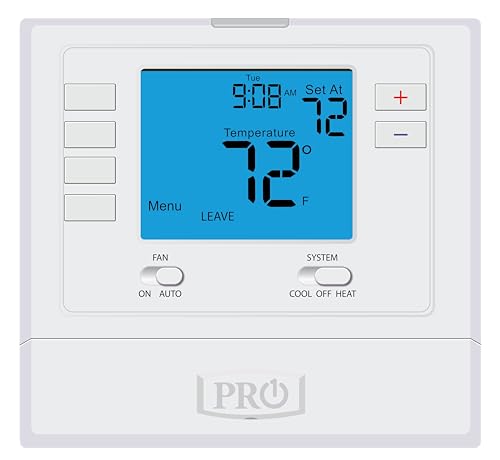
The PRO1 T715 steps up where the T701 stops, handling two heat stages and two cool stages on a conventional gas furnace system. It still lives on the T700 platform, so you get the familiar blue backlit display and glow-in-the-dark light button, but the internal brain can manage more demanding HVAC equipment.
Programming here is the full set: 7-day, 5/1/1, or non-programmable modes, so the T715 can run as a scheduled thermostat or behave like a manual unit if you prefer. Power can come from AA batteries or a hardwired connection, which removes the common-wire headache in many older homes. For a homeowner with a two-stage gas furnace who wants genuine scheduling without paying for a connected app, this lands in a useful niche.
Practical Pluses
- 2 heat/2 cool staging supports two-stage furnaces and AC condensers for tighter temperature control
- Three operating modes (7-day, 5/1/1, non-programmable) match different household routines
- Battery or hardwire power lets the unit install cleanly in homes without a C-wire
Small Caveats
- Limited to conventional gas systems, so heat pump owners should pivot to the PRO1 T725
- Lacks Wi-Fi connectivity, which rules out app-based remote adjustments
Whose Shelf It Belongs On
Owners of two-stage gas furnace systems who want real scheduling without a connected app on the wall.
Reach For A Different Pick When
You want full app-based remote control, where the Honeywell Home RTH9600WF delivers Wi-Fi alongside its color touchscreen.
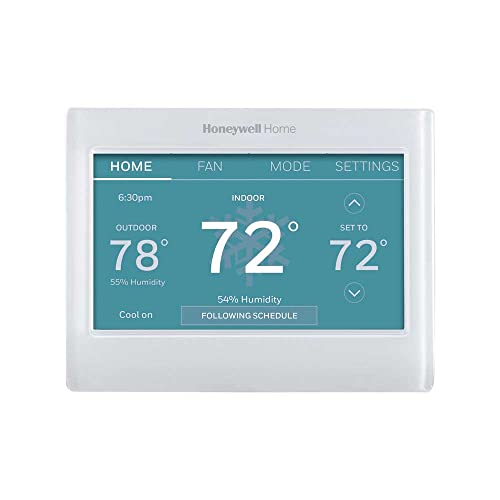
The Honeywell Home RTH9600WF is the first true Wi-Fi pick in this list, and it leans hard into the connected experience. The color touchscreen can be re-themed to match a room’s decor, which sounds trivial until you realize the thermostat is often the first thing guests see when they walk in. Behind the screen, the unit supports flexible programming that aligns with peak-rate utility pricing if your provider offers time-of-use plans.
Through the app, you can monitor and manage your home’s temperature from anywhere, which is the actual selling point of a connected thermostat. Voice integration with common smart assistants extends that control hands-free. A common wire (C-wire) is required, so this is not a drop-in upgrade for every home. For someone building a smart-home ecosystem around scheduling and remote access, the RTH9600WF earns its place.
The Good Stuff
- Customizable color touchscreen lets the unit blend with a room’s design rather than stand out
- Wi-Fi app control supports remote monitoring from a phone, useful for second homes and travel
- Flexible programming adapts to peak-rate utility pricing for households on time-of-use plans
Things To Weigh
- Requires a C-wire, which older homes without a common wire will need to retrofit
- Hands-free voice control depends on having a compatible smart assistant already in the home
Key Attributes
Perfect Match For
Smart-home enthusiasts with a C-wire already in place who want app control and a polished color display.
Where A Sibling Pick Shines
Homeowners without a C-wire and tighter budget should look at the Honeywell Home RTH9585WF, a similar connected unit in a slightly different class.
The Reliance 9000507-045 is a different animal from everything else on this list. It is a lower electric thermostat, which is a small immersion-style control designed to sit in the lower position of an electric water heater, not a wall thermostat for an HVAC system.
It exists for a very specific reason: electric water heaters usually use two thermostats, one near the top element and one near the bottom, and either can fail. A water heater that produces lukewarm water or runs constantly often points at the lower thermostat. For a homeowner or plumber diagnosing that exact problem, this part is a direct replacement rather than an upgrade. Anyone shopping for a wall thermostat should skip ahead.
Noteworthy Benefits
- Direct-fit lower thermostat for many standard residential electric water heaters
- Inexpensive way to repair lukewarm-water or constantly-running heater symptoms
- Simple mechanical design that homeowners can swap in themselves with basic tools
Honest Caveats
- Not a wall thermostat and cannot control furnaces, heat pumps, or central air
- Compatibility with specific water heater models should be verified before ordering
Who Will Love This
DIYers troubleshooting an electric water heater that is no longer producing reliably hot water.
Swap It Out When
You actually need a wall thermostat for a heating or cooling system, where any of the other picks on this list will do the job.
The PRO1 T721 is the cousin that bridges two system types without forcing a choice. It supports either a 2 heat/1 cool heat pump or a 1 heat/1 cool conventional setup, so it works in homes where the fuel source has changed over the years or where the basement runs a heat pump while the upstairs furnace is conventional.
The 4-square-inch blue backlit display keeps the screen consistent with other PRO1 T700-series units, and the glow-in-the-dark light button is a small but appreciated feature. Power comes from AA batteries or a hardwired connection, easing installation where a common wire is not already run. It is a non-programmable unit, which keeps the interface simple, but it does sacrifice scheduling that some of its siblings offer.
Bright Spots
- Works with both heat pump and conventional systems, useful when a home has mixed HVAC equipment
- Battery or hardwire power lets the unit install in homes without a common wire
- Glow-in-the-dark button keeps nighttime adjustments easy without fumbling for a switch
Less Ideal Details
- No scheduling means daytime setback is not automatic during unoccupied hours
- Does not support multi-stage conventional systems, where the PRO1 T715 fits better
The Right Fit
Homeowners with a single-stage heat pump or a simple conventional system who want a fuss-free manual thermostat.
A Better Fit Elsewhere
You want app-based remote control and color touchscreen features, where the Honeywell Home RTH9600WF fits the connected lifestyle.
The Honeywell Home RTH9585WF is the more accessible Wi-Fi sibling of the RTH9600WF. It is a second-generation connected thermostat with a customizable color touchscreen, designed for households that want app-based control without venturing into pricier smart-home territory.
The 7-day programmable scheduling pairs with the touchscreen for at-the-wall control, and Wi-Fi connectivity allows the companion app to handle adjustments from a phone, tablet, or computer. Setup is designed as a DIY project for homeowners comfortable with basic wiring, and a C-wire is required. It also plays nicely with common smart assistants for hands-free voice adjustments. The gray housing finishes the look without competing with wall paint.
Everyday Wins
- Customizable color touchscreen blends with a range of wall colors and room styles
- 7-day scheduling covers weekday and weekend routines without manual tweaks
- App-based remote management from a phone, tablet, or computer adds flexibility
Where It Is Less Suited
- Requires a C-wire, which older homes may not have without a small rewiring job
- Not compatible with line-voltage heating systems, so electric baseboard owners should look elsewhere
Feature Snapshot
Built With In Mind
Homeowners building a connected ecosystem on a moderate budget who already have a C-wire in the wall.
Where Another Pick Suits Better
Heat pump households without a C-wire should consider the PRO1 T725 for a non-connected but versatile alternative.
The Honeywell Home 7 Day Programmable Touchscreen Thermostat is the unit for people who want the touchscreen experience without the Wi-Fi subscription to their home network. The display is crisp and clear, and setup walks you through the scheduling so even first-time programmable users can land on a workable weekly routine.
Scheduling can run day-by-day, weekends-only, or one program all week, which gives you flexibility depending on how predictable your routine is. The package includes the thermostat, a quick installation guide, screws, anchors, and a UWP mounting system that keeps wall installation tidy. For homeowners who want a touchscreen but are wary of app accounts, cloud services, and cybersecurity questions, this is a reasonable middle path.
Useful Highlights
- Touchscreen interface simplifies setup compared with button-driven programmable units
- Three scheduling modes (day-by-day, weekends, full week) match different routines
- Installation kit includes mounting hardware for a clean wall swap
Practical Considerations
- No Wi-Fi means no remote app control, which limits flexibility for frequent travelers
- Touchscreens can occasionally misread taps, a common quirk worth adjusting to during setup
Who Should Grab It
Homeowners who want a programmable touchscreen but prefer to keep their HVAC system off the home network.
Not Your Match When
You want full app-based remote control, where the Honeywell Home RTH9585WF adds Wi-Fi to a similar touchscreen design.
The PRO1 T805 rounds out the list as a single-stage programmable option with a noticeably larger display. Built on the T800 platform rather than the T700 used by earlier PRO1 picks in this roundup, it stretches the screen to about 7 square inches, which makes a real difference for anyone reading the temperature from across a room.
It supports 7-day, 5/1/1, and non-programmable modes, so the T805 behaves like a manual unit when you want and a scheduled thermostat when you need. The glow-in-the-dark light button returns, and the blue backlit screen keeps nighttime readability high. For an everyday replacement where the screen size is the deciding factor, this lands well.
Positive Points
- Extra-large 7-square-inch display improves readability from a distance or for users with limited vision
- Three operating modes cover both scheduled and set-and-forget preferences
- Glow-in-the-dark light button plus blue backlight handles low-light conditions cleanly
Potential Compromises
- Limited to single-stage 1H/1C conventional systems, which rules out heat pump and multi-stage setups
- No Wi-Fi connectivity, so app control is not part of the package
Feature Card
Made For
Homeowners with a basic 1H/1C conventional system who want a larger display and flexible scheduling in one wall unit.
A Better Fit Elsewhere
You run a heat pump and want scheduling, where the PRO1 T725 offers similar programmability with heat pump support.
What Matters Most Before Choosing Wi Fi Thermostats
System compatibility comes first, before any feature on the spec sheet. Knowing whether your HVAC equipment is single-stage, multi-stage, conventional, or heat pump determines which thermostats will actually wire up cleanly. Mismatched staging can keep the system from running at peak efficiency, even if the thermostat itself works fine.
Next, think honestly about how much control you really want. A connected thermostat only earns its place if you will actually adjust it from your phone or use the scheduling. For many households, a non-programmable or 7-day programmable wall unit covers daily comfort without the added complexity of Wi-Fi, accounts, and firmware updates.
Power wiring is a quiet gatekeeper. Most modern smart thermostats need a C-wire for steady power to the Wi-Fi radio and color screen. Older homes without that wire may need a small rewiring job or a power adapter, which is worth factoring into installation time.
Finally, decide whether you want a built-in setback schedule. Programming only saves money if it runs during the hours you are away from home. Households with predictable weekday routines benefit most from a 5/1/1 or 7-day schedule, while stay-at-home households often leave the thermostat at one setpoint all day.
Picking Between Programmable And Non-Programmable
Programmable thermostats make sense when someone leaves the house for predictable stretches, like a work commute or school day, and the unit can lower the heat or raise the AC during those hours. Non-programmable units suit homes where the setpoint barely changes, and they cut out the small hassle of weekly schedule management.
Why Wi-Fi Connectivity Changes Daily Habits
Connected thermostats add two real benefits: remote control from a phone and the ability to receive software updates over time. The honest trade-off is account setup, a working C-wire, and a stable home Wi-Fi signal at the mounting location. If your router sits far from the thermostat, signal reliability can become a recurring frustration.
The Practical Role Of Multi-Stage Support
Two-stage furnaces and heat pumps ramp up gradually rather than blasting at full power, which tightens temperature swings and reduces cold drafts. A single-stage thermostat can still control a multi-stage system, but it cannot take advantage of the low stage for milder weather. Homes with multi-stage equipment benefit most from a thermostat that explicitly supports those stages.
Key Considerations Across These Picks
Pitfalls Shoppers Hit
The most common mistake is assuming any thermostat will work with any system. A 6-to-8-wire setup can quickly narrow the field, and the Heagstat unit in particular caps out at five wires. Heat pump owners who grab a conventional-only thermostat will find that the auxiliary heat never engages correctly, which is both a comfort and an efficiency problem.
A second slip-up is skipping the C-wire check before buying a Wi-Fi model. The Honeywell RTH9600WF and RTH9585WF both require it, and without it the unit will not power on consistently. A quick look behind your current thermostat’s wall plate saves a return trip.
Where The Extra Money Goes
Higher-tier models in this roundup buy you a color touchscreen, Wi-Fi connectivity, and multi-stage support. The Honeywell RTH9600WF adds app control, voice integration, and a customizable display that older units cannot match. For a homeowner who travels often or runs a variable utility-rate plan, the upgrade typically pays for itself through remote adjustments and smarter scheduling.
Frequently Asked Questions
Do I need a C-wire to install a Wi-Fi thermostat?
Most Wi-Fi thermostats, including the Honeywell RTH9600WF and RTH9585WF, require a C-wire because the Wi-Fi radio and color touchscreen draw steady power. Older homes without one can sometimes use a power adapter kit, but it adds a step to installation.
Can a heat pump work with a conventional thermostat?
A conventional-only thermostat can technically power a heat pump, but it will not manage the auxiliary heat strip correctly in cold weather. Heat pump owners get the most reliable performance from a thermostat that explicitly supports heat pump staging, like the PRO1 T725 or T721.
What is the difference between single-stage and multi-stage support?
Single-stage thermostats control one level of heating and one level of cooling. Multi-stage units like the PRO1 T715 can manage two heat stages and two cool stages, letting the furnace ramp up gradually rather than blasting at full power.
Is a programmable thermostat worth it without Wi-Fi?
For households with predictable weekday routines, a 7-day programmable unit like the Honeywell Home 7 Day Programmable Touchscreen can deliver real savings through automatic setbacks, even without an app. The trade-off is no remote control when you are away from home.
Are these thermostats compatible with smart home voice assistants?
The Honeywell Home RTH9600WF and RTH9585WF support common smart assistants for hands-free voice control. The non-connected PRO1 and Heagstat units do not, since they rely on direct wall control rather than a network connection.
The Takeaway
The right thermostat depends less on screen size or app features and more on what your HVAC system actually needs. Match the staging first, decide how much scheduling you will use, and only then weigh Wi-Fi as a feature. The picks above cover most residential setups in 2026, from a basic single-stage furnace to a connected multi-stage system, so there is a sensible starting point for nearly any home.