Two-stage heating and cooling deserves a thermostat that actually understands staging, rather than one that flips the system on and off like a light switch. A proper control board reads your home’s temperature swing, nudges the first stage up, then brings the second stage in only when the load calls for it. The picks below cover programmable and non-programmable options, heat pump and conventional systems, plus a smart learning model for hands-off households.
The Choices Worth Comparing

PRO1 T725 Heat Pump/Conventional Programmable Thermostat
PRO1 T771 Single Stage Non-Programmable Thermostat
Honeywell TH1100DV1000 PRO 1000 Vertical Thermostat

PRO1 T701 Single Stage Non-Programmable Thermostat
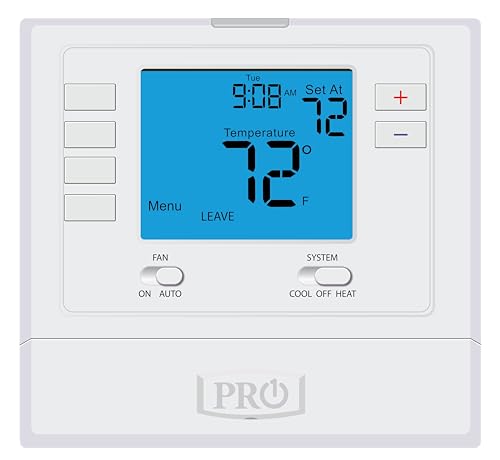
PRO1 T715 Multi-Stage Programmable Gas Thermostat

Heagstat Non-Programmable Thermostat for Home

Honeywell TL7235A1003 Line Volt Pro Digital Thermostat

PRO1 T721 Non-Programmable Heat Pump/Conventional Thermostat
PRO1 T805 Single Stage Programmable Wall Thermostat

Google Nest Learning Thermostat (4th gen) with Temperature Sensor
The PRO1 T725 sits at the top of the list because it handles the two most common staging configurations without forcing you to pick a side. It runs 2 heat/1 cool heat pump systems or 1 heat/1 cool conventional systems, which covers a large share of single-family homes in climates that swing from sticky summers to cold winters. Scheduling runs through 7-day or 5/1/1 programs, so weekdays can settle into one routine while weekends stay looser.
The 4 sq. in. blue backlit screen reads cleanly across a living room, and the T700 platform behind it has been around long enough that installer communities know its wiring quirks. For homeowners replacing a worn-out thermostat and unsure whether their equipment is conventional or heat pump, this dual-mode design removes a real point of friction.
What It Does Well
- Dual compatibility across heat pump and conventional staging, removing the need to match two separate units.
- Flexible 7-day or 5/1/1 programming helps trim run time on weekdays when nobody is home.
- The 4 sq. in. blue backlit display is readable from across a small room, which matters for hallways and open-plan layouts.
- Gas or electric configuration support covers most residential furnaces without extra relay parts.
Things To Consider
- It’s a wall-mounted wired unit, so renters may need landlord approval before installation.
- Without Wi-Fi, scheduling changes have to happen at the wall rather than from a phone.
- Owners commonly report that the C-wire (common wire, which delivers continuous 24V power) is required for reliable backlighting, so older homes may need a quick wire pull.
Who It Suits Best
Homeowners with a 2 heat/1 cool heat pump or a basic conventional system who want a programmable schedule without a learning curve or app dependency.
Skip It When
The Google Nest Learning Thermostat (4th gen) is a stronger fit for households that prefer app-based scheduling, geofencing, and remote sensors.
Single-stage thermostats usually start around 45°F and stop there, which is fine for a living room but useless in an unheated garage. The PRO1 T771 drops the setpoint range down to 25°F, opening the door to frost-watch duty in sheds, workshops, and outbuildings where pipes and plants need to stay above freezing.
It’s also a sensible pick when you want dead-simple manual control. There’s no scheduling, no app, and no learning mode, so setpoint changes happen at the wall with a clear blue backlit display. Swing adjustment and calibration live behind the faceplate for an installer who wants to fine-tune cycling.
Why It Works Well
- 25°F to 90°F setpoint range handles freeze protection in unheated spaces.
- Large blue backlit screen remains readable in dim garages and basements.
- Calibration and swing adjustment give an installer room to tune cycling without proprietary software.
- Single-stage wiring keeps the install short for older systems.
Worth Noting
- Non-programmable means every setback has to be done by hand, which can drive up bills in a primary living space.
- It’s built for conventional 1H/1C only and won’t talk to a heat pump compressor.
Made For
Shoppers outfitting a detached garage, pole barn, or workshop where freeze protection matters more than scheduling flexibility.
Consider Something Else When
The Honeywell TH1100DV1000 PRO 1000 is a better match for vertical-mount baseboard heat-only installations where a low, compact footprint matters.
The Honeywell TH1100DV1000 leans into a single job: controlling heat-only systems without fuss. Its vertical 4 11/16 in. by 2 7/8 in. footprint slots neatly into narrow wall sections where horizontal thermostats look awkward, like the side of a stair landing or a tight hallway nook.
Premier white housing keeps it visually quiet, which suits older homes where paint colors and trim work have already been finalized. There’s no app and no schedule, just an up-and-down setpoint dial and a clear temperature readout, which is exactly the point for a heat-only baseboard or millivolt system.
Where It Excels
- Vertical form factor fits narrow wall sections and slim trim spaces.
- Premier white finish blends with most interior paint palettes.
- Mechanical simplicity means fewer parts that can fail over a long lifespan.
- Heat-only compatibility covers baseboard, millivolt, and similar low-voltage systems.
Trade Offs
- Heat-only design won’t switch over a central cooling system, which limits whole-home use.
- Lacks any scheduling, so efficiency gains depend entirely on manual adjustment.
- No backlight on the readout, which can be a small inconvenience in darker hallways at night.
Best Suited To
Owners of baseboard or millivolt heating systems who want a no-nonsense wall control that disappears into the room.
Look Elsewhere When
The Honeywell TL7235A1003 is the right call when you have 240V electric baseboard or radiant heat that needs electronic line-voltage precision.
The PRO1 T701 is the kind of thermostat you install and then forget about, which is exactly what many people want. It’s built on the T700 platform for 1 heat/1 cool conventional systems, and the 4 sq. in. blue backlit display stays readable whether you’re checking it from the kitchen doorway or from the couch.
A glow-in-the-dark light button helps in power-outage moments, since you can still find the controls without fumbling for a flashlight. Power options cover AA batteries or a hardwired common wire, which gives an installer flexibility when the wall box only has a few conductors.
What Makes Sense
- Large blue backlit display is easy to read from a few feet away.
- Glow-in-the-dark light button helps during outages or in dark hallways.
- Battery or hardwire power makes it adaptable to older 4-wire walls.
- Gas or electric configuration covers most conventional furnaces.
Honest Caveats
- No scheduling or Wi-Fi, so setpoints change only at the wall.
- Limited to single-stage conventional systems, with no heat-pump staging.
The Right Fit
Conventional 1H/1C homeowners who want a simple digital wall thermostat without paying for features they won’t use.
Reach For A Different Pick When
The PRO1 T805 is worth the upgrade for anyone who wants 7-day scheduling and a noticeably larger 7 sq. in. display.
Two-stage and two-cool systems are where most budget thermostats tap out. The PRO1 T715 takes the next step with full 2 heat/2 cool staging for gas furnace setups, plus scheduling options that range from a strict 7-day routine to a relaxed 5/1/1 split, with a non-programmable mode for those who prefer manual control.
Like its T700 siblings, it shows readings on a 4 sq. in. blue backlit display and includes a glow-in-the-dark light button for low-light conditions. Battery or hardwired common-wire power rounds out an installation-friendly package.
Useful Strengths
- Full 2 heat/2 cool staging for two-stage gas systems.
- 7-day, 5/1/1, and non-programmable modes cover different scheduling needs.
- Blue backlit display and glow-in-the-dark button work well in dim rooms.
- Battery or common-wire power adapts to varied existing wiring.
Small Caveats
- Heat-pump systems aren’t supported here, so this is a gas-furnace-focused pick.
- Programming menus can feel denser than simpler 1H/1C units, which may slow first-time installers.
Who Will Love This
Households running a two-stage gas furnace paired with a two-stage air conditioner who want scheduling without a smart platform.
Swap It Out When
The PRO1 T725 is the better pick for homes with a 2 heat/1 cool heat pump rather than a gas-only staged system.
The Heagstat thermostat focuses on a narrow but very common situation: a 24VAC conventional single-stage system wired with 2 to 5 conductors, found in many older and rental properties. It pairs with gas, oil, or electric furnaces matched with a separate air-conditioning condenser and standard indoor ductwork.
There’s no scheduling and no learning curve. Setpoint changes happen at the wall, the white backlight comes on with a button press, and that’s about it. The clear compatibility notes in the manual matter here, since hooking a unit like this into the wrong wiring can short a fuse on the furnace control board.
Strong Points
- Works with common 2-to-5 wire conventional systems in older homes and rentals.
- Compatible with gas, oil, and electric furnace setups.
- White backlight aids quick nighttime checks without harsh blue light.
- Simple interface keeps the learning curve short for non-technical users.
Points To Keep In Mind
- 6-to-8 wire systems are not supported, which rules out homes with multi-speed fan control or accessory boards.
- Not compatible with heat-pump or line-voltage systems, limiting it to low-voltage conventional equipment.
- No scheduling means efficiency improvements rely on manual setpoint habits.
Perfect Match For
Renters or budget-focused homeowners with a basic 1H/1C conventional furnace and a thin wire bundle at the wall.
Another Choice May Suit
The Honeywell TH1100DV1000 PRO 1000 is a better fit for vertical-mount heat-only installations where the wall space runs tall and narrow.
Line-voltage thermostats live in a different world from the low-voltage units that hang off most furnace boards. The Honeywell TL7235A1003 runs on 240V circuits and sits between the breaker panel and an electric baseboard or radiant heater, controlling it directly rather than signaling a furnace control board.
Its on-demand backlight keeps the screen readable without leaving a glowing rectangle on the wall, and the silent electronic switching avoids the soft “click” that mechanical line-voltage thermostats make every cycle. A heating indicator confirms at a glance that the circuit is drawing current.
Everyday Advantages
- 240V electronic switching for direct baseboard and radiant control.
- On-demand backlight reduces ambient glow in living spaces.
- Silent operation removes the audible click of mechanical line-voltage units.
- Heating indicator gives quick visual confirmation of active draw.
Softer Spots
- 240V wiring is not a casual swap. Most installations call for a licensed electrician rather than a DIY thermostat job.
- No scheduling or smart features, so the unit runs as a simple setpoint controller.
Whose Shelf It Belongs On
Homeowners with 240V electric baseboard or radiant heating zones who want precise electronic control and quiet operation.
A Better Fit Elsewhere
The Honeywell TH1100DV1000 PRO 1000 suits low-voltage baseboard or millivolt systems where the wall control signals a separate heating appliance.
Mixed-fuel homes tend to need two thermostats or a model that can read both languages. The PRO1 T721 sits in the middle, handling either a 2H/1C heat pump or a 1H/1C conventional system on the same wall plate, with a 4 sq. in. blue backlit display and a glow-in-the-dark light button for low-light adjustments.
Power flexibility runs through AA batteries or a hardwired common wire, so older wiring bundles without a C-wire still get a clean install. It’s a useful bridge when a homeowner can’t quite remember which fuel type their system runs, since the menu covers both before committing to one mode.
Practical Pluses
- Dual compatibility with heat pump and conventional systems on a single unit.
- 4 sq. in. blue backlit display is readable from a distance.
- Glow-in-the-dark light button makes night adjustments easier.
- Battery or common-wire power adapts to varied existing wiring.
A Few Limitations
- No scheduling, so setback routines have to be done manually each night.
- Configuration menus can be denser than single-mode units, since the installer has to select the right system type at setup.
Right Fit For
Owners of mixed-fuel homes who want one thermostat to handle either a heat pump or a conventional system without buying two units.
Not Your Match When
The PRO1 T725 makes more sense for households that want full 7-day programmable scheduling on a heat pump system.
The PRO1 T805 jumps to a noticeably bigger 7 sq. in. blue backlit display, which is one of those small luxuries that pays off every time you check the temperature. It targets conventional 1H/1C systems and offers 7-day, 5/1/1, or non-programmable modes, so the scheduling can match a household’s actual rhythm.
As part of the T800 platform, it pairs the larger screen with a glow-in-the-dark light button and the same battery-or-common-wire flexibility that the T700 series is known for. It runs a touch warmer in setup complexity than its non-programmable cousins, but the menus stay logical.
What Works In Its Favor
- Extra-large 7 sq. in. blue backlit display reads clearly from across the room.
- 7-day, 5/1/1, and non-programmable modes offer scheduling flexibility.
- Glow-in-the-dark light button improves nighttime visibility.
- Battery or common-wire power adapts to existing wall wiring.
Possible Compromises
- Single-stage conventional only, so it won’t drive a heat pump compressor.
- Programming setup takes longer than a non-programmable swap.
Built With In Mind
Conventional 1H/1C homeowners who want a generous display and the option to run a real weekly schedule without app dependency.
Where Another Pick Suits Better
The PRO1 T701 is a simpler alternative for anyone who’d rather skip programming entirely and just turn the setpoint up or down by hand.
The Google Nest Learning Thermostat (4th gen) takes a different angle on the whole category. Instead of asking you to program a schedule, it watches your manual adjustments over the first couple of weeks and builds a routine on its own, then tunes heating and cooling run time to match. The Obsidian finish gives it a darker, more architectural look on the wall than most white plastic units.
This bundle includes a 2nd-generation Nest Temperature Sensor, which reports temperatures from another room. That’s useful in homes with a hot upstairs or a chilly nursery, since the thermostat can weigh the sensor reading alongside its own wall reading.
Real-World Strengths
- Adaptive learning builds a schedule without manual programming.
- Included Temperature Sensor helps balance multi-room comfort.
- Obsidian finish suits modern interiors better than classic white plastic.
- App control supports remote adjustments from a phone.
Potential Drawbacks
- Setup is more involved than a wall-only programmable thermostat, since it ties into a phone app and account.
- Renters may need landlord approval, and removal requires a small wiring reconfiguration at the wall.
Who Should Grab It
Connected households and short-term rental owners who want learning behavior, app control, and remote temperature sensing in one package.
Where A Sibling Pick Shines
The PRO1 T715 is a quieter, offline alternative for two-stage gas systems in households that prefer wall-only controls.
What To Weigh Before Picking A Two-Stage Thermostat
Match the system, not the spec sheet. A two-stage thermostat only delivers its real benefit when the heating and cooling equipment can actually stage. A two-stage gas furnace paired with a single-stage air conditioner will still light the second stage on the heating side, but the cooling side will behave like a single-stage system regardless of what the thermostat can do. Confirm the staging count on the furnace data plate and the air handler wiring diagram before committing.
Voltage and wiring decide more than features do. Most residential thermostats run on 24VAC low-voltage circuits, but electric baseboard and some radiant systems use 120V or 240V line-voltage wiring. A low-voltage thermostat on a line-voltage system is a fire hazard, and a line-voltage unit on a furnace board will short the control fuse. Count the conductors at the wall and check whether a C-wire is present before ordering.
Setpoint range matters for non-living spaces. Garages, sheds, and basements often need freeze-protection setpoints in the high 20s or low 30s, which most living-room thermostats won’t reach. A wide-range non-programmable unit like the PRO1 T771 covers that range, while a standard living-area thermostat usually caps at 45°F.
Schedule depth should match the household. A 7-day program suits shift workers and irregular routines. A 5/1/1 schedule fits families with stable weekday and weekend patterns. Non-programmable controls work fine in guest rooms and spaces that hold a steady temperature year-round.
Smart features trade complexity for control. Learning thermostats reduce manual scheduling but require an account, an app, and a stable Wi-Fi signal. Wall-only programmable units stay simple and dependable for anyone who doesn’t want a thermostat tied to a phone.
Key Considerations Across These Picks
Where Shoppers Go Wrong
The most common mistake is matching the thermostat to the marketing rather than to the equipment. A two-stage thermostat on a single-stage furnace behaves like a single-stage unit, and a heat-pump thermostat on a conventional furnace will misread signals. Compatibility notes matter more than display size or scheduling depth.
Another trap is overlooking the C-wire. Battery-only thermostats can lose their backlight and clock after a year of use, and a missing common wire is the silent reason many wall-only units feel sluggish. Confirm wiring at the wall plate before ordering, and plan on a quick wire pull or a power-stealing module if the bundle is short.
When Paying More Pays Off
Higher-tier thermostats earn their keep through scheduling depth and learning behavior. A 7-day programmable unit trims run time on weekdays when nobody is home, and a learning model like the Google Nest adapts as routines shift without manual reprogramming. For most households, the upgrade pays back through a few percentage points of HVAC run time per week, which compounds over a heating season.
Frequently Asked Questions
What does a two-stage thermostat actually do?
A two-stage thermostat signals the furnace or heat pump to run on low stage for mild weather and brings the high stage in only when indoor temperature drifts further from the setpoint. That gentler ramp reduces cold drafts at startup and keeps the system from cycling hard every few minutes.
Can a two-stage thermostat work with a single-stage furnace?
Yes, but the thermostat will only use the first stage. The second-stage terminals sit unused, and the system behaves as if it were a single-stage setup. You get cleaner scheduling and display features without gaining staging efficiency.
Do two-stage thermostats need a C-wire?
Most modern digital thermostats, including the PRO1 T700-series units, expect a C-wire for continuous 24V power. Without it, they often fall back on battery power and dim the backlight. Some models support power-stealing adapters, but a dedicated common wire is the cleanest path.
Are smart thermostats worth it for two-stage systems?
Learning thermostats like the Google Nest (4th gen) add value when routines shift regularly, since they adjust schedules automatically. For predictable households, a wall-only programmable unit delivers most of the efficiency without the app dependency.
How hard is it to install one of these myself?
Most low-voltage swaps take fifteen to thirty minutes with a screwdriver and a phone flashlight. Turn the breaker off, label the wires, swap the baseplate, and remount the faceplate. Line-voltage installations like the Honeywell TL7235A1003 should go through a licensed electrician rather than a DIY job.
Closing Remarks
A two-stage thermostat only earns its keep when it matches the equipment behind the wall, the wiring at the plate, and the way the household actually lives. Read the furnace data plate, count the wires, and decide how much scheduling you really want before clicking through to the retailer. The right pick keeps rooms steady and run time lower without adding a second device to manage.