Heating and cooling quietly swallow the biggest share of most household energy budgets, and the controller on the wall decides how much of that money turns into comfort versus waste. Swapping a tired manual dial for a properly matched programmable or learning thermostat is one of the few upgrades that pays back season after season, and the right match depends on your system type, your schedule, and how much tinkering you actually enjoy. This roundup walks through ten wall thermostats that span simple non-programmable dials to fully learning smart hubs, so you can pick the level of automation that fits your home.
A Closer Look At The Lineup

PRO1 T725 Heat Pump/Conventional Programmable Wall Thermostat
PRO1 T771 Single Stage Non-Programmable Wall Thermostat

PRO1 T701 Single Stage Non-Programmable Wall Thermostat
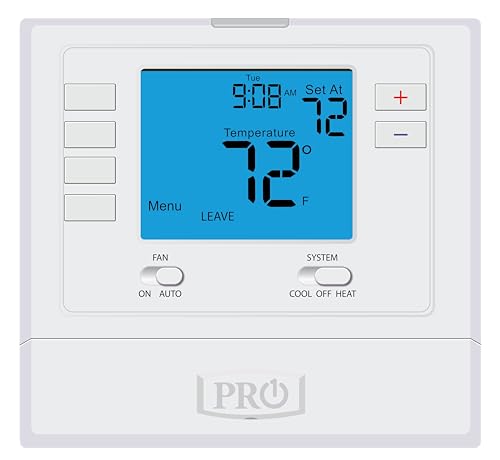
PRO1 T715 Multi-Stage Programmable Gas Thermostat
White-Rodgers 1F80-361 Emerson 80 Series Programmable Thermostat

Heagstat Non-Programmable Thermostat 1 Heat/1 Cool

PRO1 T721 Heat Pump or Conventional Wall Thermostat

Venstar T2800 Commercial Platinum Slimline Thermostat
PRO1 T805 Single Stage Programmable Wall Thermostat

Google Nest Learning Thermostat (4th gen) with Temperature Sensor
The Picks, Examined More Closely
The PRO1 T725 sits in the middle of the lineup and earns the Editor’s slot because it speaks two equipment languages at once. It will run a 2 heat/1 cool heat pump or fall back to a 1 heat/1 cool conventional setup, which means renters, owners upgrading mid-cycle, and anyone unsure of their wiring don’t have to guess at the wall plate.
Built on the T700 platform, the unit pairs 7-day or 5/1/1 scheduling (a common program structure that splits the week into weekdays, Saturday, and Sunday) with a 4 sq. in. blue backlit screen. Compared with the simpler PRO1 T701 covered later, this model adds programming depth that pays off for households with predictable weekday routines.
Noteworthy Benefits
- Compatible with both heat pump and conventional equipment, sidestepping a second wall swap if your system changes later.
- 7-day and 5/1/1 scheduling capture a real workday rhythm, trimming run time during empty hours.
- 4 sq. in. blue backlit display reads cleanly across a dim hallway at night.
- Multi-stage staging (the ability to call for low and high heating or cooling independently) lets the system ramp gently instead of blasting on and off.
Trade Offs To Consider
- Program setup has a learning curve, so first-timers may need the manual open for the first weekend.
- No remote sensor included, so distant rooms may run a degree off the setpoint.
- Battery or hardwire options vary by installation, so confirm wiring before mounting.
Who It Suits Best
Heat pump owners on predictable weekday schedules who want one thermostat that handles programming without needing a phone app.
Where Another Pick Suits Better
Shoppers wanting self-adjusting automation with remote sensors will find the Google Nest Learning Thermostat (4th gen) a stronger long-term fit.
The PRO1 T771 is built for spaces where you don’t want a learning curve, you just want a wall control that holds a temperature. It’s a single-stage (one heating or cooling output, no low/high steps) non-programmable unit aimed at 1 heat/1 cool conventional systems, and the standout spec is its unusually wide 25°F to 90°F setpoint range, which makes it useful for rooms that run colder than a living space.
Compared with the T701 reviewed just below, the T771 drops glow-in-the-dark features but extends the lower temperature floor, opening up garage, workshop, and shed applications where freezing pipes are a concern.
Everyday Wins
- Wide setpoint range down to 25°F suits unheated garages and storage spaces.
- Non-programmable layout means zero schedule setup, just turn the dial.
- 4 sq. in. blue backlit screen is legible from across a wide garage bay.
Worth Bearing In Mind
- No scheduling means savings depend entirely on manual adjustment discipline.
- Single-stage only, so it won’t help homes with multi-stage equipment.
Made For
Detached garages, sheds, and workshops where freeze protection matters more than programming.
Consider Something Else When
Heated living spaces with predictable routines will see more savings from the programmable PRO1 T805 with its larger display.
The PRO1 T701 is the friendliest swap on the list for anyone replacing a 20-year-old analog dial. It runs on the larger T700 platform, handles single-stage 1 heat/1 cool conventional gear, and pairs a 4 sq. in. blue backlit screen with a glow-in-the-dark light button, which sounds like a small detail until you walk past it barefoot at 2 a.m.
Where the T771 stretches toward extreme low temperatures, the T701 stays inside the typical home comfort range, making it the more natural pick for primary living spaces without programming needs.
A Few Highlights
- Glow-in-the-dark light button eliminates fumbling for the switch in a dark hallway.
- Gas, oil, or electric conventional compatibility covers most older American furnaces.
- No scheduling menus to navigate, which is the whole point for some households.
Small Caveats
- Single-stage only, so it won’t stage equipment up and down for tighter comfort.
- Requires manual temperature changes for day and night, which can drift energy use.
Best Suited To
First-time thermostat swappers who want set-and-forget simplicity without learning a schedule interface.
A Better Fit Elsewhere
Two-stage gas furnace households will benefit more from the PRO1 T715’s multi-stage handling.
The PRO1 T715 earns its Performance Leader badge by handling 2 heat/2 cool gas systems, which is two heating stages and two cooling stages, more than most of the wall controls in this price band. The T700 platform under the hood supports 7-day, 5/1/1, or non-programmable modes, so you can start simple and grow into scheduling without replacing the hardware.
Compared with the T725 reviewed above, this unit drops heat pump compatibility in exchange for fuller conventional staging, which is the right trade for homes with a true two-stage furnace.
Real Benefits
- 2 heat/2 cool staging keeps temperatures steadier by using low fire more often.
- Three mode options give households a soft landing into automation.
- 4 sq. in. blue backlit display with a glow-in-the-dark light button stays readable in dim rooms.
- Battery or hardwire power accommodates older wiring cabinets.
Honest Caveats
- No heat pump support, so it won’t work for households relying on a heat pump compressor.
Who Will Love This
Households running a two-stage furnace that want scheduling and tighter comfort without jumping to a smart thermostat.
Look Elsewhere When
Heat pump owners should pivot back to the PRO1 T725 or PRO1 T721 for compatible staging.
Feature Snapshot
The Emerson 1F80-361 is the seasoned workhorse of this list, sold from contractor bulk packs with the manual listed separately and a factory anti-static bag for safe storage. It’s a single-stage heat/cool programmable unit rated for 24V systems, plus millivolt compatibility (the low-voltage signal used by some standing-pilot gas systems) that opens the door to older homes without a common wire.
Versus the newer PRO1 models above, this one leans on Emerson’s long installer track record rather than flashy features, which makes it the safe call for properties with legacy equipment.
Notable Upsides
- Millivolt compatibility supports standing-pilot gas systems that reject most modern thermostats.
- Single thermostat from contractor bulk pack is a familiar fit for trade installers.
- Programmable schedule supports energy-saving setbacks during work hours.
Points To Keep In Mind
- Factory anti-static bag packaging is utilitarian, so gift-givers may want to wrap it themselves.
- Manual is hosted online rather than printed, so plan a phone or laptop nearby during setup.
The Right Fit
Owners of older homes with millivolt or 24V conventional systems who prioritize long-term reliability over app control.
Reach For A Different Pick When
Smart-home households will prefer the Google Nest Learning Thermostat (4th gen) for app-based scheduling.
The Heagstat non-programmable thermostat targets the simplest conventional 1H/1C systems and is the lowest-friction swap for renters and first-time homeowners. The big caveat lives in the wiring: the base accepts 2 to 5 wires only, so anyone with 6 to 8 wire configurations will need to look elsewhere.
Side by side with the PRO1 T701, this unit trims features for a tighter price point, sacrificing the glow-in-the-dark button for a plain white backlight that still does the job after dark.
The Good Stuff
- Lower price point makes it approachable for budget-tight projects.
- 24VAC single-stage support covers most basic furnace and AC pairings.
- White backlight keeps the screen readable without overwhelming a small room.
A Few Limitations
- 2 to 5 wire limit excludes homes with multi-stage or added accessory wiring.
- Not compatible with heat pump or high-voltage baseboard systems.
Perfect Match For
Conventional 1H/1C homes with simple wiring where the goal is a clean digital swap at a modest cost.
Swap It Out When
Households needing more than five conductors should step up to the PRO1 T725 or PRO1 T715 for safer compatibility.
The PRO1 T721 is the chameleon of the T700 family, running either a 2 heat/1 cool heat pump or a 1 heat/1 cool conventional system from the same wall plate. It is non-programmable, which makes it the no-menu sibling to the T725 covered above.
That dual personality matters during HVAC transitions: if a household flips from a furnace to a heat pump or vice versa, the wall thermostat can come along for the ride without another swap.
What Stands Out
- Dual heat pump and conventional compatibility in a single unit.
- 4 sq. in. blue backlit display with glow-in-the-dark light button.
- AA battery or hardwire power options simplify older cabinet wiring.
Less Ideal Details
- Non-programmable, so all setback savings rely on manual adjustment.
Whose Shelf It Belongs On
Mixed-system households that expect to change equipment types within the thermostat’s lifespan.
Another Choice May Suit
Schedulers who want 7-day automation in the same dual-system form should pick the PRO1 T725 instead.
Key Product Details
The Venstar T2800 steps out of the residential lane and into light commercial territory with 3 heat/2 cool staging, three configurable outputs, and service reminders for filters and UV lights. The color-coded keys and legends plus a backlit display keep the interface usable for staff who aren’t HVAC-savvy.
Against the PRO1 T715’s 2 heat/2 cool gas focus, the Venstar adds an extra heating stage and the configurability that property managers tend to want when one thermostat serves a workshop, studio, or small office suite.
Useful Touches
- 3 heat/2 cool staging handles heavier commercial rooftop units.
- Configurable outputs adapt to unusual equipment wiring.
- Service filter and UV light reminders protect indoor air quality over time.
- Manual or auto changeover (the thermostat picks heat or cool based on the setpoint vs. room temp) supports unattended operation.
Trade-Offs To Consider
- Commercial feature set is overkill for a single-zone apartment, depending on your use case.
- Setup menus are denser than residential models, so first-time installers should budget time.
Built With In Mind
Light commercial spaces, studios, and workshops where staged heating and service reminders earn their keep.
Skip It When
Typical homeowners will find the PRO1 T715 easier to live with day to day.
Feature Overview
The PRO1 T805 brings everyday programming to the T800 platform, where the headline upgrade is a generous 7 sq. in. blue backlit display, roughly 75 percent more screen area than the T700 family. It’s still a 1 heat/1 cool conventional unit, but the larger readout is a real win for households where anyone in the family squints at the wall.
The T805 sits between the T701’s set-and-forget simplicity and the T725’s heat pump flexibility, giving programmers an oversized canvas for the same conventional systems as the entry-level models.
Why It Works Well
- Extra-large 7 sq. in. display is easy on aging eyes.
- 7-day, 5/1/1, or non-programmable modes ease newcomers into scheduling.
- Glow-in-the-dark light button keeps the controls findable at night.
Small Limitations
- Single-stage only, so it won’t stage a multi-speed furnace.
Who Should Grab It
Households prioritizing readability and straightforward programming over multi-stage complexity.
Not Your Match When
Two-stage gas households will benefit more from the PRO1 T715’s extra heating and cooling steps.
The Google Nest Learning Thermostat (4th gen) closes the list as the most hands-off option, and it ships with a second-generation Nest Temperature Sensor to balance hot and cold rooms. After a learning period, the thermostat builds its own schedule from the temperatures you actually choose, which is the right behavior for unpredictable routines.
Unlike the wall-mounted PRO1 models above, this unit leans on a connected app and a smart-home ecosystem. Households already running Google Home, Matter (a cross-brand smart-home standard), or similar platforms will find the integration smoother; everyone else may end up using it as a beautifully designed scheduler.
The Upside
- Self-learning schedule automation adapts to shifting routines without reprogramming.
- Included second-gen remote sensor addresses hot and cold rooms.
- Obsidian finish and edge-to-edge display elevate the wall’s appearance.
- App control supports remote adjustments from a phone.
Practical Considerations
- Higher price point than the wall-mounted PRO1 models on this list.
- Learning period means the first few weeks can feel uncertain before the schedule firms up.
- Smart-home households get the most out of it, depending on your platform mix.
Right Fit For
Tech-comfortable households that prefer automation over menu-driven programming and want balanced comfort across rooms.
A Better Fit Elsewhere
Homeowners avoiding app dependencies should pick the PRO1 T725 for scheduling without a smartphone.
Quick Technical Notes
Picking The Right Wall Controller For Your System
Smart shopping for a wall thermostat starts with your equipment, not the feature list. A heat pump system (a refrigerant-based unit that moves heat in or out of the home) needs a thermostat that explicitly lists heat pump support, otherwise the auxiliary heat strip will cycle at the wrong times and burn money. Conventional furnaces and air conditioners use simpler wiring, but multi-stage equipment still benefits from a thermostat that can call for low and high fire independently.
Next, think about how your household actually lives. A predictable weekday schedule rewards 7-day or 5/1/1 programming, while shift workers and home-based households often get more savings from a learning thermostat that adapts to irregular patterns. Non-programmable dials make sense for guest rooms, garages, and spaces where nobody sets a schedule.
Wiring is the third filter. Count the conductors at your existing wall plate before you buy, since units like the Heagstat cap at five wires and will physically not connect to a six-wire system. If your current thermostat lacks a common wire (a continuous power return, often labeled C), look for models that run on AA batteries or include a power adapter.
Finally, weigh display size and button layout against the people who actually use the wall. Larger 7 sq. in. screens like the one on the PRO1 T805 help households where anyone has aging eyes, while glow-in-the-dark buttons keep night-time adjustments painless.
Key Considerations Across These Picks
Common Shopping Slip Ups
The most expensive mistake is buying a beautiful thermostat that doesn’t speak your system’s language, so verify equipment staging before you fall for a glossy display. A close second is ignoring wire count: homeowners assume any wall control will connect, only to discover a missing C-wire adapter at install time.
A subtler trap is treating a non-programmable model like a savings win. Manual control only saves energy if someone consistently adjusts the temperature, and many households end up leaving it at one setting year-round.
What The Higher Tier Buys
Premium thermostats like the Google Nest Learning Thermostat (4th gen) trade simple menus for self-adjusting automation and remote sensors that rebalance comfort across rooms. The extra cost covers the learning engine, the app ecosystem, and the smoother hardware, which together pay off when routines shift often or when one room consistently disagrees with the rest of the house.
For staged equipment, stepping up from a single-stage unit to a 2 heat/2 cool model means gentler temperature ramps, less audible cycling, and usually tighter humidity control during shoulder seasons.
Frequently Asked Questions
How much can a programmable thermostat actually save on utility bills?
Programmable setbacks (lowering the temperature 7 to 10 degrees for eight hours a day) commonly trim heating bills by a noticeable margin, with exact savings depending on climate, insulation, and how consistently the schedule is followed. The savings show up fastest in homes with predictable empty hours during the workday.
Do I need a C-wire to install any of these thermostats?
Not every model, but several, including most Wi-Fi and learning thermostats, expect a continuous 24V power return labeled C. Battery-powered options like the PRO1 T701 and PRO1 T805 sidestep that need, while some installs use a plug-in power adapter when no C-wire exists at the wall.
Will a smart thermostat work without Wi-Fi?
Yes for basic heating and cooling control, since the wall unit still calls for heat or cool based on the setpoint. The features that depend on Wi-Fi, like app adjustments, learning automation updates, and remote sensor reporting, simply go quiet until the network returns.
Can I install one of these thermostats myself?
Most homeowners comfortable with a voltage tester and a screwdriver can swap a like-for-like wall control, especially when the wiring labels match between old and new units. Heat pump systems and missing C-wire situations tend to push the job toward a professional installer.
How do I know whether my system is single-stage or multi-stage?
Single-stage equipment has one heating step and one cooling step, while multi-stage adds low and high outputs for finer temperature control. The simplest check is the model number on your furnace or air handler, or the existing thermostat’s wiring count: more conductors usually mean more stages.
Closing Remarks
The right energy saving thermostat is the one that matches your equipment today, fits how your household actually uses the rooms, and stays out of the way once it’s set. Start with system compatibility, then weigh programming against learning automation, then pay attention to wiring and display size. With those three filters in place, any of the ten picks above can quietly trim your utility bills without changing the way you live.